Firearm Wounding Factors: A Caliber Effectiveness Guide
You're free to republish or share any of our articles (either in part or in full), which are licensed under a Creative Commons Attribution 4.0 International License. Our only requirement is that you give Ammo.com appropriate credit by linking to the original article. Spread the word; knowledge is power!
Selecting a firearm for self-defense or hunting isn’t always easy, especially when you dive into terminal ballistics, and the wounding factors of different calibers.
Wounding factors vary based on the bullet’s diameter, design, velocity, and shot placement. Full metal jacket (FMJ) bullets typically inflict similar entry and exit wounds, whereas jacketed hollow point (JHP) and soft point (SP) bullets are designed to produce wider exit wounds.
This article will help you understand the terminal ballistics (i.e. wounding capabilities) of various bullet calibers and designs.
Disclaimer: Predicting the exact size of a bullet wound, especially an exit wound, is not possible with certainty. Too many variables are at play, including bullet design, impact velocity, barrel length, angle of impact, shot placement, clothing, and the density of the tissue struck. A bullet may not produce an exit wound at all, especially if it is a modern jacketed hollow point designed to expand and remain inside its target.
The information in this article is intended as a general overview of ballistic principles and approximate comparisons between calibers; not as a definitive guide to real-world wound outcomes. Every shooting incident is unique and cannot be reliably predicted or replicated.
Quick Links: 10mm Bullet Wound | .40 S&W Bullet Wound | 9mm Bullet Wound | .380 ACP Bullet Wound | .38 Special Bullet Wound | .357 Magnum Bullet Wound | .45 ACP Bullet Wound | 5.56 NATO/.223 Rem Bullet Wound | .22 LR Bullet Wound | 5.7x28mm Bullet Wound | 6.5mm Creedmoor Bullet Wound | 7.62x51mm (.308 Win) Bullet Wound | .30-06 Springfield Bullet Wound | .300 AAC Blackout Bullet Wound | 7.62x39mm Bullet Wound | .338 Lapua Magnum Bullet Wound | .50 BMG Bullet Wound | 12 Gauge Bullet Wound | AR-15 Bullet WoundBest Self-Defense Caliber and Damage to the Human Body
No caliber is effective for defense without proper shot placement. That being said, certain calibers are more effective for defense than others.
The best self-defense caliber is the one you can fire most competently. For example, .22 rimfire cartridges are quite small and have little power compared to others, but their low recoil facilitates accurate shot placement.
Conversely, larger cartridges’ stronger recoil complicates fast follow-up shots, but they compensate for that shortcoming by striking harder and inflicting broader wound channels.
With experience and proper training, such cartridges’ superior ability to inflict damage (colloquially known as “stopping power”) makes them preferable for everyday carry.
Some of the best handgun cartridges for self-defense are:
Effectiveness of Bullet Wounds: How Gunshot Wounds Work
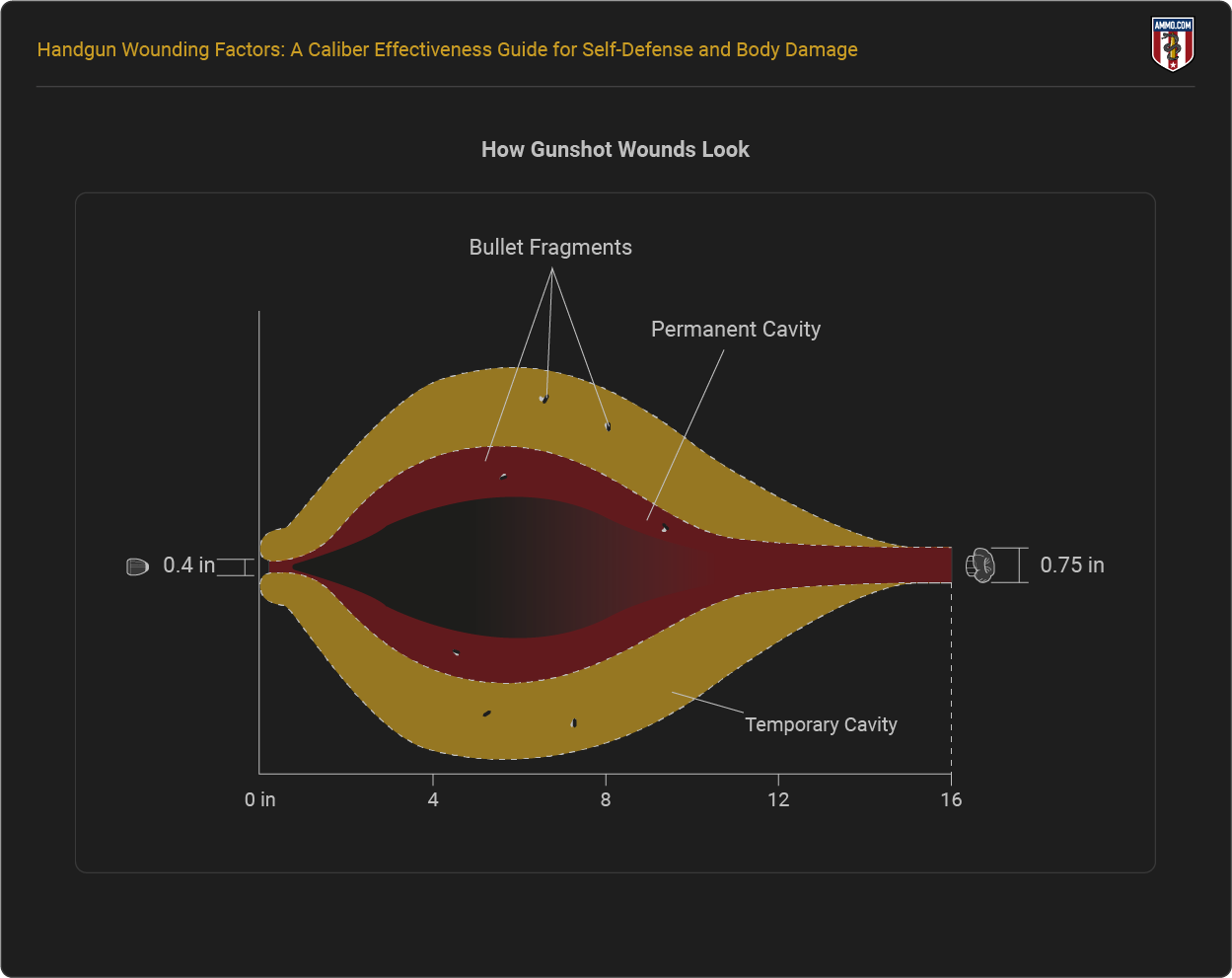
To understand a bullet’s efficiency at incapacitating a target, we must have some basic understanding of the mechanics of wounding; i.e. how damage to the human body works. Four major factors contribute to the effectiveness of a bullet:
- Penetration - Measures the amount of tissue through which the projectile passes, and which it disrupts or destroys. A bullet’s capacity for penetration is commonly referenced as “sectional density.”
- Permanent cavity - Measures the volume of space, once occupied by tissue, that is destroyed by the passage of the projectile. It is a function of penetration and the frontal area of the projectile. Quite simply, it is the hole permanently inflicted via passage of the bullet.
- Temporary cavity - Measures the expansion of the permanent cavity by stretching due to the transfer of kinetic energy during the projectile’s passage. True to its name, a temporary cavity is removed upon the contraction of surrounding soft tissue.
- Fragmentation - Describes projectile pieces (and possibly fragments of bone) which are impelled outward from the permanent cavity. Such fragments may gouge muscle tissues, blood vessels, etc., apart from the permanent cavity. Fragmentation is not necessarily present in every projectile wound. It may or may not occur, and can be considered a secondary effect.
Projectiles incapacitate by damaging or destroying the central nervous system, or by causing significant (and potentially lethal) blood loss. In no uncertain terms: the more damage a bullet inflicts, the greater the likelihood that it will incapacitate its target.
Wounding Factors by Common Calibers
The effectiveness of a bullet depends heavily on shot placement and four additional factors. While none of them has a direct bearing on incapacitation, they must all be considered.
- Shot Placement - Where the shot strikes the body matters greatly. A bullet’s potential to wound depends heavily on the amount of soft tissue it bores through, or whether it encounters bone.
- Bullet Design - The bullet’s design affects how it reacts with a target during and after impact. FMJs typically conserve their shape, whereas JHPs expand to gouge wider wound channels into their targets.
- Velocity - When two bullets of the same weight strike a target, the one traveling at the higher velocity will necessarily transfer more kinetic energy to said target. The faster-flying bullet’s potential to wound is accordingly greater.
- Penetration - The distance a bullet travels upon striking its target has a material effect on its capability. Shallow penetration is less likely to reach a vital organ. Conversely, a bullet that passes clean through its target may inflict inadequate damage to incapacitate it quickly.
- Caliber - A bullet’s diameter directly bears on how wide a wound channel it can inflict. Generally speaking, the wider the bullet, the wider the hole it bores through its target.
Disclaimer: Bullets of the same diameter are seldom interchangeable. Weight, velocity on impact, frontal profile, sectional density (i.e. capacity for penetration), and terminal ballistics (i.e. capacity for expansion/tumbling) all have a material effect on a bullet’s ability to incapacitate its target.
10mm Bullet Wound
A 10mm bullet is 0.4005" in diameter (i.e. slightly narrower than a Crayola Super Tip marker). Although the width of the entry wound will be proportional to the diameter of the bullet, the exit wound varies depending on impact velocity, bullet design, and shot placement.
- Entry Wound (FMJ): Similar to the diameter of the bullet.
- Exit Wound (FMJ): Slightly larger than the entry wound.
- Entry Wound (JHP): Similar to the bullet's diameter.
- Exit Wound (JHP): Significantly larger if expansion successfully occurs; may be approximately the diameter of a penny (0.74" to 0.79").
.40 S&W Bullet Wound
.40 S&W bullets are 0.4005" in diameter (i.e. slightly narrower than a Crayola Super Tip marker). Although the width of the entry wound will be proportional to the diameter of the bullet, the exit wound varies depending on impact velocity, bullet design, and shot placement.
- Entry Wound (FMJ): Similar to the diameter of the bullet.
- Exit Wound (FMJ): Slightly larger than the entry wound.
- Entry Wound (JHP): Similar to the bullet's diameter.
- Exit Wound (JHP): Significantly larger if expansion successfully occurs; may be approximately the diameter of a penny (0.74" to 0.79").
9mm Bullet Wound
A 9mm bullet measures 0.355" in diameter, slightly greater than the diameter of a pencil (0.275"). The size of the entry wound is proportional to the size of the bullet. The exit wound varies depending on impact velocity, bullet design, and shot placement.
- Entry Wound (FMJ): Similar to the diameter of the bullet.
- Exit Wound (FMJ): Slightly larger than the bullet's diameter.
- Entry Wound (JHP): Similar to the bullet's diameter.
- Exit Wound (JHP): Larger than the bullet's diameter; potentially as wide as 0.50".
.380 Bullet Wound
A .380 ACP bullet measures 0.355" in diameter, slightly more than the diameter of a pencil (0.275"). The size of the entry wound is proportional to the size of the bullet. The exit wound varies depending on impact velocity, bullet design, and shot placement.
- Entry Wound (FMJ): Similar to the diameter of the bullet.
- Exit Wound (FMJ): Slightly larger than the bullet's diameter, depending on impact velocity and shot placement.
- Entry Wound (JHP): Similar to the bullet's diameter.
- Exit Wound (JHP): Larger than the bullet's diameter; potentially as wide as 0.50".
.38 Special Bullet Wound
.38 Special bullets measure 0.357" wide, or slightly slimmer than the diameter of an AAA battery (0.41"). The size of the entry wound is proportional to the size of the bullet. The exit wound varies depending on impact velocity, bullet design, and shot placement.
- Entry Wound (FMJ): Similar to the bullet's diameter.
- Exit Wound (FMJ): Similar to the size of the entry wound, or slightly larger depending on shot placement and impact velocity.
- Entry Wound (JHP): Similar to the bullet's diameter.
- Exit Wound (JHP): Larger than the diameter of the bullet; approximately the diameter of an AA battery (0.53 to 0.57") or more, depending on shot placement.
.357 Magnum Bullet Wound
True to its name, a .357 Magnum bullet is 0.357" in diameter. The size of the entry wound is proportional to the size of the bullet. The exit wound varies depending on impact velocity, bullet design, and shot placement.
- Entry Wound (FMJ): Similar to the bullet's diameter.
- Exit Wound (FMJ): Slightly larger than the bullet's width; potentially the diameter of a dime (0.705").
- Entry Wound (JHP): Similar to the bullet's diameter.
- Exit Wound (JHP): Larger than the bullet's diameter; potentially ranging from the size of a nickel (0.835") to a quarter (0.955").
.45 ACP Bullet Wound
A .45 ACP bullet has a diameter of 0.452", which is slightly larger than that of an AAA battery (~0.41"). The size of the entry wound is proportional to the size of the bullet. The exit wound varies depending on impact velocity, bullet design, and shot placement.
- Entry Wound (FMJ): Similar to the diameter of the bullet.
- Exit Wound (FMJ): Similar to the entry wound.
- Entry Wound (JHP): Similar to the bullet's diameter.
- Exit Wound (JHP): Significantly larger than the bullet's diameter; ranging from nickel- to quarter-sized.
5.56 NATO Bullet Wound
A 5.56 NATO cartridge (which is nearly identical to .223 Rem) is loaded with a bullet that measures 0.224" in diameter. The size of the entry wound is proportional to the size of the bullet. The exit wound varies depending on impact velocity, bullet design, and shot placement.
- Entry Wound (FMJ): Similar to the bullet's diameter before impact.
- Exit Wound (FMJ): Slightly larger than the bullet's diameter, depending on shot placement and impact velocity. Note that 5.56 FMJ bullets are highly likely to fragment apart following high- to mid-velocity impact, which may produce a small exit wound (or no exit wound at all).
.22 LR Bullet Wound
A .22 LR bullet measures 0.22" in diameter, which is roughly the same as a #2 pencil. The size of the entry wound is proportional to the size of the bullet. The exit wound varies depending on impact velocity, bullet design, and shot placement.
- Entry Wound (LRN): Similar to the bullet's diameter.
- Exit Wound (LRN): Similar to the size of an entry wound, depending on shot placement. Even plated (e.g. CPRN) .22 LR bullets are soft relative to jacketed centerfire bullets, meaning they are (A) likely to deform following impact with soft tissue, and (B) unlikely to pass through a man-sized target.
5.7x28mm Bullet Wound
5.7x28mm bullets are 0.224" in diameter, which is roughly the same as a #2 pencil. The width of the entry wound is proportional to the size of the bullet. The exit wound varies depending on impact velocity, bullet design, and shot placement.
- Entry Wound (FMJ): Similar to the bullet's diameter.
- Exit Wound (FMJ): Similar to the size of an entry wound, depending on impact velocity, bullet design, and shot placement.
- Exit Wound (expanding bullets): Potentially larger than an entry wound, approximately the size of a dime or smaller.
6.5mm Creedmoor Bullet Wound
6.5mm Creedmoor bullets are 0.264" in diameter, or slightly thicker than a #2 pencil. The width of the entry wound is proportional to that of the bullet. The exit wound varies depending on impact velocity, bullet design, and shot placement.
- Entry Wound (FMJ): Similar to the bullet's diameter.
- Exit Wound (FMJ): Slightly larger than the bullet's diameter, depending on shot placement and impact velocity.
- Exit Wound (expanding bullets): Potentially much larger than the bullet's original diameter, e.g. the diameter of a nickel or wider.
7.62x51mm (.308 Win) Bullet Wound
7.62x51mm bullets measure 0.308" in diameter. The size of the entry wound is proportional to the size of the bullet. The exit wound varies depending on impact velocity, bullet design, and shot placement.
- Entry Wound (FMJ): Similar to the bullet's diameter.
- Exit Wound (FMJ): Slightly larger than the bullet's diameter, depending on shot placement and impact velocity.
- Exit Wound (expanding bullets): Between 2" to 3" in diameter, depending on shot placement, bullet design, and impact velocity.
.30-06 Springfield Bullet Wound
.30-06 Springfield bullets have a diameter of 0.308". The width of the entry wound is proportional to that of the bullet. The exit wound varies depending on impact velocity, bullet design, and shot placement.
- Entry Wound (FMJ): Similar to the bullet's diameter.
- Exit Wound (FMJ): Slightly larger than the bullet's diameter due to the velocity.
- Exit Wound (expanding bullets): Between 2" to 3" in diameter, depending on shot placement, bullet design, and impact velocity.
.300 AAC Blackout Bullet Wound
.300 AAC Blackout bullets are 0.308" in diameter. The width of the entry wound is proportional to that of the bullet. The exit wound varies depending on impact velocity, bullet design, and shot placement.
- Entry Wound (FMJ): Similar to the bullet's diameter.
- Exit Wound (FMJ): Slightly larger than the bullet's diameter.
- Exit Wound (expanding bullets): Between 2" to 3" in diameter, depending on shot placement, bullet design, and impact velocity.
7.62x39mm Bullet Wound
7.62x39mm bullets are 0.312" in diameter. The width of the entry wound is proportional to the bullet. The exit wound varies depending on impact velocity, bullet design, and shot placement.
- Entry Wound (FMJ): Similar to the bullet's diameter.
- Exit Wound (FMJ): Slightly wider than the bullet's diameter, depending on shot placement and impact velocity.
- Exit Wound (expanding bullets): Between 2" to 3" in diameter, depending on shot placement, bullet design, and impact velocity.
.338 Lapua Magnum Bullet Wound
.338 Lapua Magnum bullets are .338" in diameter, which is narrower than an AAA battery (~0.41"). The width of the entry wound is proportional to that of the bullet. The exit wound varies depending on impact velocity, bullet design, and shot placement.
- Entry Wound (FMJ): Similar to the bullet's diameter.
- Exit Wound (FMJ): Slightly larger than the bullet's diameter, depending on shot placement and velocity.
- Exit Wound (expanding bullets): Substantially wider than the bullet's original diameter, much larger than a quarter due to the velocity and size of the bullet.
.50 Browning Machine Gun (BMG) Bullet Wound
True to their name, .50 caliber bullets measure half an inch in diameter. The width of the entry wound is proportional to that of the bullet. The exit wound varies depending on impact velocity, bullet design, and shot placement.
- Entry Wound (FMJ): Similar to the diameter of the bullet.
- Exit Wound (FMJ): Slightly larger than the bullet's diameter, depending on impact velocity and shot placement.
- Entry Wound (Soft Point): Similar to the diameter of the bullet.
- Exit Wound (Soft Point): Extremely large due to the immense velocity and size of the bullet.
12 Gauge Wound
12 Gauge shotshell entry and exit wounds depend on several factors. Shot placement, impact velocity, shot or slug size, and shot material all determine wound channel(s) and aftermath.
For example, 12 Gauge birdshot fired over a long distance may fail to break skin, whereas a close-range hit from a full-power payload of 00 buckshot can kill large game instantly.
AR-15 Bullet Wound
AR-15 bullet wounds vary widely depending on caliber, bullet design, shot placement, and impact velocity. The most popular AR-15 rifles are chambered in 5.56 NATO, with FMJs being the most commonly fired bullet. A typical AR-15 bullet wound channel is larger than 0.224" wide.
Shooting Incident Analyses
The wounding capabilities of a caliber or cartridge are largely inconsistent, making it challenging to objectively measure wound damage and effectiveness.
It would be inaccurate to say that one caliber is more lethal than another, because cartridge design and shot placement (e.g. an accidental shooting) may affect the effects of a targeted hit are of great importance. Ultimately, every gunshot is unique and unreplicable. We cannot recreate one or assume its data would reliably predict the outcome of a subsequent shooting.
Gun owners can increase successful outcomes by selecting cartridges designed for self-defense or hunting, and sticking to manageable calibers (e.g. .357 Magnum may not be right for every shooter, though it can be highly effective if you're able to wield it competently).
We've done our best to set adequate expectations for each cartridge in this article, but results vary. Gun owners should choose a round that's likely to be effective (9mm, 10mm, etc.) but also manageable.
Sources
- Differing sizes of bullet entrance holes in skin of the anterior and posterior trunk
- Gunshot wounds: A review of ballistics, bullets, weapons, and myths

Self Defense
- Arming Yourself: A Woman's Guide to Self Defense and Concealed Carry (CCW)
- Protecting Your Family: A Parent's Guide to Self Defense and Concealed Carry (CCW)
- Arming the Elderly: A Self-Defense Guide for Senior Citizens
- Holsters for Self Defense: A Guide to Carrying Concealed
- Arming Toddlers and The "Kinder-Guardians" Program: A Shamefully Bad Idea
- Handgun Wounding Factors: A Caliber Effectiveness Guide for Self Defense and Body Damage
- Self Defense for LGBT: Self-Protection and Concealed Carry (CCW) for the LGBT Community
- Arming the Disabled: A Self-Defense and Concealed Carry Guide for People With Disabilities