458 SOCOM Ballistics From the Factory Ammunition Manufacturers
Congrats! You discovered our in-depth look at 458 SOCOM ballistics from major ammo manufacturers.
Click the links below to skip to your favorite ammunition company and find the 458 SOCOM ballistics data you need for your preferred factory ammo.
458 SOCOM Ballistics Charts
Jump to your favorite 458 SOCOM ammo company: Buffalo Bore | Underwood
Buffalo Bore
Jump to a ballistics chart: Buffalo Bore 300 Grain Barnes TTSX | Buffalo Bore 300 Grain Nosler Ballistic Tip | Buffalo Bore 350 Grain JFN | Buffalo Bore 400 Grain JFN | Buffalo Bore 405 Grain Hard Cast GC FN | Buffalo Bore 500 Grain Hard Cast GC FN | Buffalo Bore 500 Grain JRN
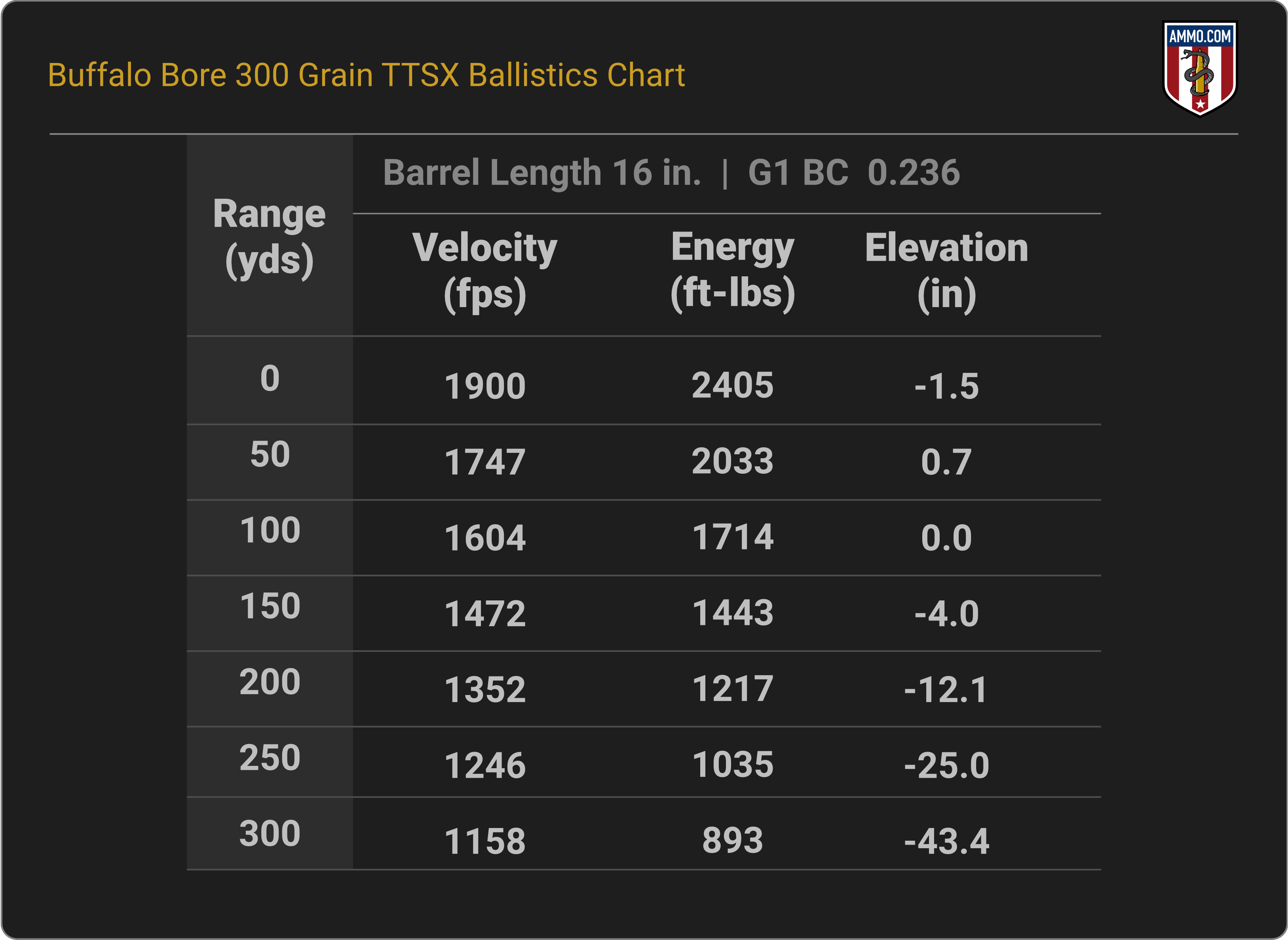
Buffalo Bore 300 Grain Barnes TTSX
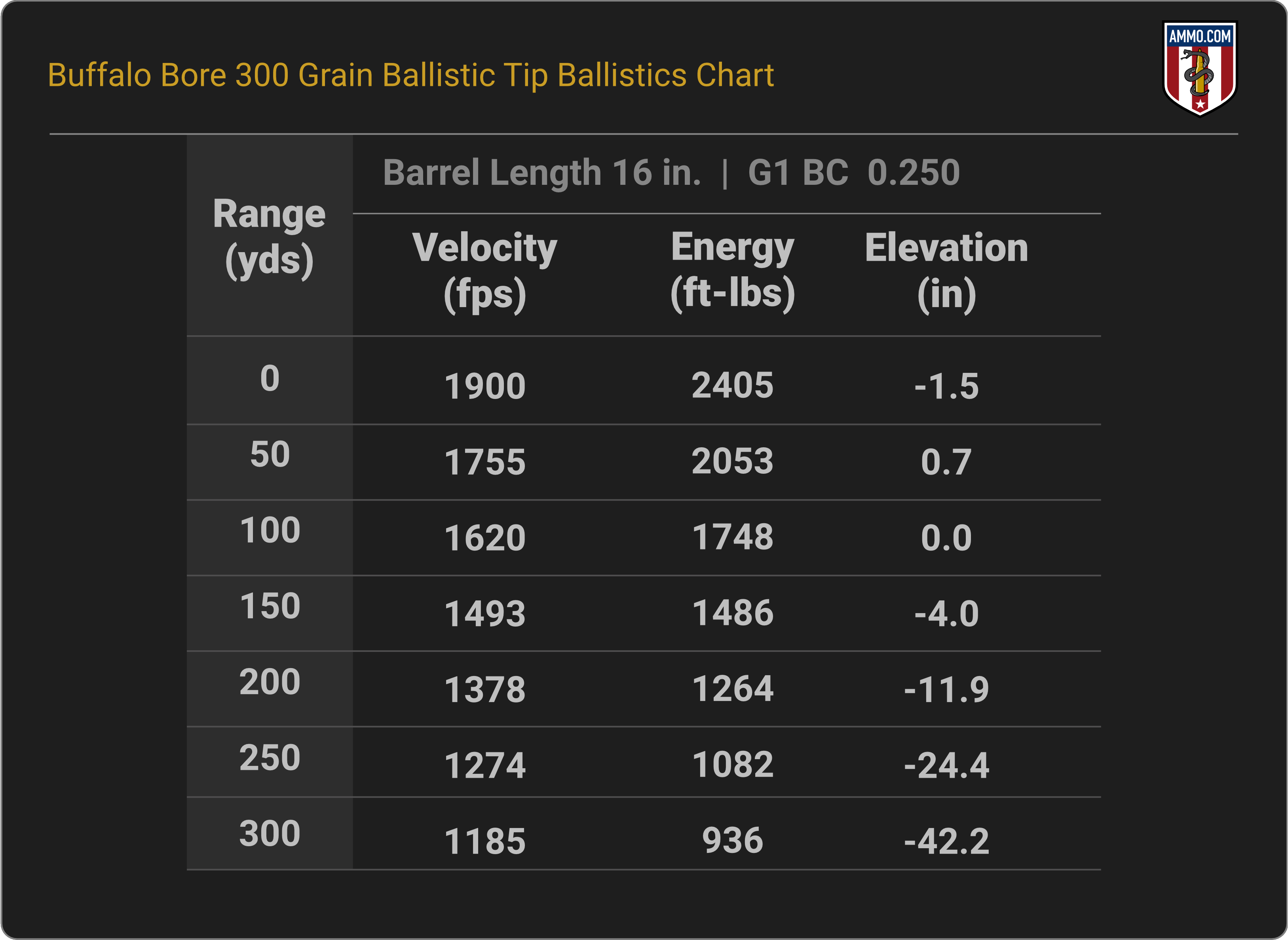
Buffalo Bore 300 Grain Nosler Ballistic Tip
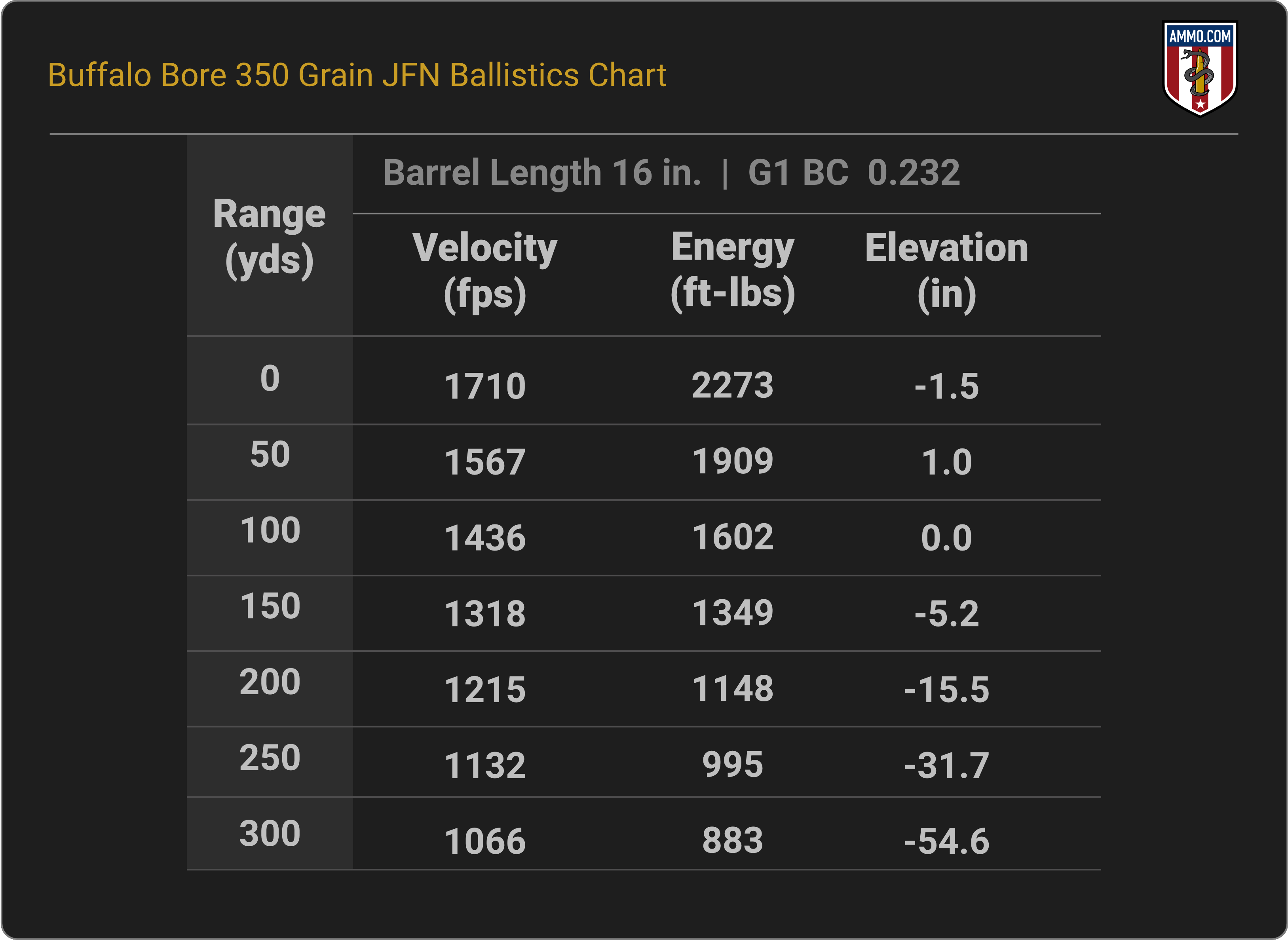
Buffalo Bore 350 Grain JFN
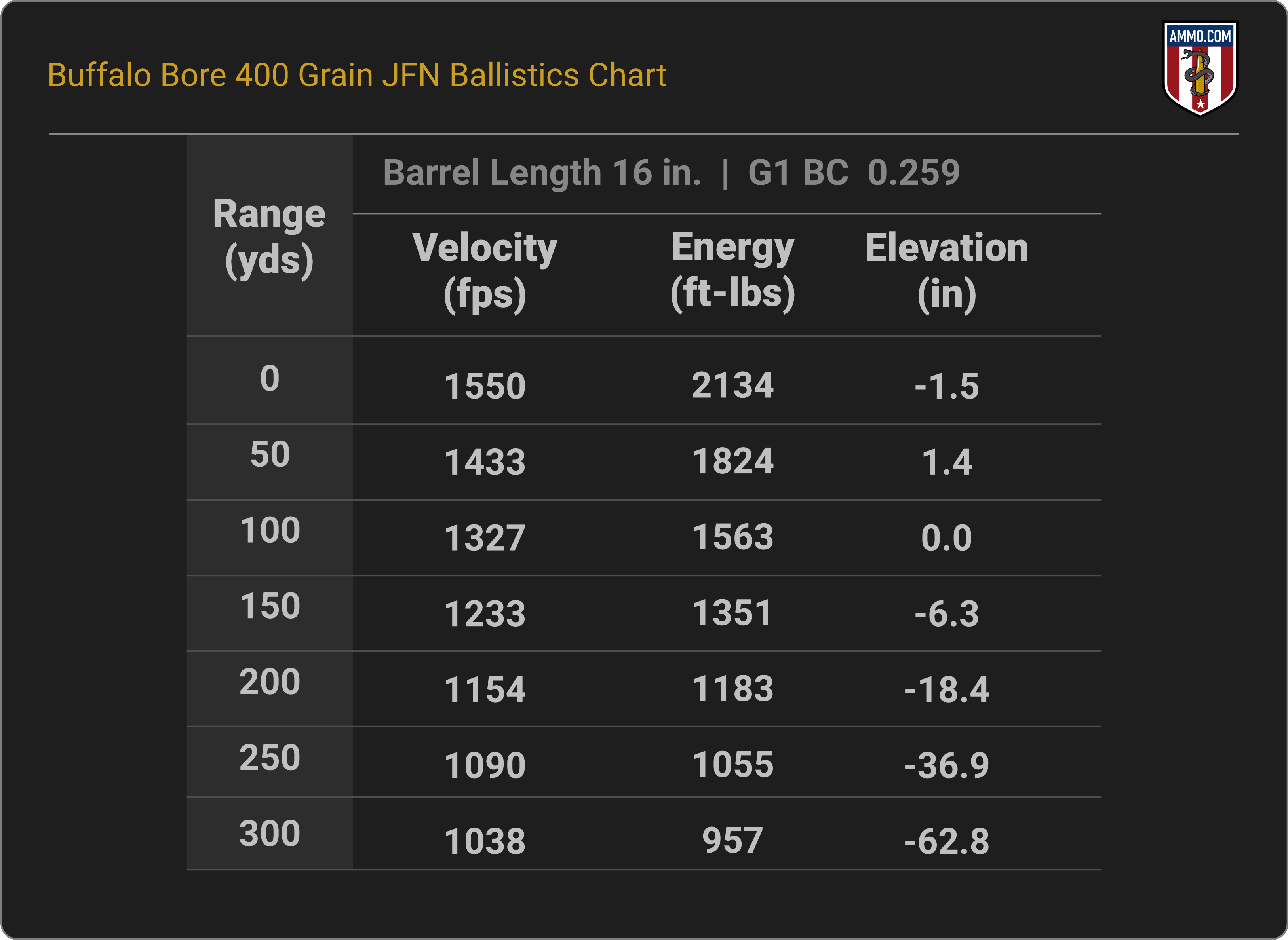
Buffalo Bore 400 Grain JFN
Buffalo Bore 405 Grain Hard Cast GC FN
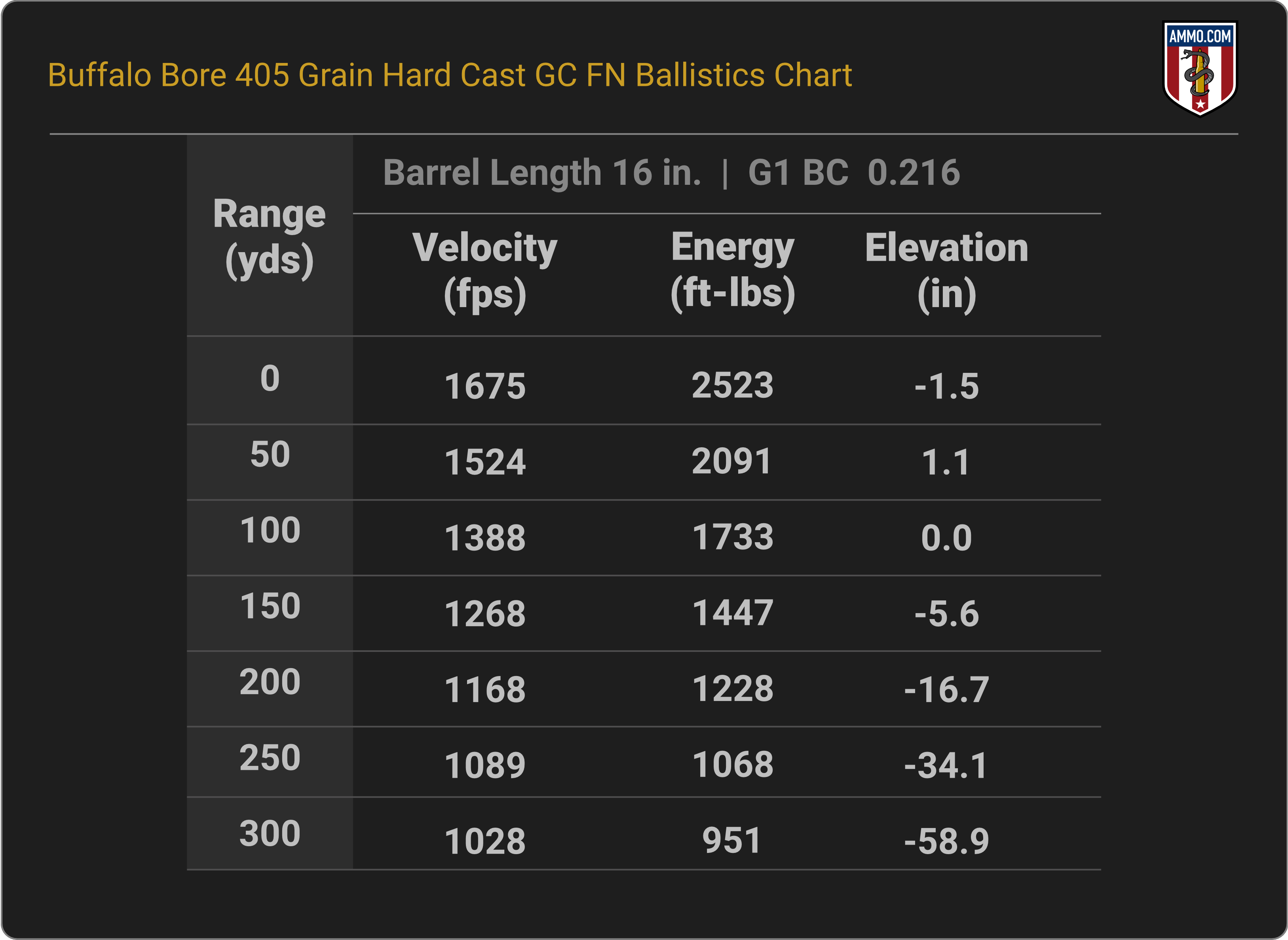
Buffalo Bore 500 Grain Hard Cast GC FN
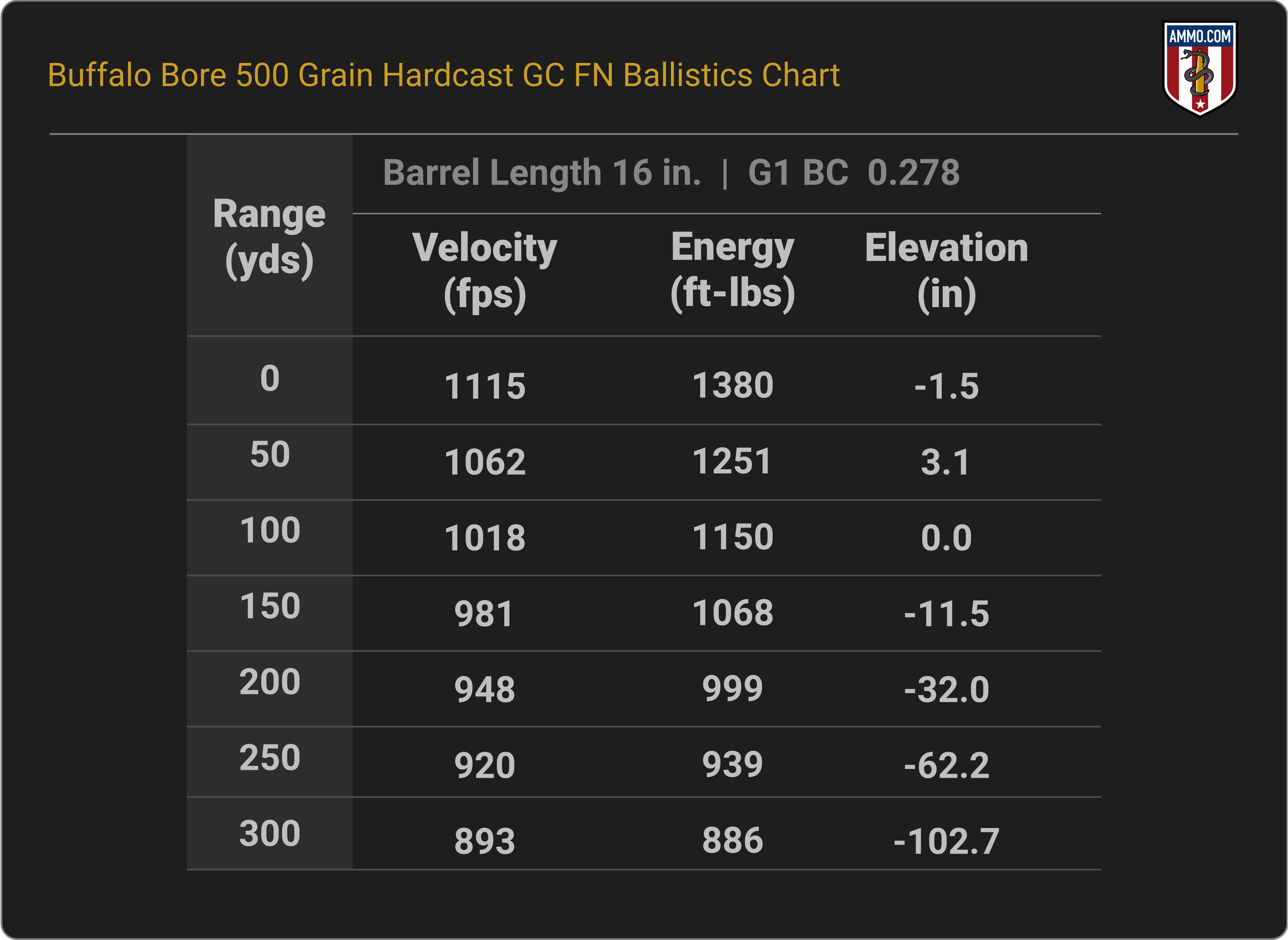
Buffalo Bore 500 Grain JRN
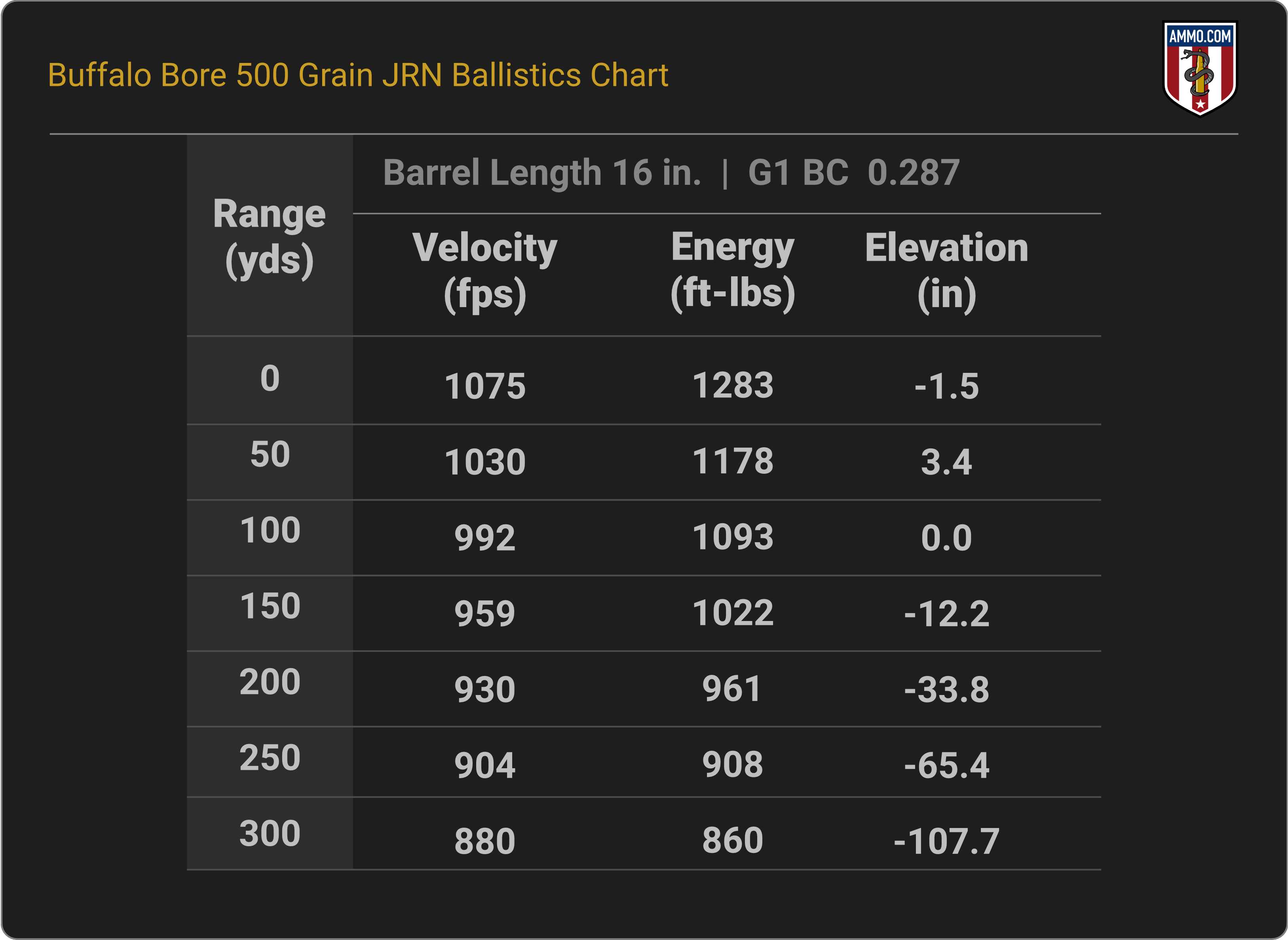
Underwood
Jump to a ballistics chart: Underwood 300 Grain Ballistic Tip | Underwood 300 Grain HP
Underwood 300 Grain Ballistic Tip
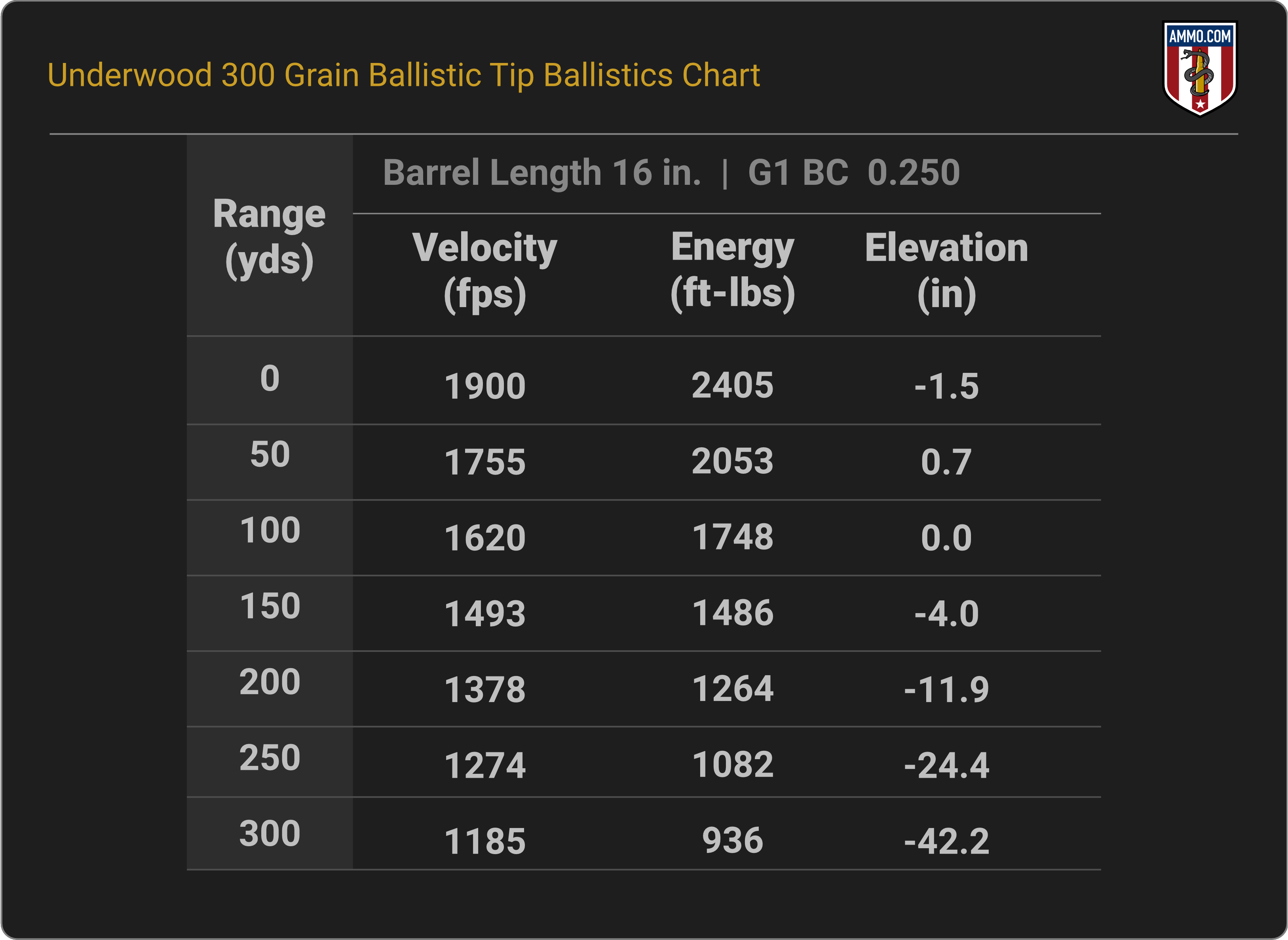
Underwood 300 Grain HP
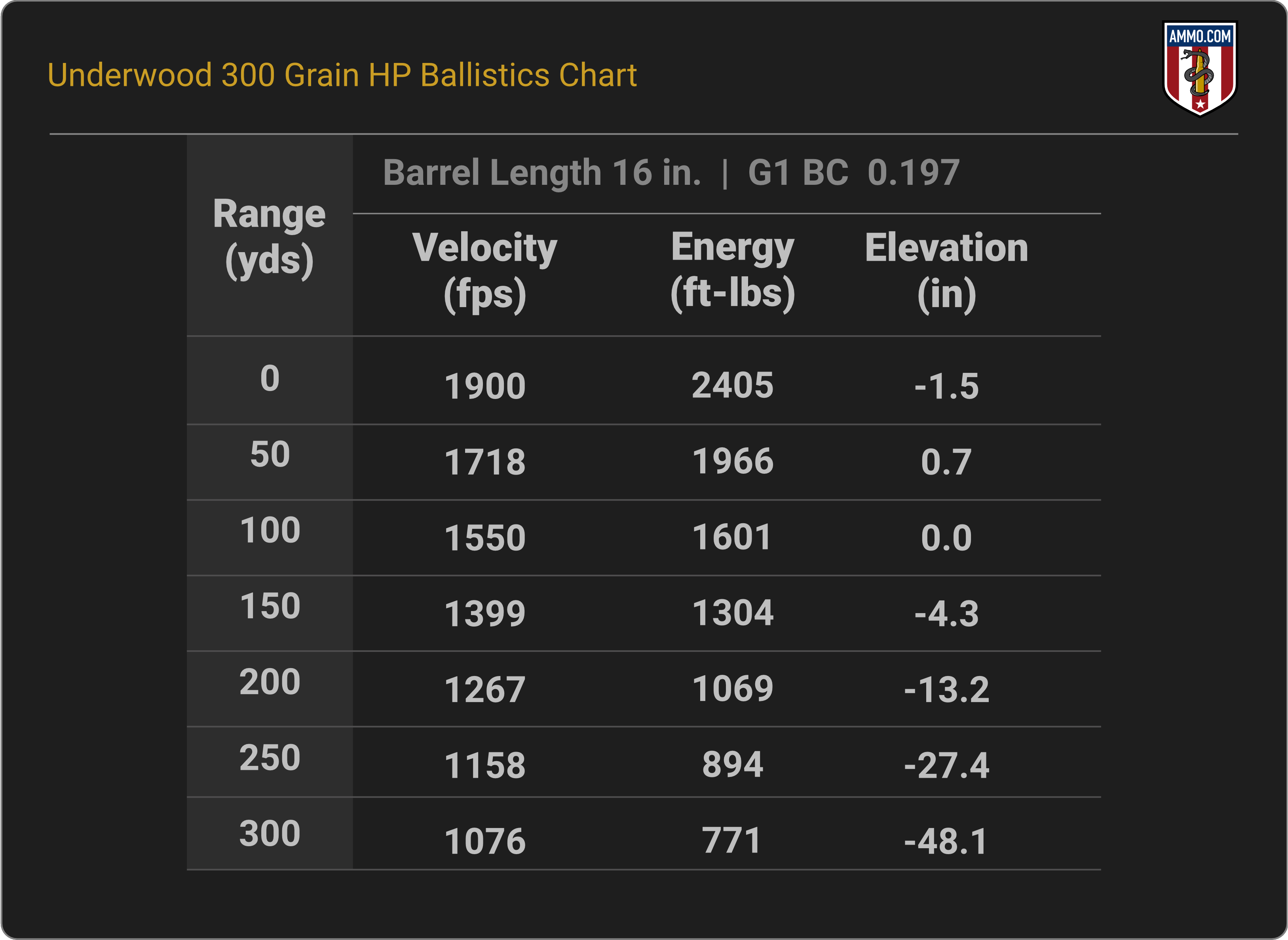
Administrative Note: The information above is provided by ammo manufacturers. Actual ballistics obtained with your firearm can vary considerably from advertised ballistics. Also, ballistics can vary from lot to lot with the same brand and type. When the manufacturer's ballistic data was unavailable, ballistic data were calculated using a ballistic calculator.
458 SOCOM Trajectory Chart
A bullet's trajectory is its flight path. Shooters measure trajectory in inches of bullet drop, milliradians (MIL), or minute of angle (MOA). For this article, I use inches of bullet drop.
A flatter trajectory is preferred for long-range shooting because shooters require fewer adjustments to compensate for bullet drop. The 458 SOCOM is not known for having a flat trajectory. When zeroed at 100 yards, a 300 grain ballistic tip leaving the muzzle at 2,100 fps will drop -10" at 200 yards, and at 500 yards, it's dropped a whopping -153". A 500 grain JRN exiting the muzzle at 1,200 fps will drop -29" at 200 yards, and -345" at 500 yards.
Here is a sample 458 SOCOM bullet drop chart to give you a general idea of the 458 SOCOM's trajectory.
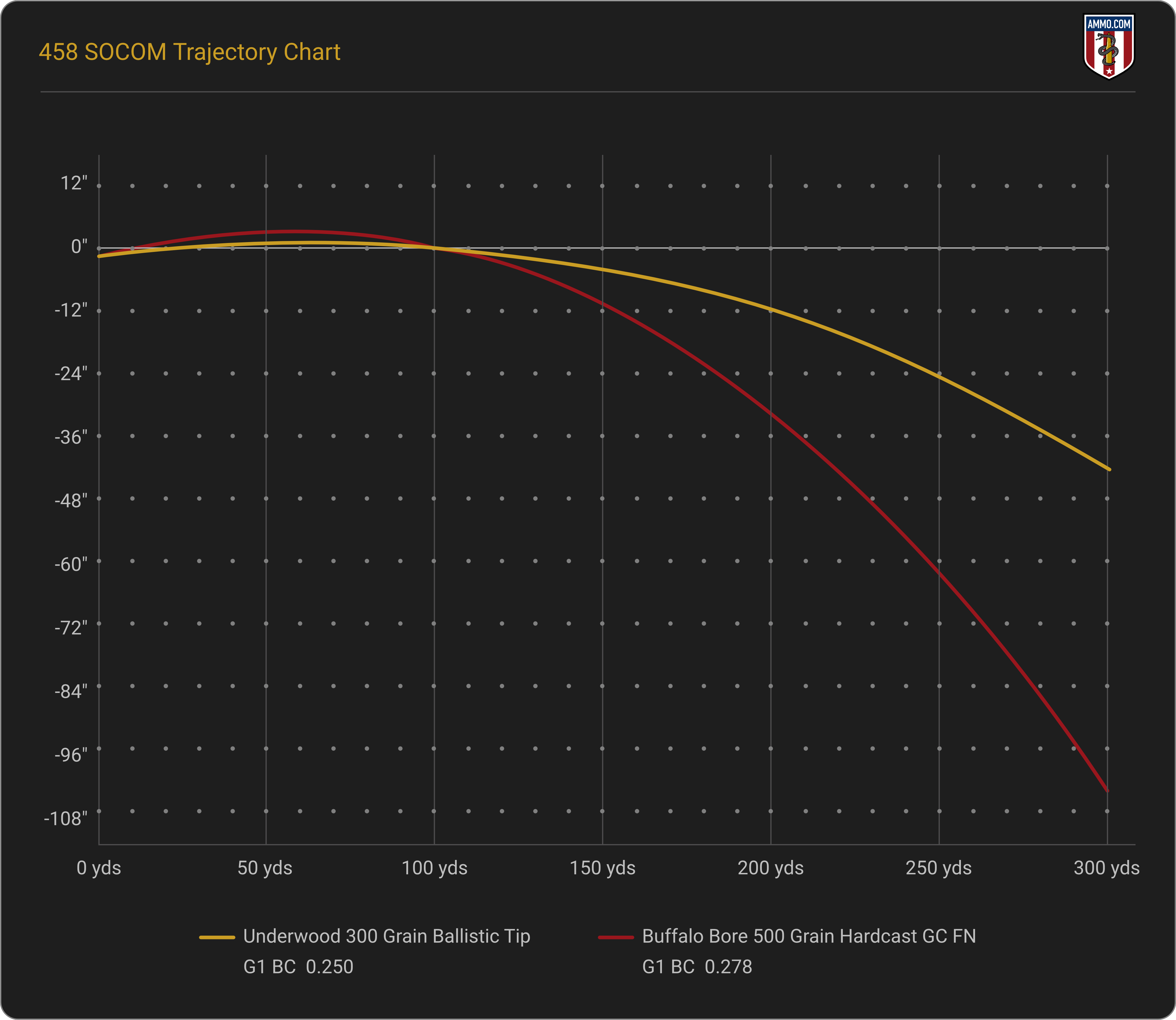
Note: The chart above is an example of a 458 SOCOM load. Actual ballistic performance varies depending on bullet weight, lot, barrel length, and environmental conditions.
458 SOCOM Velocity
Muzzle velocity is the rate at which a bullet exits the barrel, measured in feet per second (fps). Typically, a longer barrel produces a higher muzzle velocity, as the extra length gives exploding propellant more time to exert its energy against the base of the projectile.
We can expect 458 SOCOM muzzle velocities to range from about 1,200 fps to 2,100 fps. The low-ballistic-coefficient bullets don't conserve velocity downrange very well. If a 300 grain Ballistic Tip (0.250 G1 BC) attains 2,100 fps muzzle velocity, its velocity slows to 1,799 fps at 100 yards. At 500 its 1,023 fps velocity is lower than that of sound. A 500 grain JRN (0.287 G1 BC) that attains 1,200 fps muzzle velocity becomes subsonic by 100 yards, at which range its velocity is 1,079 fps. By 500 yards, its velocity cools to 840 fps.
458 SOCOM Kinetic Energy
Muzzle energy is the amount of force a bullet possesses the instant it leaves the barrel, measured in foot-pounds (ft-lbs). The 458 SOCOM's heavy bullets tend to have low muzzle velocity relative to those of other rifle cartridges.
Muzzle energy for the 458 SOCOM typically ranges from 1,599 to 3,552 ft-lbs. The round's characteristically low-BC bullets do a poor job of conserving kinetic energy downrange. A 300 grain TTSX (0.236 G1 BC) with 2,100 fps muzzle velocity and 2,937 ft-lbs muzzle energy maintains 2,115 ft-lbs energy at 100 yards; 663 ft-lbs at 500 yards. A 500 grain JRN bullet (0.287 G1 BC) with 1,200 fps muzzle velocity and 1,599 ft-lbs muzzle energy conserves 1,292 ft-lbs energy at 100 yards; 784 ft-lbs at 500 yards.
458 SOCOM Effective Range
The 458 SOCOM's effective range for hunting and tactical applications is 250 yards. It's great for hog and deer hunting at close-to-medium ranges, but beyond 250 yards, the drop in kinetic energy reduces the likelihood of a clean, ethical kill. A skilled shooter can hit targets out to 300 yards, but the significant bullet drop makes it challenging to remain accurate much past that point.
How Do 458 SOCOM Ballistics Compare to Other Rifle Cartridges?
The Ammo.com team has compared the 458 SOCOM to other common thumper rounds and rifle cartridges to give you a better understanding of its ballistic performance.
458 SOCOM vs. 45-70 Govt
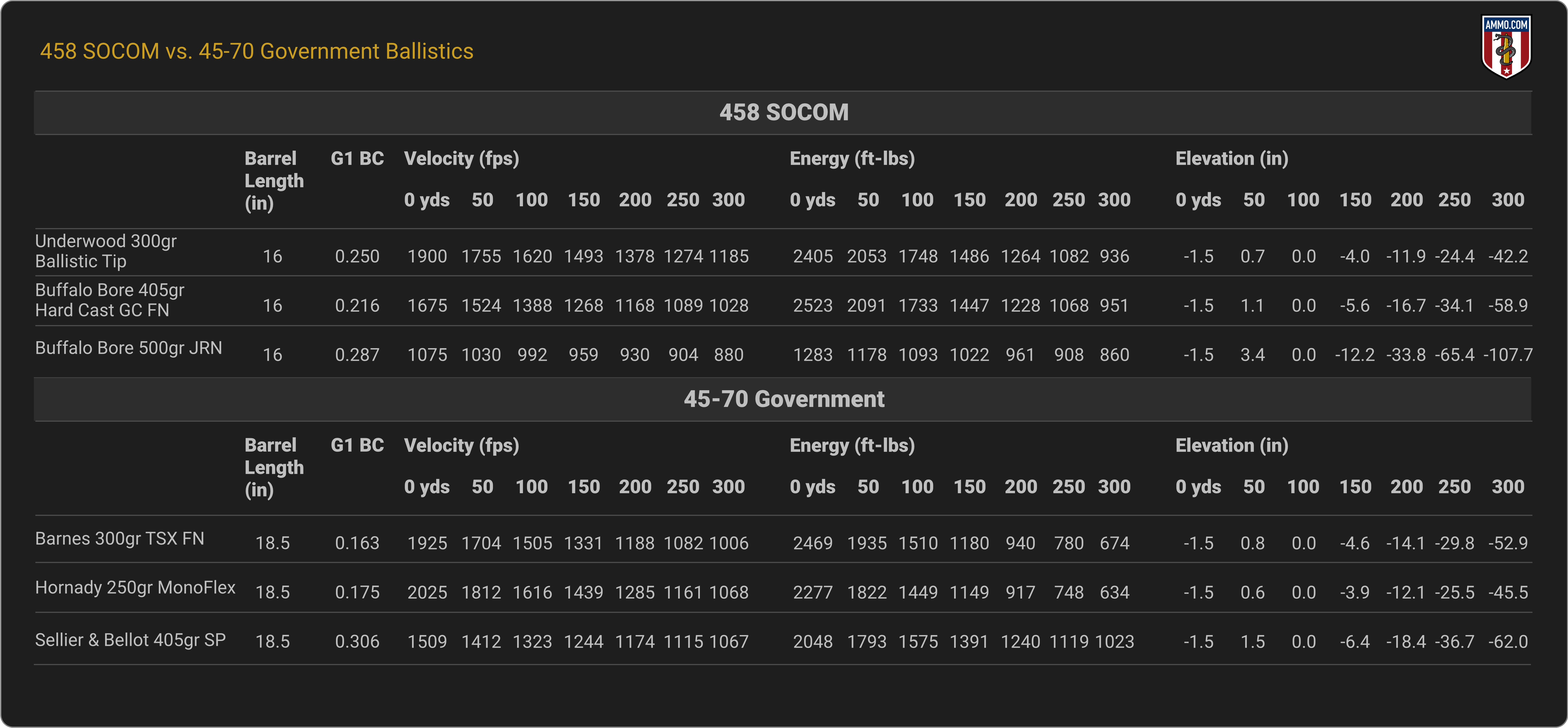
For complete performance data on this shoulder-thumper comparison, check out our 458 SOCOM vs. 45-70 Govt article. For a closer look at how the old buffalo round performs across its modern load lineup, see our 45-70 Govt ballistics breakdown.
458 SOCOM vs. 450 Bushmaster
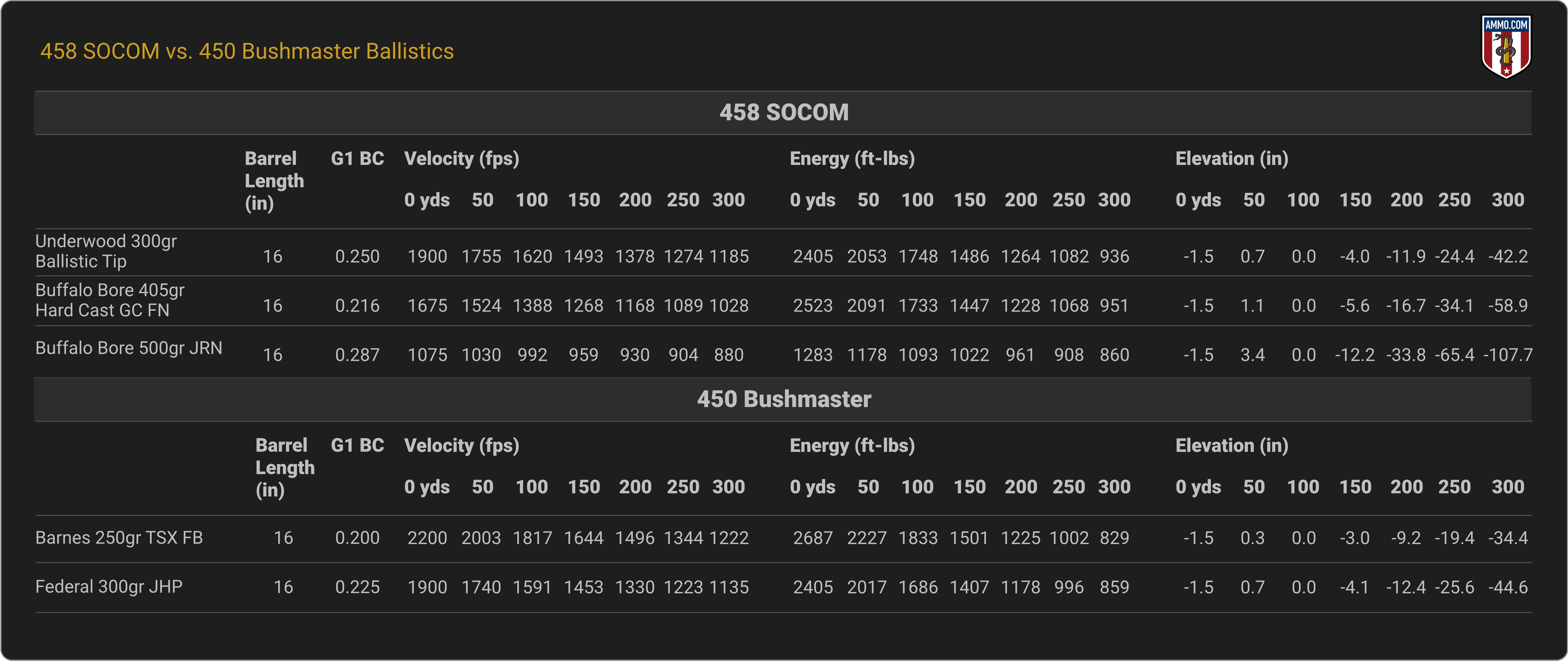
For complete performance data on this shoulder-thumper comparison, check out our 458 SOCOM vs. 450 Bushmaster article. Want to throw the 50 Beowulf into the mix? Our 450 Bushmaster vs. 458 SOCOM vs. 50 Beowulf breakdown stacks all three big-bore AR rounds side by side. For a closer look at how this straight-walled hunter performs across the major loads, see our 450 Bushmaster ballistics breakdown.
458 SOCOM vs. 300 Blackout
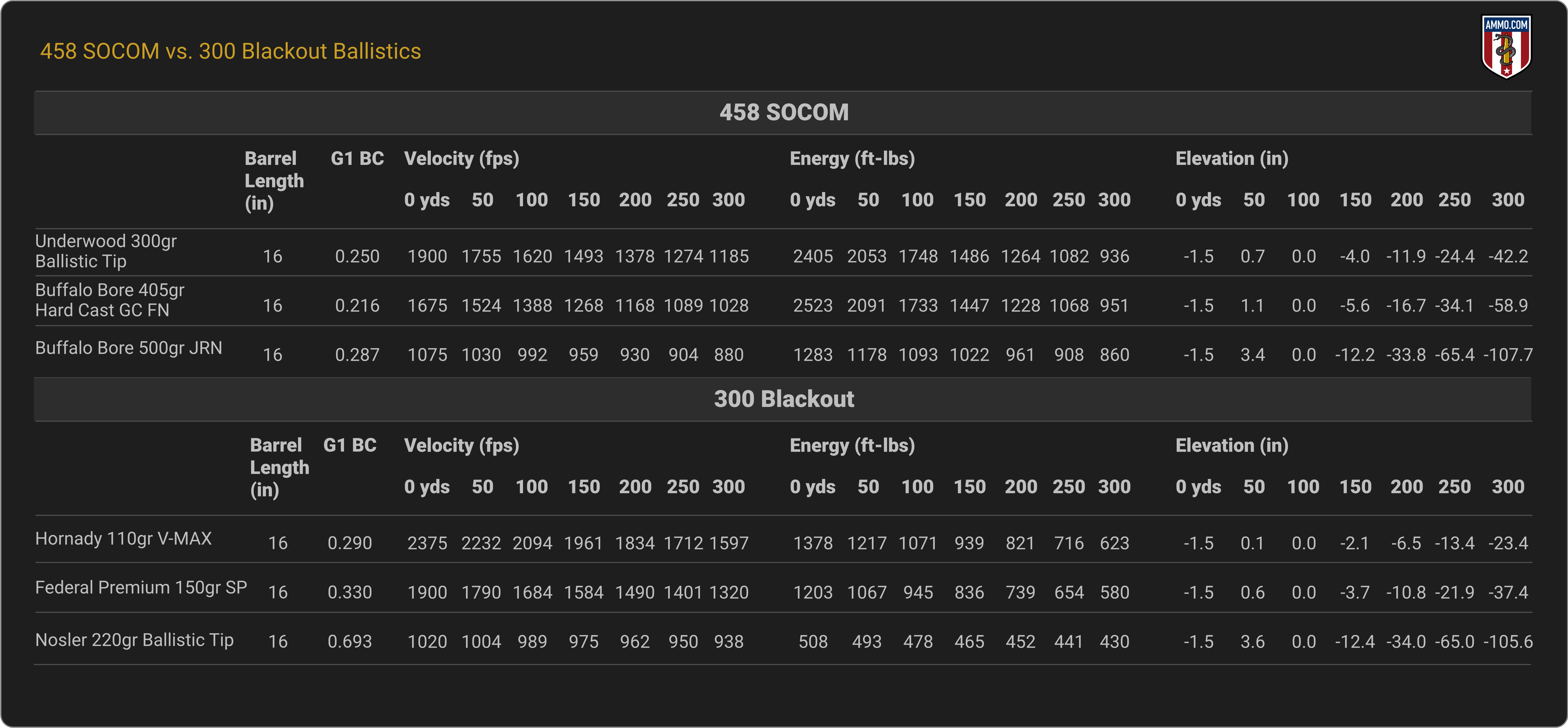
For complete performance data on this rifle cartridge comparison, check out our 458 SOCOM vs. 300 Blackout article. For a closer look at how Blackout's supersonic and subsonic loads behave downrange, see our 300 Blackout ballistics breakdown.
458 SOCOM vs. 5.56
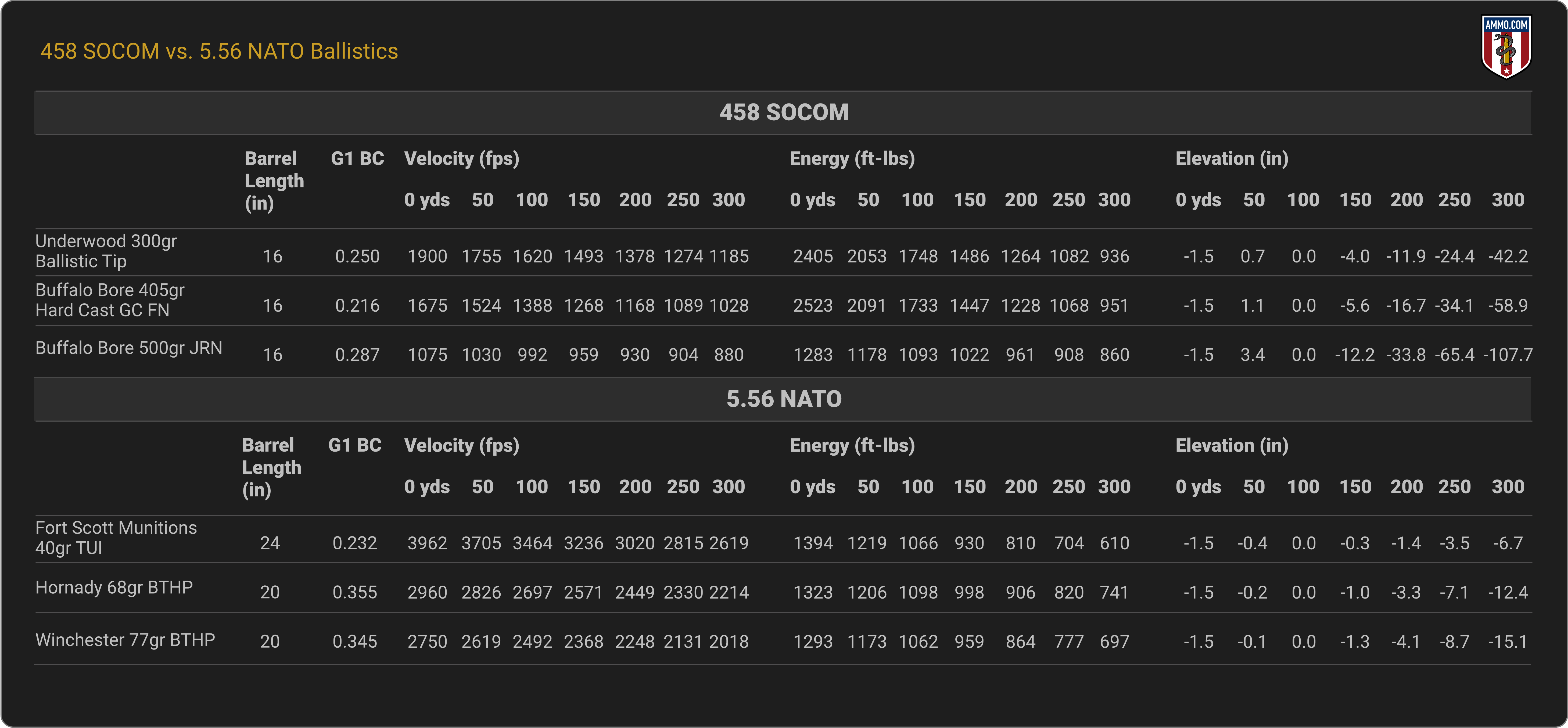
For complete performance data on this rifle cartridge comparison, check out our 458 SOCOM vs. 5.56 NATO article.

Ballistic Charts
- 308 Ballistics Charts
- 6mm ARC Ballistic Charts
- 10mm Auto Ballistics Charts
- 224 Valkyrie Ballistics Charts
- 204 Ruger Ballistics Charts
- 30-30 Ballistics Charts
- 6.8 SPC Ballistics Charts
- 350 Legend Ballistics Charts
- 300 Blackout Ballistics Charts
- FN 5.7x28 Ballistic Charts
- 7.62x39 Ballistics Charts
- 22 Creedmoor Ballistics Charts
- 300 PRC Ballistics Charts
- .360 Buckhammer Ballistics Charts
- 8.6 Blackout Ballistics Charts
- 30-06 Ballistics Charts
- 44 Magnum Ballistics Charts
- 7mm-08 Ballistics Charts
- 7mm Rem Mag Ballistics Charts
- 300 Win Mag Ballistics Charts
- 270 Win Ballistics Charts
- 45 Long Colt Ballistics Charts
- 6.5 Creedmoor Ballistics Charts
- 40 S&W Ballistics Charts
- 243 Win Ballistics Charts
- 357 Magnum Ballistics Charts
- 380 ACP Ballistics Charts
- 45 ACP Ballistics Charts
- 223 Rem Ballistics Charts
- 450 Bushmaster Ballistics Charts
- 400 Legend Ballistics Charts
- 5.56 Ballistics Charts
- 9mm Ballistics Charts
- 28 Nosler Ballistics Charts
- 45-70 Ballistics Charts
- 6.5 PRC Ballistics Charts
- 22-250 Ballistics Charts
- 22 Hornet Ballistics Charts
- 7mm PRC Ballistics Charts
- 22 ARC Ballistics Charts
- 6.8 Western Ballistics Charts
- 7mm Backcountry Ballistics Charts
- 338 ARC Ballistics Charts
- 25 Creedmoor Ballistics Charts
- 300 WSM Ballistics Charts
- 300 WSM Ballistics Charts
- 6mm Creedmoor Ballistics Charts
- 277 Fury Ballistics Charts
- 338 Lapua Ballistics Charts
- 25-06 Ballistics Charts
- 50 BMG Ballistics Charts
- 17 HMR Ballistics Charts
- 338 Win Mag Ballistics Charts
- 6.5 Grendel Ballistics Charts
- 458 Socom Ballistics Charts
- 35 Whelen Ballistics Charts
- 260 Remington Ballistics
- 444 Marlin Ballistics
- 38 Special Ballistics