12 Gauge Slug Ballistics Chart: Velocity, Energy and Drop
If you have to choose one gun to own and only one gun to do all things, there is one obvious choice: a 12 Gauge shotgun. These shotguns fit most needs, and the diversity of ammunition choices is what makes it such a good one-gun choice.
We are covering just a bit of that diversity with a deep dive into 12 Gauge slug ballistics. With the right slugs, you can punch paper, breach doors, protect yourself, and hunt big game all with the same gun!
Most 12 Gauge slugs leave the muzzle at velocities between 1,520 and 2,000 fps, with 2,365 to 2,806 ft-lbs of accompanying energy. Rifled (Foster) slugs fired from a smoothbore lose half to two-thirds of that energy by 100 yards, and drop about 3-1/2 to 5-1/2 inches by 125 yards following a 100-yard zero. Sabot slugs fired from a fully rifled barrel carry about 1,800 ft-lbs to 100 yards, and stay flat well past 150 yards.
That’s the short version. The biggest factor in 12 Gauge slug ballistics isn’t the brand on the box. It’s whether your shotgun has a smoothbore or a rifled barrel, because that decides which slugs you can shoot in the first place.
Shopping already? Browse our full selection of 12 Gauge ammo, or stock up with bulk 12 Gauge ammo.
Still deciding whether a slug is the right load at all? See our buckshot vs. slug comparison.
Looking for 12 Gauge ammo? See what we have in stock: 12 Gauge Ammo for Sale
Smoothbore vs. Rifled Barrel: Which Slug Do You Need?
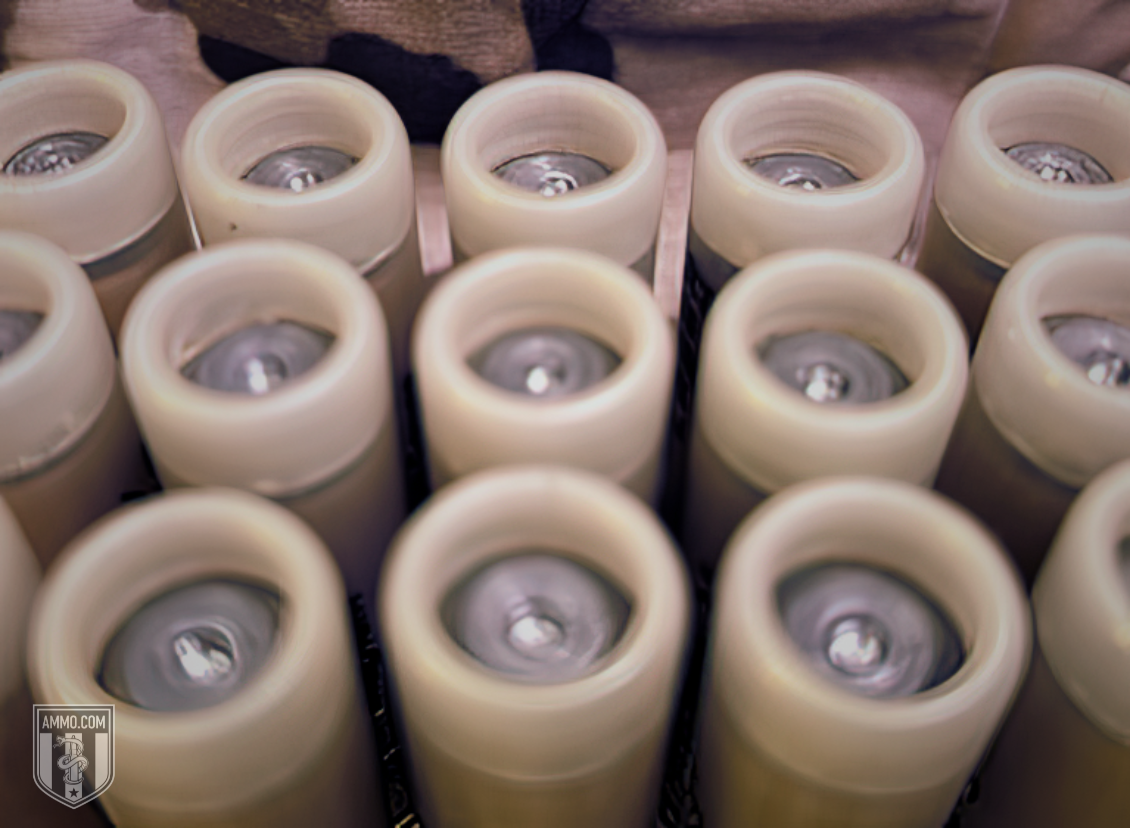
Smoothbore barrels have a perfectly smooth bore, the same as nearly every field and bird gun. Spinning a projectile isn’t their job, so the slug has to stabilize itself. That’s what a Foster (rifled) slug is designed to do. It’s hollow at the back with most of its weight up front, so it flies nose-first like a badminton shuttlecock. The “rifling” ribs on the outside of the slug help it squeeze through a choke, but the weight-forward design does most of the work.
Rifled barrels have spiral grooves cut into the bore, just like a rifle. Those grooves grip a plastic sleeve (i.e. sabot) and spin the slug inside it, so the slug can be smaller, pointier, and far more aerodynamic. That’s why sabot slugs fly flatter and hold their energy longer. Hornady and Federal both design their sabot slugs for fully rifled barrels only. Fired from a smoothbore, a sabot has nothing to grip, and you lose the accuracy you paid extra for.
Rifled choke tubes split the difference. They add a short section of rifling to a smoothbore. Some slugs, like Winchester’s Deer Season, are rated for smoothbore, rifled choke tube, or fully rifled barrels. Always check your gun’s manual and the slug maker’s barrel recommendation before you shoot.
Here’s the quick rule:
- Smoothbore – Foster (rifled) or Brenneke slugs
- Fully rifled barrel – Sabot slugs (Foster and Brenneke slugs will also fire, but you won’t get the most from the barrel, and there will be a bit of fouling that will need attending to.)
Find your load in the 12 Gauge slug ballistics chart below, and see how each one drops and how slugs compare to common rifle cartridges. Shop all 12 Gauge ammo when you’re ready!
12 Gauge Slug Ballistics Chart
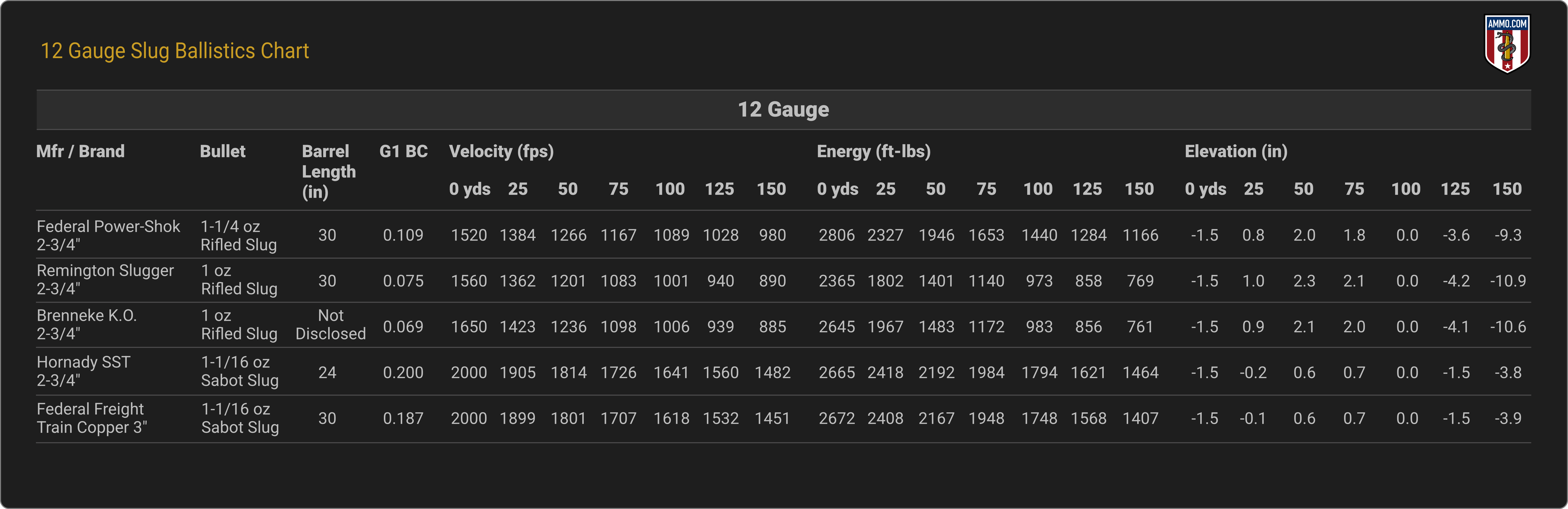
Source: muzzle velocity and energy from Federal Power-Shok, Remington Slugger, Winchester, Brenneke USA, Hornady, and Federal Freight Train Copper. Downrange velocity, energy, and drop were calculated by Ammo.com on a 100-yard zero with a 1.5 inch sight height. Federal, Remington, and Winchester list a 30" test barrel, Hornady lists 24", and Brenneke doesn’t list one. Brenneke publishes slug weight in ounces only, so the grain weights above are straight conversions.
Every load here runs out to 150 yards, and that’s where the story is. By 150, the rifled slugs are down to 620 to 1,166 ft-lbs. Both sabots are still carrying over 1,400. That gap is your effective range, right there in black and white.
Shop more 12 Gauge slugs from Federal, Hornady, Remington, and Winchester.
Rifled vs. Sabot vs. Brenneke Slugs
Rifled (Foster) slugs are soft, full-bore lead slugs. They hit very hard up close, but their blunt shape sheds speed fast. By 150 yards, the Remington Slugger is down to 769 ft-lbs and almost 11 inches low on a 100-yard zero.
Sabot slugs are smaller, pointier projectiles that hold momentum much better. The Hornady SST still carries 1,464 ft-lbs at 150 yards. Copper versions like Federal Freight Train are lead-free. You’ll find more copper sabot slugs in our lead-free roundup.
Brenneke slugs are Foster-style slugs with the wad attached to the back, which keeps the nose forward by functioning like the feathers on a dart. Brenneke rates the K.O. for rifled and smoothbore barrels.
Winchester’s Deer Season slug implements a similar idea: a stabilizing wad that travels downrange with the slug. It leaves the muzzle with 2,798 ft-lbs, second only to the Power-Shok, but it’s down to 836 by 100 yards. Heavy, blunt slugs hit hard and quit early. If you’re shopping, see our picks for the best 12 Gauge slugs.
12 Gauge Slug Trajectory Chart
Every load here is zeroed at 100 yards with a 1.5 inch sight height, so you’re comparing apples to apples. Numbers are inches above (+) or below (−) your line of sight.
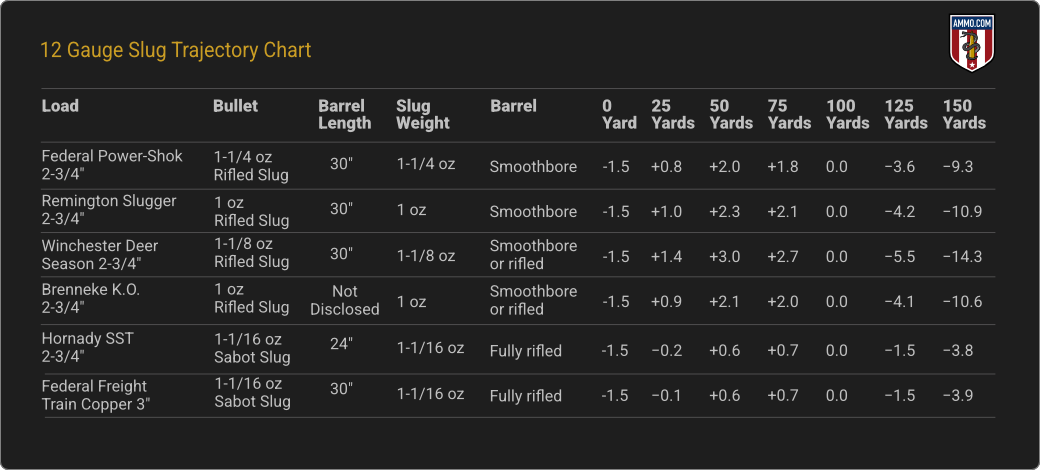
Look at the 125-yard column. Zeroed at 100, the rifled and Brenneke slugs are already 3.6 to 5.5 inches low just 25 yards past zero, and 9.3 to 14.3 inches low by 150. The two sabots? 1.5 inches low at 125, and under 4 inches at 150. Hornady publishes SST data all the way to 200 yards, where it still carries 1,199 ft-lbs. Rifled slugs fall off hard past 100 yards, and sabots out of a rifled barrel stay flat a lot longer.
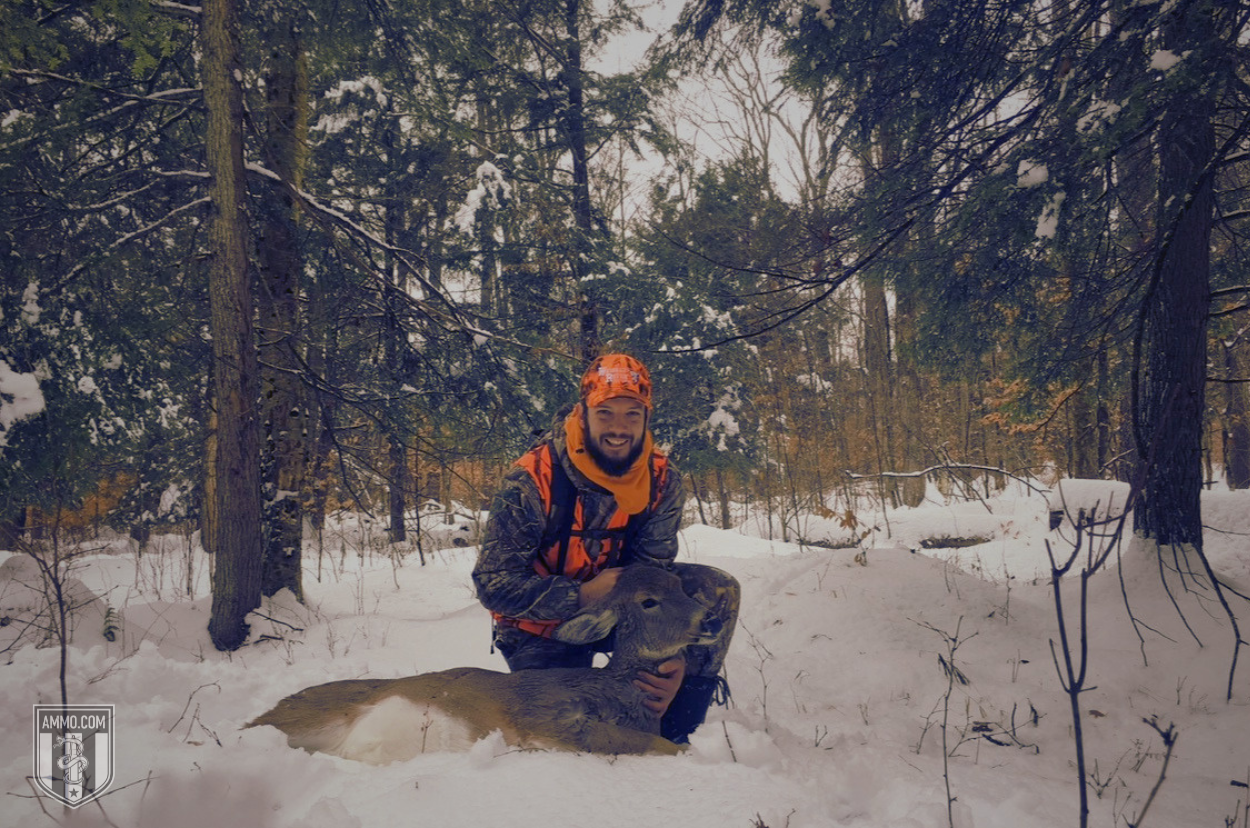
This deer was taken with a Hornady SST at about 100 yards.
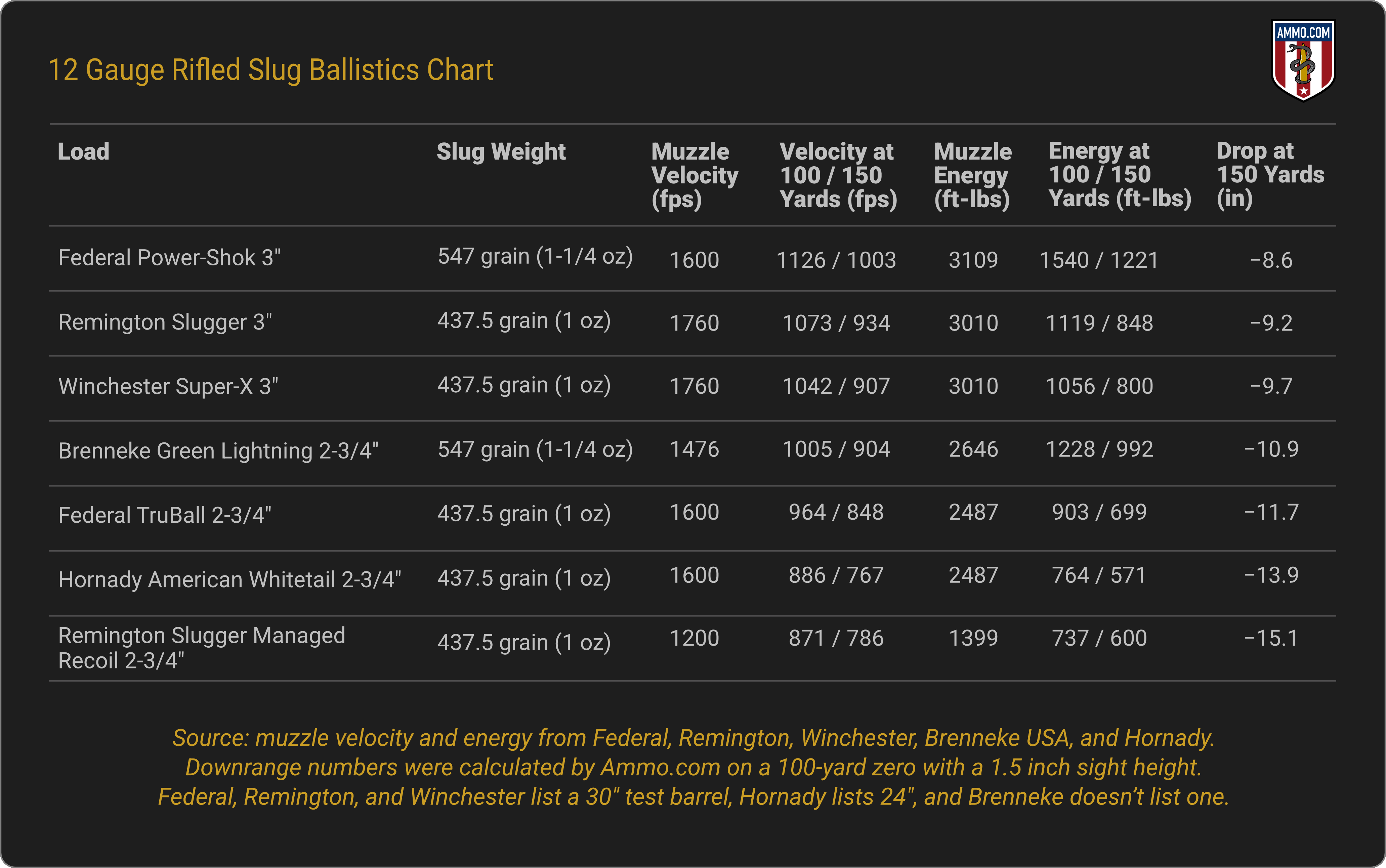
12 Gauge Rifled Slug Ballistics Chart
Running a smoothbore? Here’s how the most popular rifled slugs stack up, all on the same 100-yard zero. Heavier doesn’t always mean better here. The 1-1/4 oz Power-Shok 3" holds 1,540 ft-lbs at 100 yards and drops just 8.6 inches at 150. On the other end, the Slugger Managed Recoil gives up more than half the muzzle energy of the 3" Slugger in exchange for an easier day on your shoulder.
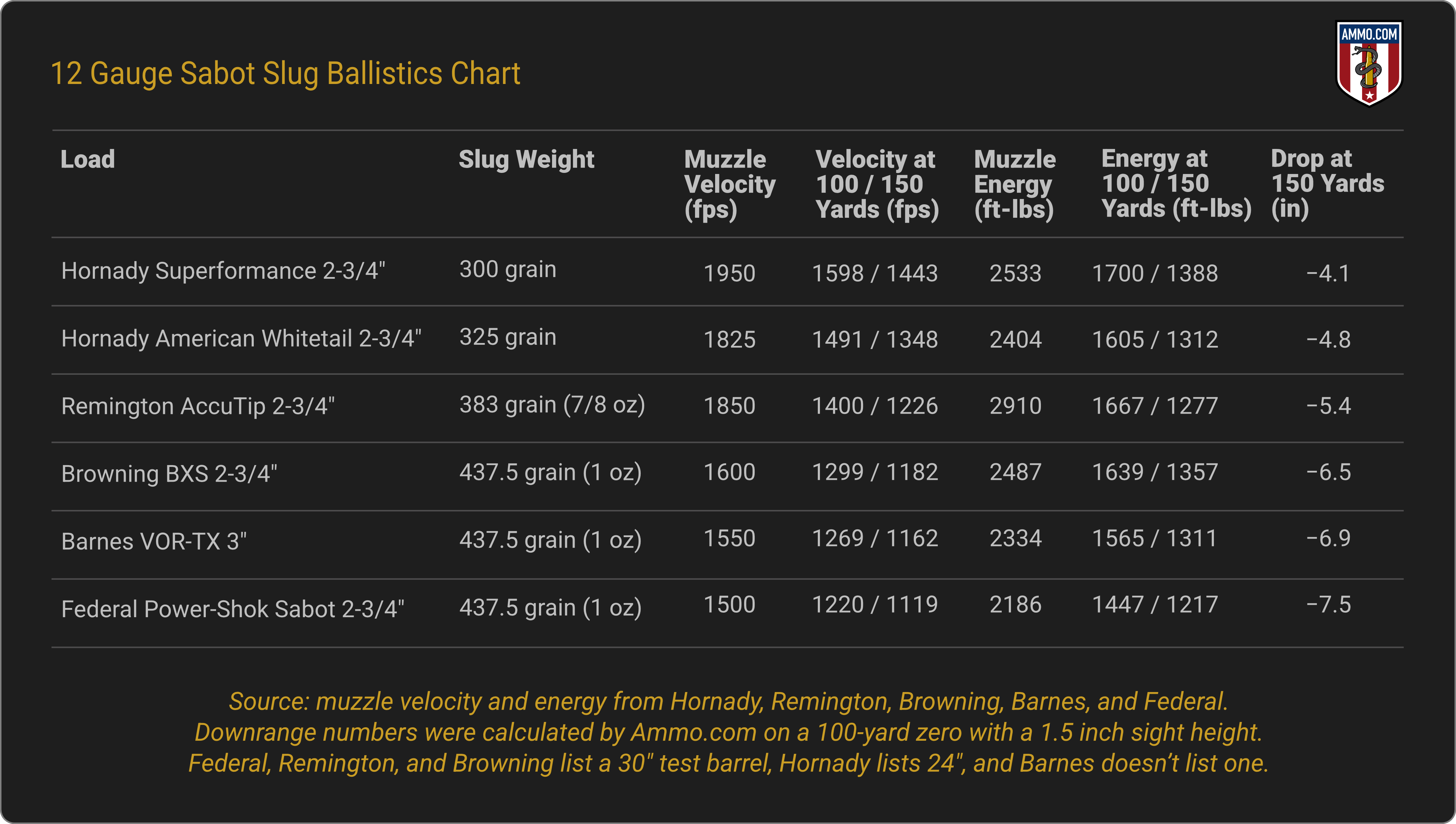
12 Gauge Sabot Slug Ballistics Chart
If your shotgun wears a fully rifled barrel, this is the chart you want. The Hornady SST still leads the pack (see the main chart above), but Hornady’s Superformance is right on its heels at 1,700 ft-lbs at 100 yards and just 4.1 inches low at 150. The heavier sabots carry more weight but leave the muzzle slower, so they drop faster once you get past 100 yards.
For other calibers, check out more ballistics charts.
What 12 Gauge Slug Ballistics Mean for Your Shooting
Slugs show up in a lot of places, and the numbers above indicate each application they’re best suited to.
- Close range – Inside 50 yards, every slug in the chart is carrying 1,250 ft-lbs or more. That’s why slugs are a staple for close-range hunting, bear protection, and home defense.
- Out to 100 yards – Rifled and Brenneke slugs from a smoothbore are still working here, but they’re dropping and slowing fast. Zero your gun at the distance you’ll actually shoot. When I am using my Browning Gold Hunter with a short smoothbore slug barrel, it loves Brenneke slugs.
- Past 100 yards – This is sabot territory. You’ll need a fully rifled barrel and a scope (or quality sights) to take advantage of a sabot slug’s superior effective range. I have taken many deer out to 125 yards with this setup.
How 12 Gauge Slug Ballistics Compare to Other Rifles
Here’s how five of the slugs above stack up against common rifle cartridges, with a .308 as the benchmark and some straight wall rifle cartridges tossed in to keep it apples to apples; every rifle load is a Federal factory load.
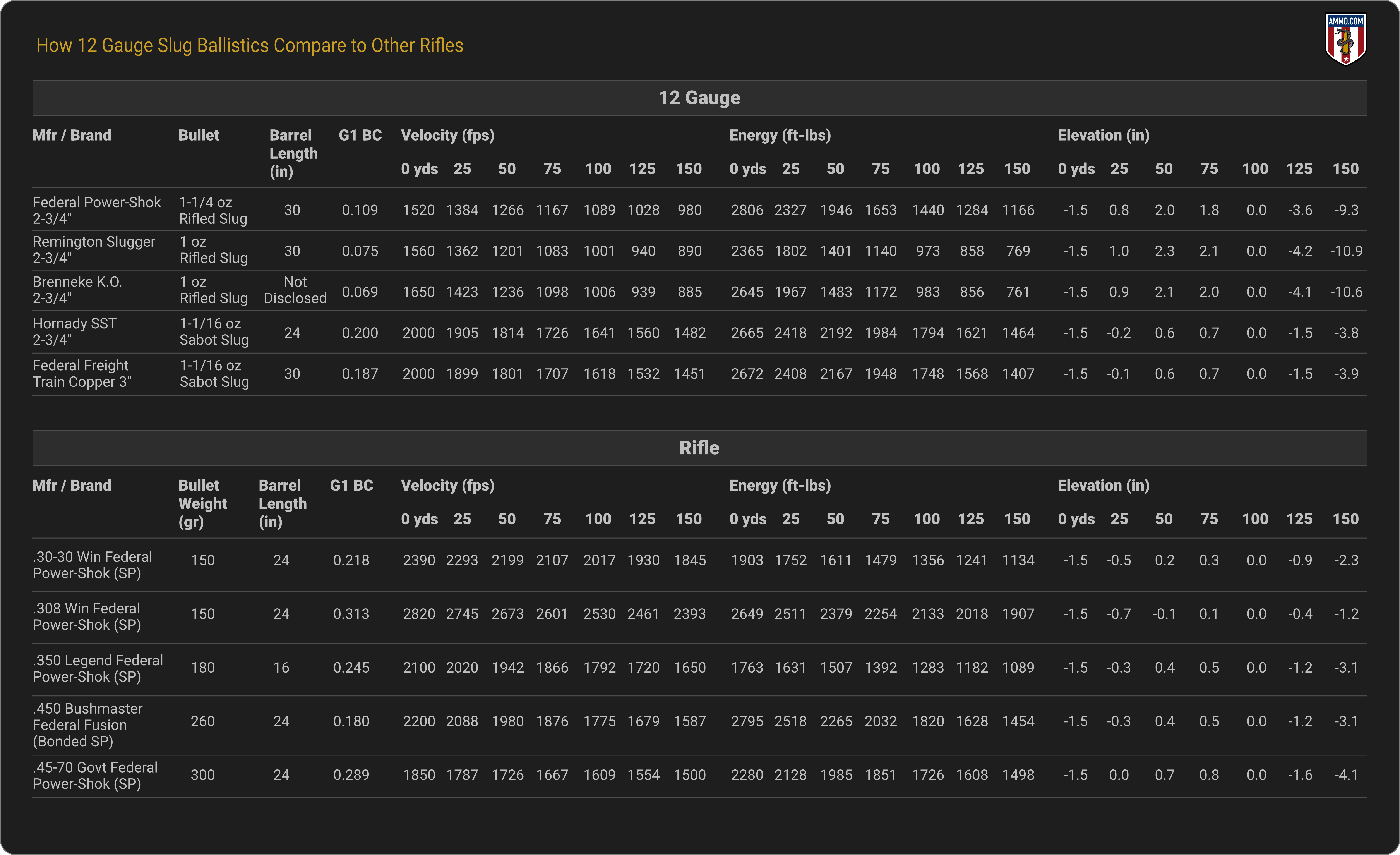
Source: Federal factory ballistics for .30-30, .45-70, .350 Legend, .450 Bushmaster, and .308.
At the muzzle, that 1-1/4 oz Power-Shok slug carries more energy than a .308. By 100 yards, it’s lost almost half of it, and sits below the .45-70 in terms of striking energy.
A good sabot out of a rifled barrel is a different animal. At 100 yards, the Hornady SST carries more energy than the .45-70, and nearly matches the .450 Bushmaster. At 200 yards, it’s still ahead of the .30-30 and .350 Legend. In other words, a 12 Gauge slug hits harder than almost anything up close, and a sabot from a rifled barrel performs a lot like a big-bore lever gun at distance.
Frequently Asked Questions
How far is a 12 Gauge slug effective?
About 100 yards for rifled slugs from a smoothbore, and 150 yards or more for sabot slugs from a fully rifled barrel. Zeroed at 100, rifled slugs are roughly 9 to 14 inches low by 150 yards, while sabots are still under 4 inches low.
How much does a 12 Gauge slug drop at 100 yards?
Zeroed at 100 yards, it’s dead on at 100, but rifled and Brenneke slugs fall 3.6 to 5.5 inches just 25 yards later.
How fast does a 12 Gauge slug travel?
The loads in our chart leave the muzzle between 1,520 fps (Federal Power-Shok) and 2,000 fps (Hornady SST and Federal Freight Train Copper).
Rifled slug vs. sabot slug, which is more accurate?
A sabot slug from a fully rifled barrel is substantially more accurate. Hornady claims sub-2" groups at 100 yards with its SST.
Can you shoot sabot slugs out of a smoothbore?
No. Hornady and Federal both design their sabot slugs for fully rifled barrels, so use rifled or Brenneke slugs in a smoothbore.
How far can a 12 Gauge slug travel?
Much farther than you’d ever aim one. A Power-Shok slug still carries 1,284 ft-lbs at 125 yards and 1,166 at 150. As always, it’s crucial to know what’s beyond your target.
12 Gauge vs. 20 gauge slug ballistics, what’s the difference?
Per Hornady, the 12 Gauge SST carries 1,794 ft-lbs to 100 yards versus 1,200 ft-lbs for the 20 Gauge. Check out our 20 Gauge ammo and best 20 Gauge ammo if lighter recoil matters more to you.
Is a 12 Gauge slug more powerful than a .308?
At the muzzle, a 1-1/4 oz slug can be more powerful (2,806 vs. 2,648 ft-lbs), but a .308 carries far more energy at 100 yards and beyond.
Final Thoughts
The numbers tell a simple story. Foster and Brenneke slugs hit hard out of a smoothbore, but run out of steam past 100 yards. Sabots from a rifled barrel stay flat and carry rifle-class energy out to 150 yards and beyond.
Every slug listed here has different ballistics, use case scenarios, and purposes. At the end of the day what matters is how they get along with your gun. Every gun is different, and they interact with different ammunition in different ways.
Match your slug to your barrel, zero at the distance you’ll actually shoot, and you’ll know exactly what your 12 Gauge slug ballistics look like downrange. If you can only have one gun, get a 12 Gauge and explore all the options (slugs included)!
Ready to stock up? Shop 12 Gauge ammo and find your slug!
Subscribers Save Up to 15% on Ammo
Join hundreds of thousands of shooters getting first access to limited-time sales, price drops, and 2A news – delivered weekly. Private, no spam, one-click unsubscribe.

Ballistic Charts
- 308 Ballistics Charts
- 6mm ARC Ballistic Charts
- 10mm Auto Ballistics Charts
- 224 Valkyrie Ballistics Charts
- 204 Ruger Ballistics Charts
- 30-30 Ballistics Charts
- 6.8 SPC Ballistics Charts
- 350 Legend Ballistics Charts
- 300 Blackout Ballistics Charts
- FN 5.7x28 Ballistic Charts
- 7.62x39 Ballistics Charts
- 22 Creedmoor Ballistics Charts
- 300 PRC Ballistics Charts
- .360 Buckhammer Ballistics Charts
- 8.6 Blackout Ballistics Charts
- 30-06 Ballistics Charts
- 44 Magnum Ballistics Charts
- 7mm-08 Ballistics Charts
- 7mm Rem Mag Ballistics Charts
- 300 Win Mag Ballistics Charts
- 270 Win Ballistics Charts
- 45 Long Colt Ballistics Charts
- 6.5 Creedmoor Ballistics Charts
- 40 S&W Ballistics Charts
- 243 Win Ballistics Charts
- 357 Magnum Ballistics Charts
- 380 ACP Ballistics Charts
- 45 ACP Ballistics Charts
- 223 Rem Ballistics Charts
- 450 Bushmaster Ballistics Charts
- 400 Legend Ballistics Charts
- 5.56 Ballistics Charts
- 9mm Ballistics Charts
- 28 Nosler Ballistics Charts
- 45-70 Ballistics Charts
- 6.5 PRC Ballistics Charts
- 22-250 Ballistics Charts
- 22 Hornet Ballistics Charts
- 7mm PRC Ballistics Charts
- 22 ARC Ballistics Charts
- 6.8 Western Ballistics Charts
- 7mm Backcountry Ballistics Charts
- 338 ARC Ballistics Charts
- 25 Creedmoor Ballistics Charts
- 300 WSM Ballistics Charts
- 300 WSM Ballistics Charts
- 6mm Creedmoor Ballistics Charts
- 277 Fury Ballistics Charts
- 338 Lapua Ballistics Charts
- 25-06 Ballistics Charts
- 50 BMG Ballistics Charts
- 17 HMR Ballistics Charts
- 338 Win Mag Ballistics Charts
- 6.5 Grendel Ballistics Charts
- 458 Socom Ballistics Charts
- 35 Whelen Ballistics Charts
- 260 Remington Ballistics
- 444 Marlin Ballistics
- 38 Special Ballistics
- 12 Gauge Slug Ballistics


