Gun Facts in the U.S. 2026: The Reality of Firearms in America
Report Highlights:
-
An estimated 30% of Americans (about 102 million) own at least one firearm.
-
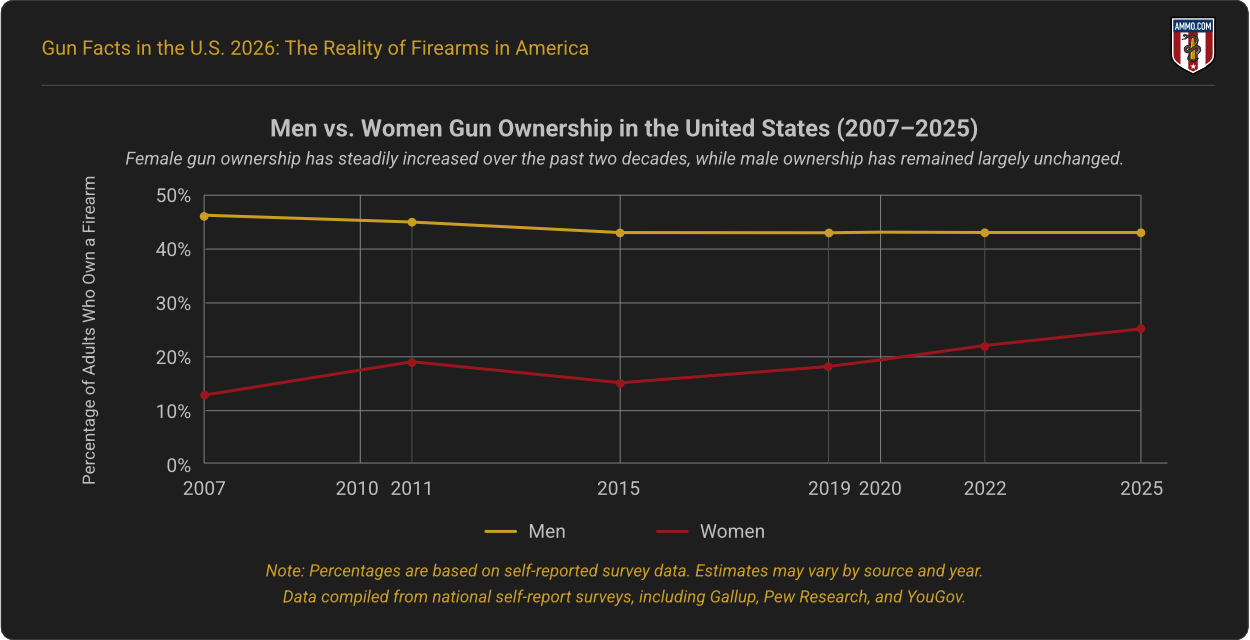
Men own more guns than women, but women are the fastest-growing demographic of gun owners.
-
As of 2017, Americans possessed 46% of the world’s civilian-owned firearms.
-
42% (57 million) of American households contain at least one firearm.
-
81% of gun owners and 57% of non-gun owners in gun households say a firearm makes them safer.
Methodology
Firearm ownership is not officially recorded, tracked, or monitored in the United States.
Furthermore, data at the state and federal level differ due to survey limitations and variances in reporting. This report relies on many sources to collect the most accurate information.
All information collected below comes from the most reputable sources available. Here is how we compiled the data in this article:
- Self-Report Surveys - Gun ownership and feelings towards guns
- CDC WONDER Database - Firearm-related deaths, homicides, and suicides
- Peer-Reviewed Studies - Correlations between gun ownership, crime, and deaths
- State-Level Data - Noting that every state has different gun laws and tracking methods, and statewide the data do not always align with national data
- NICS and ATF Reports - National Instant Criminal Background Check System (NICS) and ATF records concerning firearm sales and involvement in crimes
This article is not definitive, as firearm data reporting is incomplete and varies by source. For example, state-level reports appear lower than national ownership rates due to differences in reporting.
Ammo.com provides accurate and reliable information. You can jump to our list of reputable sources HERE.
How Many Americans Own Guns?
Despite many recent first-time gun buyers and the highest-ever gun sales, only one-third of the adult American population owns guns. Recent surveys show that 30% (or 102 million) of the American population owns guns as of 2025.(1) A previous 2025 survey suggests that only 23% of Americans own a firearm.(2)
As of 2025, over 57 million households in the United States (42%) have at least one firearm; up from 56 million households in 2019.
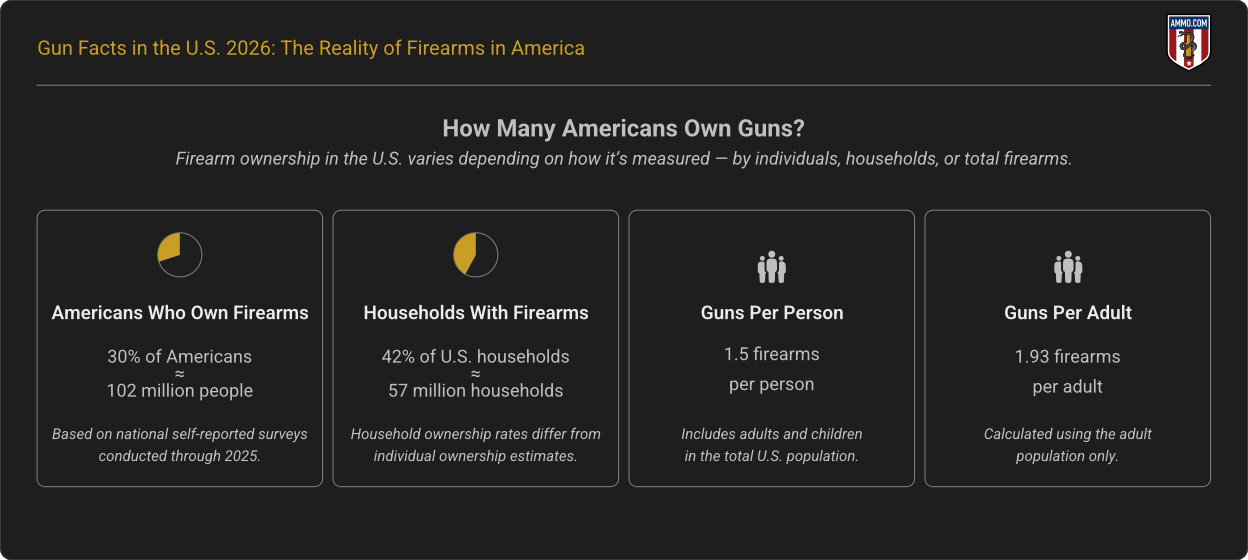
Number of People vs. Guns in the U.S.
As of 2025, comprehensive estimates show there were 1.50 firearms per person in the U.S., or 1.93 guns per adult.(4, 5, 6, 7)
The United States had a population of approximately 341 million in 2025, when there were an estimated 500 million privately owned firearms in the country.
States With the Most Guns
Per the most recent surveys and NICS reports, Wyoming has more guns per person than any other state. In 2025, the state had a population of 580,000-590,000, with surveys indicating that two-thirds owned guns. That’s 245 firearms for every 1,000 individuals.(8)
West Virginia ranked second, with 92 firearms per 1,000 people. South Dakota, New Mexico, and New Hampshire rounded out the top five in the firearms-per-capita category.(8)
Here are the five states with the highest estimated guns per capita:
- Wyoming - 245 per 1,000 people
- West Virginia - 92 per 1,000 people
- South Dakota - 72 per 1,000 people
- New Mexico - 58 per 1,000 people
- New Hampshire - 52 per 1,000 people
Note: All data included in this section are collected through self-reporting surveys on a state-by-state basis and do not align with national levels. Actual per capita rates are likely higher.
What Percentage of All the Guns in the World Are Owned by Americans?
According to the 2017 Small Arms Survey, the global estimate of firearms is over 1 billion. Of these, approximately 857 million (85%) were in civilian hands; 133 million (13%) were in military arsenals; and 23 million (2%) were owned by law enforcement agencies.
The same Small Arms Survey estimated that Americans owned 393 million firearms, which is about 120.5 firearms per 100 people. This means that Americans held roughly 46% of the world’s privately owned firearms in 2017.(5)
Men vs. Women Gun Ownership
In 2025, 43% of men and 25% of women in the U.S. reported owning firearms.(9, 10)
In 2017, 22% of U.S. females (approximately 36.9 million) owned firearms. By 2023, this percentage increased to 25%, meaning around 41.0 million women in the U.S. personally owned guns. This shows a growing trend in female gun ownership over the years.
Male firearm ownership has stagnated. In 2025, 43% of men stated they owned a firearm, which aligns with previous years.
In 2023, 29.2% of handgun permit holders in the United States were women; an increase from 28.3% in 2021. These data further highlight the growing trend of female participation in firearm ownership and concealed carry.(11)
How Many Illegal Guns Are in the U.S.?
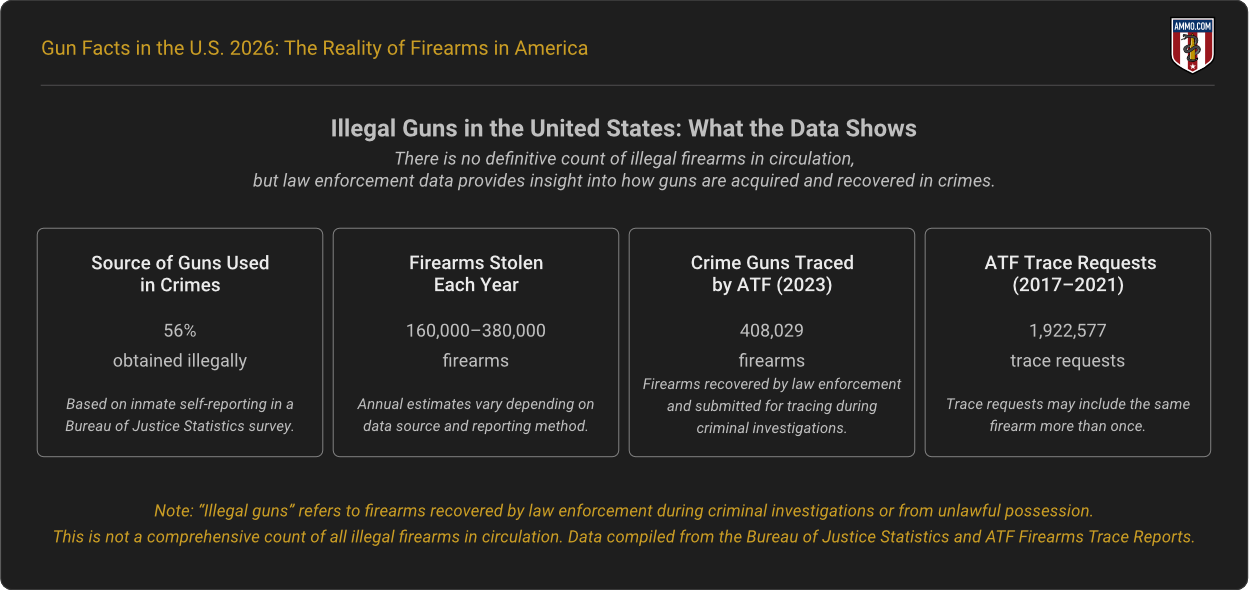
There’s no definitive record of how many guns are illegal in the U.S. However, the ATF does track guns used in crimes across the nation.
How Many Guns Used in Crimes Are Obtained Illegally?
Per the 2016 Bureau of Justice Statistics report on crime guns, 56% of inmates who used a firearm during the commission of a crime obtained that firearm illegally. Alternatively, 25% stated they acquired the firearm from a family member or friend, while 10.1% stated they obtained the firearm from a retail source (presumably, a legal purchase).(12)
As of 2023, the ATF traced more than 400,000 firearms used during the commission of a crime.(13) This is consistent with ATF reports from 2017 to 2021, which show approximately 400,000 firearms traced annually.
Law enforcement agencies submit trace requests to the ATF when they confiscate a firearm. Between 2017 and 2021, nearly 2 million trace requests were sent to the ATF.(14)
- As of 2023, the ATF traced 408,029 firearms seized during the commission of a crime.
- 85.9% of guns used in crimes were obtained illegally.
- 1,922,577 firearms were submitted to the ATF for trace requests between 2017 and 2021 (presumably recovered from crimes).
- Recent ATF reports show an average of 160,000 firearms are reported stolen annually, while some surveys suggest the figure is much higher at 380,000.(14)
Can We Define “Illegal” Guns in the United States?
There’s no single definition of “illegal firearms” in the U.S. The purchase, possession, manufacture, or transport of certain firearms may be restricted or prohibited in some jurisdictions or nationally (as we’ve seen with bump stocks and the NFA).
This report defines illegal guns as those confiscated by law enforcement agencies across the U.S. The firearms in this report were recovered during an investigation of an alleged crime or from a person who did not possess them lawfully.
What Is the Public Attitude Toward Gun Control?
According to a 2025 Gallup survey, 40% of Americans said gun laws should be stricter; 37% stated they were satisfied with current laws; 12% stated that laws are too strict.(1)
Gun control support is declining. In 2024, 46% of Americans stated they wanted stricter gun laws, while 13% stated that current laws are too strict.
In 2024, most Americans stated there should be no ban on civilian handgun ownership (78%). The majority (52%) also stated they would support another assault weapons ban.(1)
Larger majorities reportedly support prohibiting people with mental illness from owning guns (88%), increasing the minimum age to purchase to 21 (79%), and banning high-capacity magazines (66%).(3)
Gun Control: Fact vs. Fiction
Common myths about guns and gun control – and what the data actually shows. Tap a myth to see the evidence:
Myth: As the Number of Guns Rises, so Do Gun Deaths
Gun death rates in the U.S. were at their highest in 1993 (15.2 deaths per 100,000 people). The Trace estimated that 178,419,470 guns (0.7 per person) were in circulation in the U.S. that same year.(28)
In 2024, there were an estimated 500,000,000 firearms in circulation (an 180.2% increase). The gun death rate in the U.S. in 2024 was 13.1 per 100,000 (a 13.8% decrease).
Gun death rates in the U.S. were at their lowest in a sustained period (1979 to 2024) between 1999 and 2014 (between 10.1 and 10.7 deaths per 100,000). The estimated number of guns during this period increased by nearly 41.7% (81,962,129), while the gun death rate remained stable.
From 2020 through 2024, the number of guns in the U.S. increased substantially (1.1 per person to 1.47). Gun deaths spiked to a collective average of 14.0 per 100,000 in that timespan, starting at 13.7 per 100,000 in 2020, climbing to 14.7 in 2021; 14.5 in 2022; 14.0 in 2023; and then declining to 13.1 in 2024.
Despite firearm proliferation equivalent to three out of four Americans gaining an additional firearm from 1993 to 2024, there were still fewer gun deaths (15.2 down to 13.1), meaning more guns do not equal more deaths.(16, 17, 18, 19)
Myth: Mass Shootings Result From Lack of Gun Control
Mass shootings in the U.S. were rare prior to the 1990s, averaging 1.1 shootings per year from 1966 through 1979; 2.3 from 1980 to 1989; and 3.7 from 1990 to 1999.
Several federal gun control bills were passed between the 1980s and 1990s, including the 1986 Firearm Owners’ Protection Act (loosened dealer restrictions, but restricted civilian ownership and transfer of machine guns), 1993 Brady Handgun Violence Prevention Act (required federal background checks), and 1994 Violent Crime Control and Law Enforcement Act (commonly referred to as the “Federal Assault Weapons Ban”).
There was a slight decrease in the number of mass shootings per year between 2000 and 2009 (3.6, versus 3.7 in the 1990s). The rate rose to 5.4 per year in the 2010s. There have been 5.2 mass shootings per year from 2020 through 2025.
While mass shootings were increasing in the U.S., other countries, such as Australia and the United Kingdom, were passing strict gun control laws. Mass shootings (defined as 4+ killed, in public places, unconnected to crime, where innocent bystanders were targeted) continued with similar patterns.
There were four documented mass shootings in Australia prior to sweeping gun control: the Hoddle Street, Port Arthur, Queen Street, and Strathfield massacres. After the 1996 ban (which was prompted by the Port Arthur massacre), there have been three mass shootings: Darwin, Wieambilla, and Bondi Beach.(26)
The U.K. also saw a slight decline in mass shootings after passing gun control laws in 1997. There were two mass shootings before gun control (the Hungerford and Dunblane massacres), and two after (Cumbria and Plymouth).(27)
It’s impossible to say whether gun control actually saved lives in other developed nations. Even after some of the strictest gun control legislation was passed in the developed world, mass-casualty public attacks have continued (e.g. the 2024 Bondi Junction stabbings and 2017 London Bridge attack and Manchester Arena bombing). Moreover, other nations had far fewer guns when gun control was enacted than the U.S. currently has. Many armed Americans would not comply with new gun legislation.
Myth: The Second Amendment Makes the U.S. More Dangerous
The Second Amendment to the Bill of Rights limits the government’s authority over the people’s right to keep and bear arms. Unlike Mexico or Guatemala, the American Constitution has yet to cave to anti-gun advocacy groups.(29)
This raises the question: Does the Second Amendment make the U.S. more dangerous?
To start, Guatemala and Mexico both have stringent purchasing restrictions on their constitutional rights to keep and bear arms. In 2025, those countries had homicide rates of 17.4 and 15.4 per 100,000; much lower than the projected U.S. rate of 4.0.(20, 21) This suggests that the Second Amendment, as it is currently written, does not make the U.S. more dangerous.
Comparing U.S. homicide trends to those of other G7 nations suggests a similar pattern: gun control may not be America’s answer to saving lives. Every G7 country experienced a decline in homicide rates between 1990 and 2020.
Despite relaxing some of its gun control laws and making more calibers available to civilians, Italy’s homicide rate declined by 84.4% (3.2 per 100,000 to 0.5) from 1990 to 2020.(22) Although the country restricted some “military caliber” weapons in 2010, some sources attribute the dramatic decline in homicide rates to the declining Mafia subculture.(25)
Other G7 countries, such as Canada, France, Germany, and the U.K., all saw declines in homicide rates from 1990 to 2020 with increased gun control (according to the latest available data), whereas Japan’s gun laws were much more restrictive before 1990.
Canada’s homicide rate declined by 16.7% (2.4 per 100,000 to 2.0) from 1990 to 2020, although the country implemented several strict gun control laws and weapon bans. France’s homicide rate declined by 54.2% (2.4 per 100,000 to 1.1); the U.K’s by 30.8% (1.3 per 100,000 to 0.9). The U.S. homicide rate declined by 31.2% (9.3 per 100,000 to 6.4). Germany’s declined by 25% (1.2 per 100,000 to 0.9).(23, 24)
Although the U.S. increased federal gun control, states relaxed restrictions on civilian carry, and the Federal Assault Weapons Ban of 1994 expired in 2004. Even so, homicide rates continued declining.
Wrap-Up
Americans own more guns than any other country’s population. Firearms are deeply ingrained in American culture, from hunting to personal defense to sport shooting.
With nearly two firearms for every adult in their country, Americans’ attitudes toward firearms still vary greatly. Although many support stricter gun control restrictions, fewer support them today than 20 years ago.
Sources
- Gallup: Gunsnews.gallup.com
- YouGov Survey: Guns & Gun Ownershipyougov.net
- Pew: Gun Ownership & Regulationpewresearch.org
- One Million Monthly Gun Sales Streak Ends at 71shootingillustrated.com
- Small Arms Survey 2018smallarmssurvey.org
- ATF Number of Guns in 2000gunpolicy.org
- ATF Firearms 1998-2012atf.gov
- Gun Ownership by State: 2026worldpopulationreview.com
- Gun Ownership Rates Have Spiked Among Republican Womennews.gallup.com
- Key Facts About Americans and Gunspewresearch.org
- Whose guns are stolen? The epidemiology of Gun theft victimspubmed.ncbi.nlm.nih.gov
- How Many Guns Are Circulating in the U.S.?thetrace.org
- CDC Wonder Compressed Mortality (1979-1998)wonder.cdc.gov
- CDC WONDER Underlying Cause of Death, 1999-2020wonder.cdc.gov
- CDC WONDER Underlying Cause of Death, 2018-2024wonder.cdc.gov
- Crime Trends in U.S. Cities: Year-End 2025 Updatecounciloncj.org
- Italian Gun Laws: How Do They Compare to the U.S.?firearmsnews.com
- World Bank Group: Intentional homicides (per 100,000)data.worldbank.org
- Homicide rate in 1990 vs. 2020ourworldindata.org
- Mass shootings are rare in Australiaapnews.com
- The worst gun massacres in British historycrimeandinvestigation.co.uk
- The Trace: Gun Violence by Numbersthetrace.org

Infographics
- Are Guns & Ammo The New Gold? Why More Americans Are Arming Themselves
- The Greatest Gun Salesman In America: President Barack Obama
- Shooting Straight: How Both Presidential Candidates Have Changed On Gun Control
- President Obama: (Still) The Greatest Gun Salesman in America
- An Inconvenient Truth: How The Obama Administration Became Earth's Largest Arms Dealer
- Armed Drones: President Obama's Weapon of Choice
- COVID-19 Data Study: Ammunition Sales Continue to Soar in Response to Coronavirus Panic
- Data Study: 18 Months of Ammo Sales during a Pandemic, Protests, and the Biden Presidency
- Data Study: U.S. Ammo Sales Surge Following Russian Invasion of Ukraine
- Most Gun-Friendly States
- Worst States to be a Gun Owner
- Children & Firearms: Definitions and Demographics Make All the Difference
- Urban Violent Crime & Legal Gun Ownership
- Gun-Free School Zone Laws & School Shootings
- Gun Control Laws and Enforcement Trends
- Gun Ownership by State
- How Many Gun Owners are in America?
- Concealed Carry Crime Stats
- Accidental Shooting Statistics: A Review of Unintentional Firearm Deaths
- America's Stolen Guns: A Silent Contributor to Gun Crimes in the U.S.
- Gun Violence Statistics: Comprehensive Look at the Data
- Gun Laws vs. Crime Rates: A Comprehensive Analysis
- Gun Death Statistics by Caliber: A Review of Calibers and Crime
- Anti-Gun Control Arguments: Facts Gun Control Lobby Suppress
- Guns in the Home Statistics: The Effects of Firearms in the Home
- Gun Deaths in the US: Analyzing At-Risk Demographics
- How Many Guns in the U.S.: All About America's Firearms
- Gun Facts in the U.S.: The Reality of Firearms in America
- Defensive Gun Use Statistics: America's Life-Saving Gun Incidents
- Correlation Between Mass Shootings and Prescription Drugs
- Gun Ownership by Gender: Closing the Gender Gap
- Murders by Weapon Type: Statistics
- Gun Violence Among Black Americans: Statistics
- The Ultimate Hunting Caliber Chart: Best Cartridge Per Species
- How Old Do You Have to be to Buy a Gun: A State Guide
- Most Popular Guns in the U.S.: The Must-Have Guns
- Stray Bullet Deaths: Accident and Injury Statistics
- Mass Shooters by Race: Demographics of Assailants
- Ammunition Limits By State: How Much Ammo Can You Buy?
- Why Do Americans Own Guns?
- How Many Americans Want Stricter Gun Laws?
- How Many Households in the U.S. Have a Gun?
- What Percentage of Gun Deaths are Suicides?
- Average Age of Mass Shooters in the U.S.
- Firearm Ownership in America by Year
- US Firearms Deaths Per Year: A Collective Report
- Percentage of Americans Owning Guns
- Texas Gun Ownership: Total Numbers, Trends, and Most Popular Guns
- Gun Ownership Statistics Colorado: Trends & Numbers
- Hunting Accident Statistics (Causes & Trends Per Year)
- Banned Guns & Ammo List: A Review by State
- 3D Printed Gun Laws By State
- How To Build a Home Shooting Range: The Ultimate Guide
- States With the Highest Murder Rates
- Best Self-Defense Weapons for Women
- Easiest States to Buy a Gun
- Cities with the Lowest Crime Rate
- Oregon Homicide Rates
- Chicago Homicide Rate
- How Much Does a Suppressor Reduce Noise
- Texas Homicides: Statistics and Trends
- California Homicides: Rates Per 100K
- Florida Murder Rate: Statistics and Trends
- Gun Ownership by Political Party
- Mass Shooters by Gender
- U.S. Hunting and Fishing Statistics
- Where Are Silencers Illegal? State Suppressor Laws
- How Loud is a Gunshot?
- What States Have the Strictest Gun Control?
- Causes of Mass Shootings in the U.S.
- Ammo Manufacturers List
- How Criminals Get Guns