Guns in the Home: 2025 Statistics
Report Highlights: More than 50 million U.S. households have at least one firearm. There's an average of 40,000 firearm-related deaths annually.
-
According to recent surveys, 81% of gun owners and 57% of non-gun owners feel safer with a firearm in the home.
-
Four in ten U.S. households have at least one firearm (out of 129 million, equalling at least 51.6 million households)
-
55% of homicides where the victim dies at home are firearm-related.
-
0.002% of children who were in a home with a loaded and unsecured firearm were killed in an accidental shooting incident between 2003 and 2021.
Ammo.com provides information from reputable sources. You can view the sources used in this article here.
Related Studies: How Many Households in the U.S. Have a Gun?, Firearm Ownership in America by Year, Gun Ownership by State, How Many Gun Owners are in America?
The Statistics: Does Having a Gun in Your Home Make You Safer?
Approximately half of American households have at least one firearm. Although reasons for owning firearms vary, Americans report owning them for self-defense more than any other reason.
Let's take a look at why the vast majority of gun owners keep at least one for personal protection:
- In 2023, there were 8,351 homicides in U.S. households. Approximately 55% (4,593) of those involved firearms. Source 4
- Approximately 0.007% of U.S. households experienced firearm-related homicides in 2023. Source 3, 4
- Conservative estimates indicate that defensive gun uses are 3.8 times more likely to occur in a home than a firearm-related homicide. An estimated 70,000 defensive gun uses occur annually. Source 3, 4, 12
- An estimated 33.4% (14,966/44,880) of suicides occurred in a home and with a firearm in 2023 (63.5% occurred at home; 52% of all suicides involve guns). This estimate assumes firearm use is evenly distributed across all locations, which may not reflect actual patterns. Source 2, 3, 8
- Conservative estimates suggest that guns in the home are used in acts of self-defense 1.17 times more often as they are involved in suicides. Source 3, 12
This data highlights the complex role firearms play in American households, contrasting perceived risk with actual benefits. Estimates suggest that defensive gun uses occur at higher rates in the home than firearm-related homicides or suicides.
What Percentage of Gun Accidents Happen in the Home?
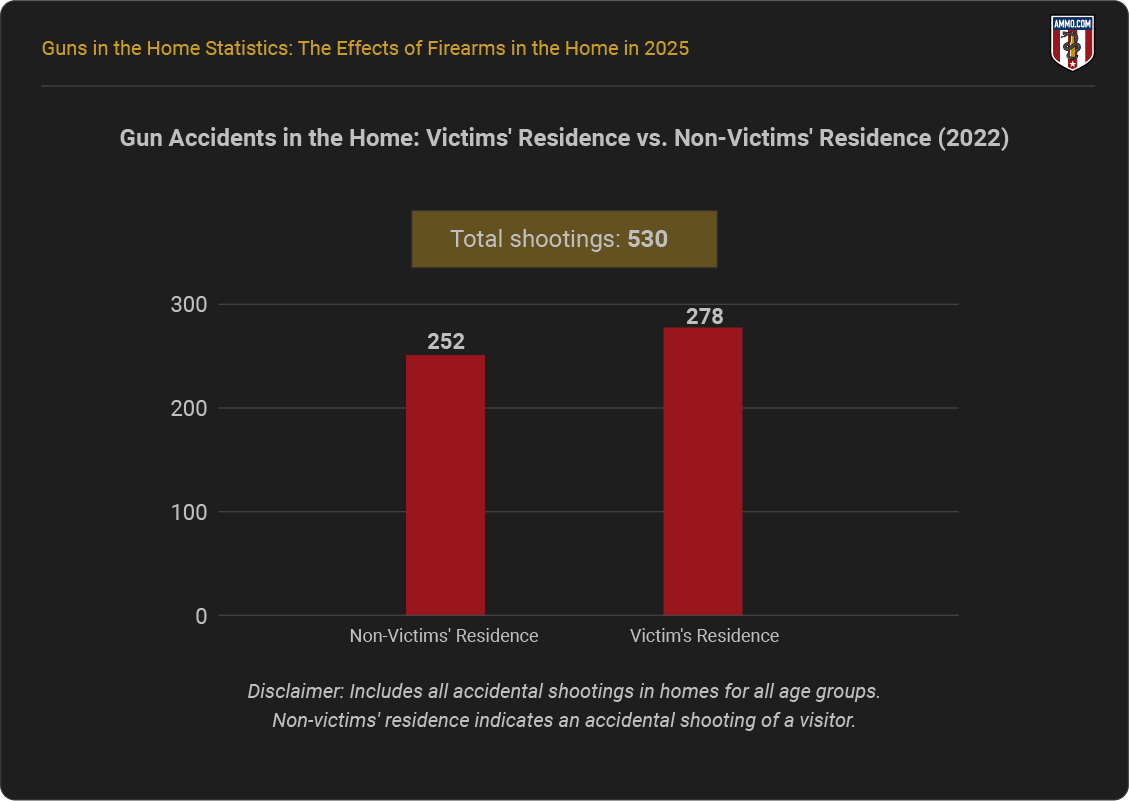
In 2022, 78.3% of the 530 recorded unintentional shooting deaths occurred in a private residence. Of these incidents, 52.5% occurred in the victims' homes. Source 2
Between 2003 and 2021, 85.5% of all accidental shootings (1,262) involving adolescents occurred in a home or apartment. Over half of these incidents (55.6%) occurred in the victims' residence. Source 1
- In 2022, 0.0006% of households with guns experienced an unintentional shooting death.
- Between 2003 and 2021, 0.002% of American households experienced an accidental shooting death of a minor (ages 0-17).
- Over the past two decades, 702 children were accidentally shot and killed in their own homes, while 561 children were killed in someone else's home.
Domestic Violence and Guns in the Home
In 2023, the FBI recorded 21,248 victim/offender relationship homicides. Of these, 3,416 (16.1%) involved a victim who was related to the offender (family member or romantic partner). These cases are commonly categorized as "domestic" or "intimate partner violence" (IPV). Source 4
That same year, 59% of all murders involved a gun; 36.5% occurred in a private residence. Although the FBI doesn't break down weapon use for domestic homicides, applying the overall firearm rate suggests that an estimated 2,015 of the 3,416 domestic homicides during 2023 happened inside the home and involved firearms.
- 16.7% of homicides in 2023 involved a victim who was related to or romantically involved with the offender. Source 2, 3, 4
- Approximately 0.0016% of gun-owning households experienced a firearm-related domestic violence homicide in 2023, based on the household distribution of all gun-owning households (1,037). Source 2
Disclaimer: These estimates are based on national averages and assume that firearm use and domestic violence are evenly distributed across all gun-owning households (66.5 million). Actual rates may vary due to regional, demographic, and situational factors. These figures are inferred from broader trends.
Do Guns Put Women at Risk?
Of the estimated 169.2 million women in the United States, 25% (42 million) own a gun. Another 17-20% state that they live in households where someone other than them owns at least one gun. Studies estimate that women are the defenders in 12–15% of all defensive gun uses (70,000 per year, on the low end). Source 2, 6
The CDC WONDER database reports 4,106 female homicides (of 20,146 total murders) in 2024. Of those, 2,625 (64%) were murdered with a gun.
Conservatively, women are seven to 11 times more likely to use a gun for self-defense than they are to be murdered.
Home Invasion and Defensive Gun Use Statistics
Home invasions are estimated to range from 800,000 to 2.5 million per year (depending on how the incidents are defined). The U.S. Department of Justice reports that one in four home burglaries occurs when the residence is occupied.
Americans often report grabbing a firearm for home defense. A 1994 study examined 1,896,842 incidents in which an individual reported grabbing a firearm to stop a home invader. In 260,060 of these cases, the homeowner saw a suspect, and the suspect fled as a result.
A landmark National Institute of Justice survey of convicted felons (Wright & Rossi, 1986) found that 74% of inmates acknowledged avoiding breaking into homes when they believed the homeowner to be armed. Many cited fear of being shot as a primary deterrent.
Domestic Violence
You’ve likely heard having a gun in the home means you’re more likely to be shot during a violent altercation. However, after looking at the stats, that's not the case.
Of 17,215 homicides recorded by the FBI in 2022, only 15% were committed by a family member or domestic partner. Abusers often use other means to kill their victims, and women are less likely to personally own a firearm for defensive use than men.
Between 2003 and 2012, a firearm was used in only 3.7% of domestic violence incidents compared to 10.7% of incidents where a stranger was the aggressor.
Studies indicate that 77% of domestic violence incidents occur at or near the home, and 1.1% were classified as Serious Violent Crimes. Intimate partner violence increases after leaving the home: 44.7% of intimate partner violence occurred during a separation, and 11.4% occurred after a divorce.
Suicide and Firearm Access
In 2024, 48,815 individuals committed suicide. Of those, 57% (27,591) used a firearm.
Firearms in the home don't increase a person's inclination to commit suicide – but firearms are more effective, to the tune of 90% efficiency (per some reports). Source 8 To illustrate: in 2024, America's suicide rate was 14.8 per 100,000. Firearm related suicides occurred at a rate of 8.2 per 100,000, while all other suicide methods (suffocation, poisoning, fall, etc.) occurred at a rate of 6.4 per 100,000. Although other methods were attempted, they were not as effective as firearms.
Youth Access and School Incidents
The U.S. Secret Service investigates targeted attacks on schools. The agency examined 41 firearm-related attacks on schools between 2008 and 2017, and 43 averted attacks between 2006 and 2018.
Of those who carried out attacks on schools, 76% obtained at least one firearm from a family member. Fewer than half (48%) had unimpeded access to a firearm, while others gained access to a locked safe or cabinet. Source 11
Although the attacks were averted (the plotter was caught in the planning stages), an additional 64% of plotters had unimpeded access to a firearm in their home or someone else's. Source 10
Prevention and Safety Strategies
Gun safety is of the utmost importance for every American, regardless of ownership. Whether you're keeping yourself or someone else safe, here are a few gun safety tips to practice:
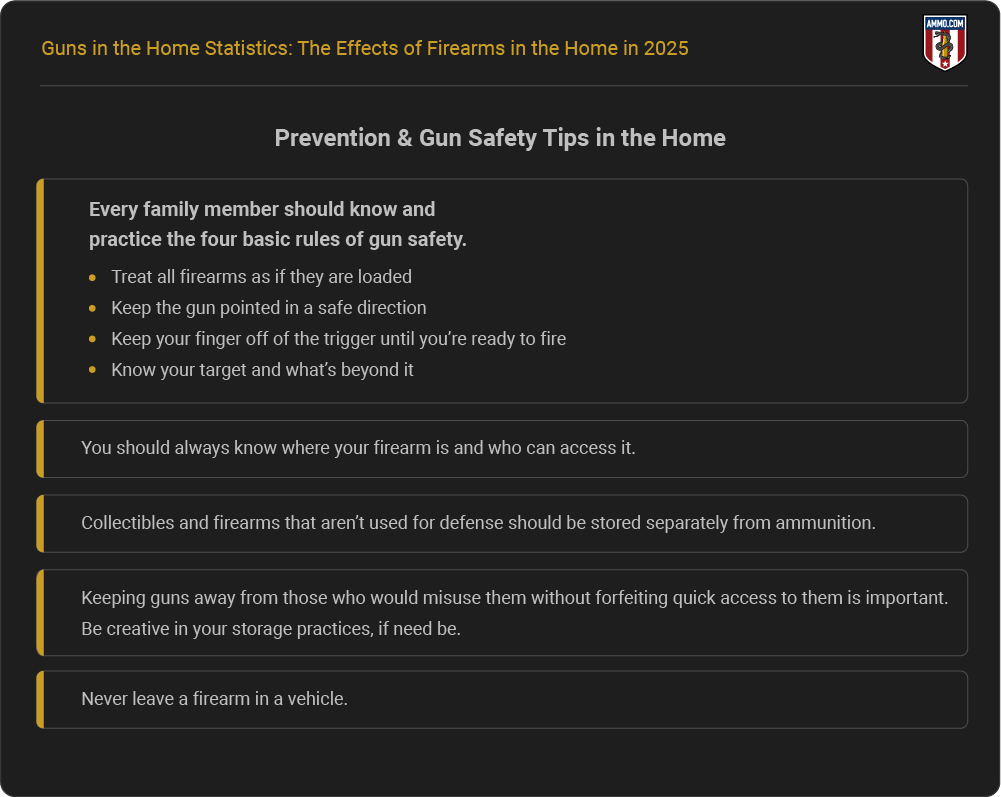
- Every family member should know and practice the four basic rules of gun safety.
- You should always know where your firearm is and who can access it.
- Collectibles and firearms that aren't used for defense should be stored separately from ammunition.
- Keeping guns away from those who would misuse them without forfeiting quick access to them is important. Be creative in your storage practices, if need be.
- Never leave a firearm in a vehicle.
Guns in the Home: Wrap-Up
Many American homes contain firearms. Although the relationship between firearm owners and injuries is complex, the vast majority of gun owners will never experience a firearm-related injury or fatality in their home.
That said, firearm-related injuries are undeniably more common in homes where guns are present. The risk doesn't present simply because people own firearms, but rather because of how they're stored, accessed, and used.
Sources:
- Unintentional Firearm Injury Deaths Among Children and Adolescents Aged 0–17 Years — National Violent Death Reporting System, United States, 2003–2021
- Surveillance for Violent Deaths — National Violent Death Reporting System, 50 States, the District of Columbia, and Puerto Rico, 2022
- CDC WONDER Provisional Mortality Statistics
- FBI Crime Data Explorer
- Victimization During Household Burglary
- Key facts about American gun ownership
- Estimating intruder-related firearm retrievals in U.S. households, 1994
- Firearm injuries in the United States
- Burglary and the Armed Homestead
- Youth Access and School Incidents: A U.S. Secret Service Analysis of Plots Against Schools
- Protecting America's Schools: A U.S. Secret Service Analysis of Targeted School Violence
- Trends and Patterns in Firearm Violence: 1993-2018

Infographics
- Are Guns & Ammo The New Gold? Why More Americans Are Arming Themselves
- The Greatest Gun Salesman In America: President Barack Obama
- Shooting Straight: How Both Presidential Candidates Have Changed On Gun Control
- President Obama: (Still) The Greatest Gun Salesman in America
- An Inconvenient Truth: How The Obama Administration Became Earth's Largest Arms Dealer
- Armed Drones: President Obama's Weapon of Choice
- COVID-19 Data Study: Ammunition Sales Continue to Soar in Response to Coronavirus Panic
- Data Study: 18 Months of Ammo Sales during a Pandemic, Protests, and the Biden Presidency
- Data Study: U.S. Ammo Sales Surge Following Russian Invasion of Ukraine
- Most Gun-Friendly States
- Worst States to be a Gun Owner
- Children & Firearms: Definitions and Demographics Make All the Difference
- Urban Violent Crime & Legal Gun Ownership
- Gun-Free School Zone Laws & School Shootings
- Gun Control Laws and Enforcement Trends
- Gun Ownership by State
- How Many Gun Owners are in America?
- Concealed Carry Crime Stats
- Accidental Shooting Statistics: A Review of Unintentional Firearm Deaths
- America's Stolen Guns: A Silent Contributor to Gun Crimes in the U.S.
- Gun Violence Statistics: Comprehensive Look at the Data
- Gun Laws vs. Crime Rates: A Comprehensive Analysis
- Gun Death Statistics by Caliber: A Review of Calibers and Crime
- Anti-Gun Control Arguments: Facts Gun Control Lobby Suppress
- Guns in the Home Statistics: The Effects of Firearms in the Home
- Gun Deaths in the US: Analyzing At-Risk Demographics
- How Many Guns in the U.S.: All About America's Firearms
- Gun Facts in the U.S.: The Reality of Firearms in America
- Defensive Gun Use Statistics: America's Life-Saving Gun Incidents
- Correlation Between Mass Shootings and Prescription Drugs
- Gun Ownership by Gender: Closing the Gender Gap
- Murders by Weapon Type: Statistics
- Gun Violence Among Black Americans: Statistics
- The Ultimate Hunting Caliber Chart: Best Cartridge Per Species
- How Old Do You Have to be to Buy a Gun: A State Guide
- Most Popular Guns in the U.S.: The Must-Have Guns
- Stray Bullet Deaths: Accident and Injury Statistics
- Mass Shooters by Race: Demographics of Assailants
- Ammunition Limits By State: How Much Ammo Can You Buy?
- Why Do Americans Own Guns?
- How Many Americans Want Stricter Gun Laws?
- How Many Households in the U.S. Have a Gun?
- What Percentage of Gun Deaths are Suicides?
- Average Age of Mass Shooters in the U.S.
- Firearm Ownership in America by Year
- US Firearms Deaths Per Year: A Collective Report
- Percentage of Americans Owning Guns
- Texas Gun Ownership: Total Numbers, Trends, and Most Popular Guns
- Gun Ownership Statistics Colorado: Trends & Numbers
- Hunting Accident Statistics (Causes & Trends Per Year)
- Banned Guns & Ammo List: A Review by State
- 3D Printed Gun Laws By State
- How To Build a Home Shooting Range: The Ultimate Guide
- States With the Highest Murder Rates
- Best Self-Defense Weapons for Women
- Easiest States to Buy a Gun
- Cities with the Lowest Crime Rate
- Oregon Homicide Rates
- Chicago Homicide Rate
- How Much Does a Suppressor Reduce Noise
- Texas Homicides: Statistics and Trends
- California Homicides: Rates Per 100K
- Florida Murder Rate: Statistics and Trends
- Gun Ownership by Political Party
- Mass Shooters by Gender
- U.S. Hunting and Fishing Statistics
- Where Are Silencers Illegal? State Suppressor Laws
- How Loud is a Gunshot?
- What States Have the Strictest Gun Control?
- Causes of Mass Shootings in the U.S.
- Ammo Manufacturers List
- How Criminals Get Guns