Most Gun Friendly States in 2026
How does your state rank in terms of encouraging legal gun ownership? Our results are surprising! We took into account current gun laws, legislators' past voting records, 2A-centric taxes, and more to bring you this comprehensive list for 2026.
Report Highlights:
-
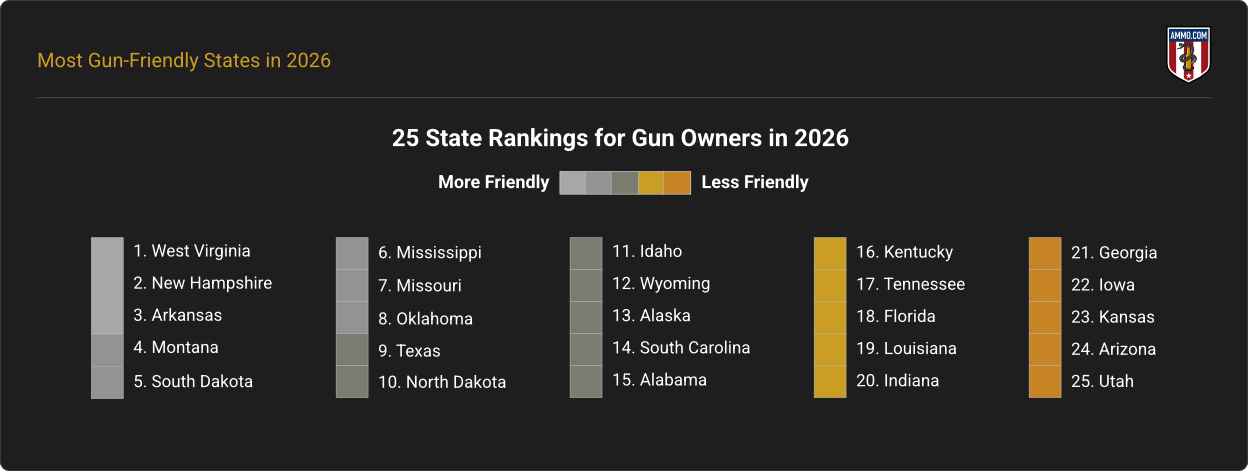
West Virginia is #1 thanks to its incredibly relaxed gun laws, low crime rates, and lack of sales tax on firearms.
-
New Hampshire is #2 due to its enhanced permit options, Constitutional carry freedoms, and lack of state sales tax.
-
Arkansas, Montana, and South Dakota are #3, #4, and #5 thanks to their pro-2A governors, stand-your-ground laws, and relaxed carry and conceal requirements.
-
Utah, Arizona, and Kansas ranked #25, #24, and #23 due to their current governors' Second Amendment stance.
Our ranking factors and how we weighed each of those factors are detailed here: Ranking Factors: What Did We Measure?. Our sources are listed here. Without further ado, please scroll down to see how we ranked America's best states for gun owners in 2026.
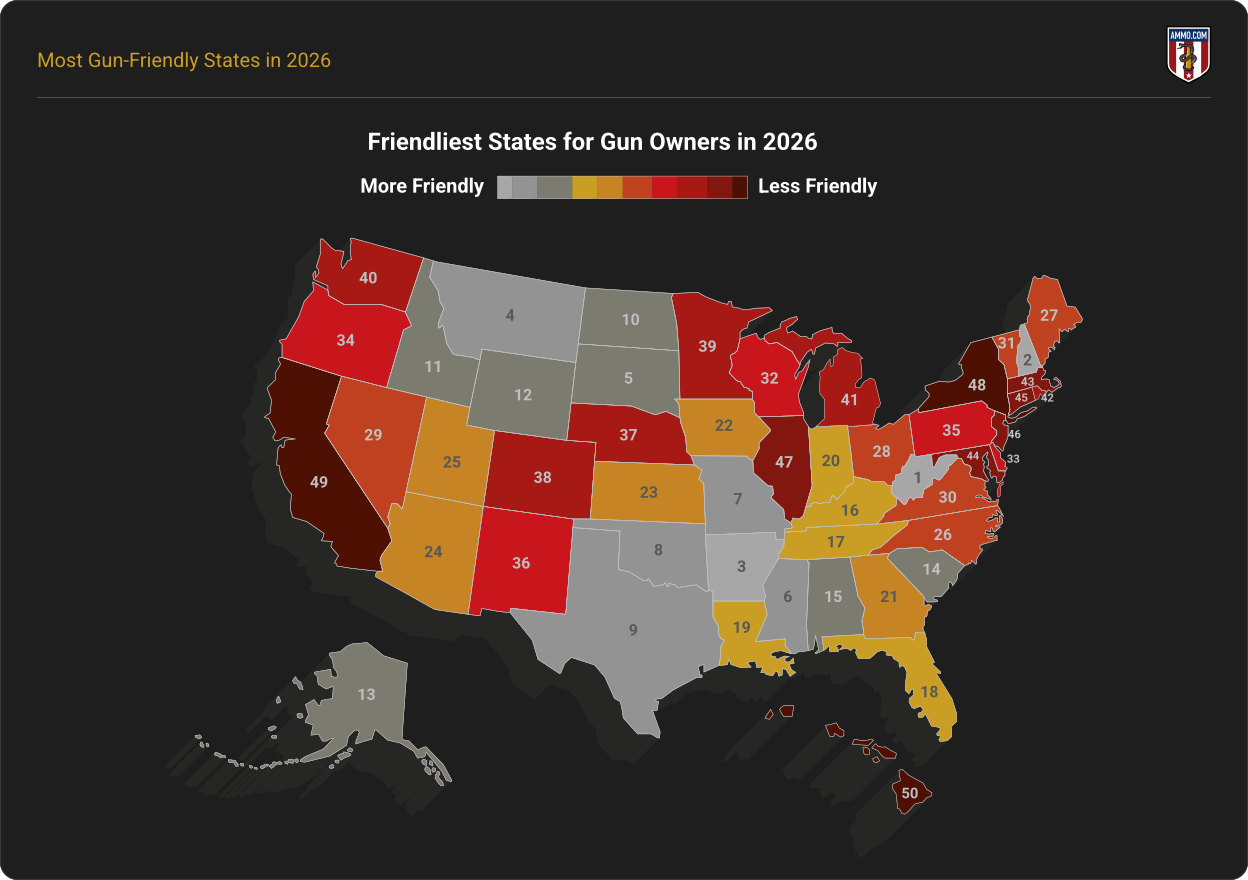
Best States for Gun Owners
#25 Utah
Utah residents may conceal or openly carry a firearm,12 but some restrictions apply. For example, residents may not carry in courthouses, jails, or other prohibited places. Those over 18 may carry an unloaded firearm without a permit, while those over 21 may carry a loaded firearm without a permit.
While there aren’t any additional taxes, firearm purchasers will pay an additional $7.50 for background checks. However, those with an in-state CCW are exempt from this fee. There are also tax exemptions for firearms and ammunition purchases.
Utah does not require background checks for private sales and transfers, but it does impose penalties for selling firearms to prohibited persons.13 Utah has stand-your-ground laws13 with no duty to retreat to protect those acting in self-defense from prosecution.
Recently, Governor Spencer Cox14 made remarks that he is open to discussing gun regulation measures. However, actions speak louder than words and the governor did sign legislation15 in 2022 to keep local municipalities from enacting gun control restrictions.
#24 Arizona
Arizona is a Constitutional Carry state, allowing citizens to carry a firearm (open or concealed) without a permit. It’s also a shall-issue permit state1, meaning the state must issue a permit to all eligible residents. Those over 18 can open carry a firearm without a permit, but only those over 21 can purchase handguns and conceal firearms with no permit.
The state’s CWP (Concealed Weapon Permit2) is valid in a whopping 36 states, and those traveling to AZ can open carry in most places3. If you ever find yourself in a threatening situation, AZ does have the Castle Doctrine, and there’s no duty to retreat.
Firearms are subject to the state sales tax but are exempt from the TPT (transaction privilege tax4). Arizona sits comfortably near the top of our list at the moment, but with new Governor Katie Hobbs, we can’t be sure the state will remain on this list. Her voting record5 does not comfortably align with other pro-2A governors.
#23 Kansas
Kansas is a Constitutional Carry state where citizens can open or conceal carry a firearm without a permit.6
Those 18 and over can apply for the state’s CCHL (Concealed Carry Handgun Licenses). You don’t have7 to get a CCHL in Kansas, register your firearms, or pass background checks outside of the standard federal checks.
Kansas tax rates are the same for firearms as they are for any other goods, and there are no tax breaks8 for components or safe storage accessories. Kansas also has a Castle Doctrine with no duty to retreat9. Citizens with a CCHL can visit 39 other states with their firearms.
Kansas’s Governor, Laura Kelly, vetoed a bill10 to teach firearm-appropriate training and also advocates for11 harsher background checks and even some equipment bans.
#22 Iowa

As another Constitutional Carry state, Iowa allows law-abiding citizens to open or concealed carry firearms under permitless carry laws but still offers a PCW (Permit to Carry Weapons16) for those over 21 years of age (those under 18 are eligible if the permit is required for work). The state honors 49 others’ CCWs, while Iowa’s citizens can carry in 33 states with a PCW.
The state’s standard sales tax17 also applies to all firearms and ammunition purchases, but some state legislators have supported firearms tax holidays in the past.
Citizens do have some protections with Iowa’s self-defense laws18, and there’s no duty to retreat. On another note, the state is considering passing legislation19 to allow gun owners to keep firearms in their vehicles on school campuses.
We are seeing some progress in Iowa for gun owners in the state under Governor Kim Reynolds. She was instrumental in passing legislation20 that stopped requiring permits for purchases, and supports lowering the age to buy or carry a handgun to 18 years.
#21 Georgia
Georgia is a Constitutional Carry state that allows those over 2121 who are lawfully permitted to possess firearms to conceal a firearm in some places. The state honors carry permits from 32 other states, and 33 states accept Georgia’s WCL. Among the standard licensure requirements, those with previous mental illness cannot legally possess firearms, as is the case in many states due to Federal background checks.
Georgia does not require residents to register their firearms, and you won’t need a purchase permit to acquire one from an FFL. Georgians also won’t receive any tax credits on firearms or ammunition purchases.
The state has stand-your-ground laws22 with no duty to retreat. This means that if a person acts, according to a reasonable individual in self-defense, they may not be prosecuted - even if the situation occurs outside of the individual’s residence.
Brian Kemp signed legislation23 that made it possible for Georgians to openly carry firearms in the state without a permit.
#20 Indiana
Any resident over 18 years old can open or concealed carry a firearm in Indiana without a permit unless prohibited from possessing a firearm. Indiana accepts CCW permits from 48 other states, and residents can travel to 32 other states with their Indiana permits.
Indiana does have Red Flag Laws where police officers have the authority to remove firearms from dangerous individuals. However, courts also have the duty24 to rule on whether those firearms were removed lawfully within 14 days. The state doesn’t require registration for firearms.
Residents are protected from prosecution25 in self-defense situations by the state’s stand-your-ground and castle doctrines with no duty to retreat.
While those purchasing firearms and ammunition will pay standard sales tax, a bill is currently sitting with the State’s Means & Ways Committee26 to exempt firearms and ammunition.
Governor Eric Holcomb signed the bill to make Indiana a Constitutional Carry state, but also enacted legislation27 to stop the purchase of equipment known to convert firearms to fully automatic. Depending on your 2A stance, this could be a positive or negative for gun owners in the state.
#19 Louisiana
Louisiana is also a Constitutional Carry state, where anyone over the age of 18 can lawfully carry a firearm as long as they aren’t restricted from doing so (open carry is not covered in the statute). However, the state also has mandates restricting open or concealed carry28 at parades and bars. The state does issue Concealed Handgun permits (CHPs)29, residents can carry to 37 other states, and Louisiana accepts weapons permits from 37 states.
You won’t have to go through a permit process, additional background checks outside of federal ones, or registrations to obtain a firearm in Louisiana. At the time of writing, Louisiana sales tax applies to all guns, ammunition, and accessories. However, the state does occasionally implement tax holidays for accessories and safety devices30.
Those who find themselves in a threatening situation are protected from prosecution under the state’s Stand Your Ground laws and Castle Doctrine31, and there is no duty to retreat. Yet, in Louisiana, a person must be met with force to apply force.
Governor Jeff Landry signed Constitutional Carry32 into law, despite past governors vetoing the bill. So far, this Louisiana governor seems to be on track to secure Louisiana’s ranking on our Best States for Gun Ownership list.
#18 Florida

Known as “The Gunshine State,” Florida is a Concealed Constitutional Carry state33, meaning it is legal for lawful citizens to conceal a firearm without a permit (you can only open carry when you’re fishing, camping, traveling, or hunting). Those who like to travel will enjoy reciprocity in 37 other states. Florida also honors CCWs from 35 states.
Florida has its own standards34, aside from federal background checks, for firearm purchases - this further limits gun ownership in the Panhandle state. Florida does not issue tax exemptions for firearms, but you also don’t have to register your firearms in the state.
The state has protections35 for those who act in self-defense, and there’s no duty to retreat as long as a reasonable person believes the individual acted appropriately for the situation.
Lastly, Governor Ron DeSantis signed the concealed carry legislation, so we don’t expect Florida to fall off this list.
#17 Tennessee

Tennessee is a Constitutional Carry state36 where anyone over 21 who can lawfully possess a firearm can carry and conceal their weapon without a license. Those wanting to apply for a CCW must meet criteria similar to federal background checks (no felonies, orders of protection, domestic violence charges, including misdemeanors, and no mental health adjudication).
Tennessee reciprocity agreements37 allow resident CCW holders to travel to 37 other states while also accepting CCWs from 48 other states. Tennessee has a history of tax exemptions38 for gun safety equipment. However, firearms purchases and all other related equipment are currently taxed at the standard rate.
The state also has stand-your-ground and castle doctrine protections that include no duty to retreat. Of course, these protections39 do not cover criminal activity or situations where a reasonable person wouldn’t have acted similarly.
Tennessee also performs background checks with the state’s TBI (Tennessee Bureau of Investigation) and the federal NICS. Tennessee’s governor, Bill Lee, is a staunch supporter of the people’s Second Amendment rights and even blocked Extreme Risk Protection Orders in 2024.
#16 Kentucky
Kentuckians over the age of 21 can conceal or open carry (as lawfully permitted to do so40) without a CCW. The state accepts CCWs41 from all 50 states, while residents can travel to 37 other states with their Kentucky permits (CCDW42).
Kentuckians must pass the federal NICS background check43 before purchasing firearms from an FFD, but there are no firearm registration requirements. Citizens may be protected from44 prosecution when using deadly force to protect life and property. Firearms purchases are subject to standard sales tax, but the state is considering tax exemptions45.
Governor Andy Beshear claims to be a strong supporter of the Second Amendment. He supports the right to keep and bear arms despite cannabis use, and didn’t contest the state’s Second Amendment Sanctuary legislation.
#15 Alabama

Alabama, another Constitutional Carry state, allows concealed and open carry for residents over 19. Residents can still apply for the state’s CCW at their local sheriff’s department. With a minimal fee and state background check, anyone who has not committed prior offenses and has no history of mental illness may obtain the permit46. Of course, the state also gives power to the issuing department to deny permits.
Alabama honors 48 states’ permits, while residents can lawfully conceal and carry firearms in 32 other states with an Alabama CCW. Firearm purchases in Alabama are subject to the state’s standard sales tax, but firearm registration isn’t required. The state also protects47 those lawfully protecting life or property from prosecution with stand-your-ground, castle doctrine, and no duty to retreat.
With Memaw Ivey at the helm, an endearing term for the state’s current governor, Alabama gun rights are safe for the time being. She signed a bill48 to solidify the right to carry, making Alabama one of the best states for gun ownership.
#14 South Carolina
South Carolina is a Constitutional Carry state, meaning that any individual over 18 who can legally possess a firearm can do so without a permit (open or concealed). The state also doesn’t require background checks for private sales and residents may use their carry permits in lieu of background checks.
Residents don’t have to register their firearms or pass redundant background checks (considering federal law mandates stringent background checks already). Another redeeming quality for the state is that it occasionally offers tax holidays49 for firearms and ammunition purchases.
South Carolina does afford protection50 to those acting in self-defense. The state now has Stand Your Ground laws, and there is no duty to retreat.
The state’s Governor, Henry McMaster, has voiced his support51 for the 2nd Amendment over the years. In addition to those statements, he’s also pushing for harsher punishments52 for those who possess firearms illegally.
#13 Alaska
Alaskan residents also enjoy Constitutional Carry legislation, and anyone over the age of 2153 can open or conceal carry handguns without a CCW (Concealed Weapons Permit). There’s no sales tax in the state, so you won’t have to pay an additional tax on handgun purchases. Gun owners can travel to 26 other states54, and visitors from all 50 states, Puerto Rico, and D.C. can also carry in Alaska with their state’s CCW.
There are no firearm registration, CCW requirements, or additional background checks (aside from form 4473 to comply with federal laws) to purchase a firearm in Alaska. However, those who’ve been convicted of a crime carrying a penalty of at least one year in prison, and those with pending domestic violence litigation (including orders of protection), and unable to carry or purchase a firearm in the Last Frontier.
So, what happens if you ever need to use your firearm in Alaska? Well, the state has both Stand Your Ground laws and there’s no duty to leave the area (unless you’re the aggressor, then it’s a good idea to politely excuse55 yourself from a threatening situation).
With Governor Mike Dunleavy at the helm, it looks like Alaska will remain one of the best states for gun ownership. He supports campus carry56 and has made many statements that he is a 2nd Amendment proponent.
#12 Wyoming
Wyoming also has Constitutional Carry, and allows its law-abiding citizens to open or conceal carry and stand their ground with no duty to retreat. While you can get enhanced carry permits for traveling (accepted by 35 other states57), they aren’t required for purchase, and neither is gun registration or additional background checks.
You’ll still pay the state’s 4% sales tax on any firearm and safety equipment, but the state offers protection for those who use their firearms in acts of self-defense with its Stand Your Ground, Castle Doctrine, and No Duty to Retreat58 policies.
Wyoming’s Governor, Mark Gordon, is a proponent of the Second Amendment and signed the 2A Protection Act59 to protect citizens’ firearms rights from federal government overreach.
#11 Idaho
Idahoans can open and concealed carry without a permit in this Constitutional Carry state. Those traveling to Idaho will need a CCW, although the state accepts permits from all 50 states60. The state’s standard sales tax applies to all firearms and equipment, but you won’t have to register your firearms or take additional courses before purchasing.
If you ever find yourself in a self-defense scenario, you are protected under the state’s Stand Your Ground doctrine61. There’s no duty to retreat and no duty to assess the situation further than reasonably necessary.
Governor Brad Little has a history of going up against the federal government to secure 2nd Amendment rights, as seen with his Credit Card Privacy Bill62. We feel confident that Idaho will remain on this list for quite some time.
#10 North Dakota
Residents of North Dakota (for more than 30 days) will enjoy open and concealed Constitutional Carry freedoms63 as long as they are at least 18 years of age, have no felony convictions (which you can get your 2A rights back after serving your sentence), and have no pending criminal charges or protective orders against you. Of course, even those who have prior convictions may have an opportunity to get their 2A rights back64 in North Dakota.
If you apply for a CCW in North Dakota, local law enforcement has the authority to deny your permit if they reasonably believe you are a danger to yourself or others. The state honors 38 other states' CCWs, and ND residents can travel to 39 others with a North Dakota CCW. What’s better is that you don’t have to register your firearms, and the state doesn’t have additional background checks outside of federal ones.
North Dakota is a Stand Your Ground state. Not only does one have the right to use deadly force65 in defense of oneself and others, but the state also provides immunity from civil liability if said use of force is justifiable.
While you won’t get any tax breaks for firearms or equipment, you won’t see additional penalties for fees, either. North Dakota also has Stand Your Ground laws with no duty to retreat from any place where you are legally allowed to be present. Governor Doug Burgum recently declared North Dakota a Second Amendment Sanctuary State66, so we don’t anticipate any changes soon.
#9 Texas

If you’re at least 21 years of age and lawfully allowed to possess a firearm, you can conceal or open carry without a permit69 in Texas. However, Commissioned Officers are unable to enforce carry restrictions70 on those aged 18-20 due to a 5th Circuit Court of Appeals ruling (although this is subject to change). Residents can travel to 37 other states with an enhanced firearm permit, and Texas honors 44 other states’ CCWs.
While firearms and ammunition aren’t exempt from taxation, safety equipment, such as safes, barrel locks, and trigger locks, are exempt71.
Texas also has a Stand Your Ground and Castle Doctrine72 in place for those who lawfully use force to stop a threat. Citizens of Texas have prosecutorial protections when they are protecting their own lives, someone else’s life, and even property without a duty to retreat (as a reasonable person would also act similarly).
As far as Texas Governor Greg Abbott is concerned, Texas will remain one of the great states for gun ownership in the near future. Governor Abbott is well known for signing sweeping legislation73 to protect gun ownership in the Lonestar state.
#8 Oklahoma
Oklahoma is a Constitutional Carry state. Anyone over the age of 21 who is lawfully allowed to possess a firearm can open or concealed carry (with an 18+ exception for active-duty military personnel). The state honors permits from all 50 states, and residents can travel to 38 other states with their OK firearms permits.
Not only does Oklahoma have a castle doctrine and stand-your-ground protections with no duty to retreat, but the state also protects those acting lawfully from civil liability74. The state does have restrictions on firearms75 purchases and possession pertaining to the firearm type and caliber. However, the state doesn’t specifically ban “Machine guns,” which are only illegal per federal law.
Similar to other states, Oklahomans will pay the standard sales tax on all firearms, ammunition, and equipment. But there is a bill in the state legislature for exemptions76. We don’t see Oklahoma falling off of this list anytime soon, as Governor Kevin Stitt declared April 3rd77 as NRA and Oklahoma Rifle Association Day.
#7 Missouri
Missouri allows those over the age of 19 to open-carry and conceal firearms as a Constitutional Carry state.78. The state accepts traveler’s permits from all 50 states, while residents’ MO permits79 (CCP) are valid in 36 states. Those applying for a permit must complete firearm training and obtain the permit from their county sheriff.
Firearm registration is not required, and there are no magazine capacity limits. Purchasers are subject to federal background checks for sales from FFLs. Missourians do pay a sales tax to exercise their 2A rights, despite a bill sitting in committee to eliminate the policy.
In 2016, Missouri modified its right to self-defense laws to include no duty to retreat. Residents may not be prosecuted if acting in defense of themselves or another and their property per current state laws80.
Governor Mike Kehoe has made no clear indication regarding support of Second Amendment rights or gun control. However, his past voting history indicates staunch support for the right to keep and bear arms.
#6 Mississippi
As yet another Constitutional Carry state, Mississippians also will enjoy permitless carry, and those over the age of 18 will also enjoy the state’s open carry legislation, while those over 21 can conceal carry. Civilians interested in obtaining a firearm permit81 must take an 8-hour training course, but that also means they can lawfully carry firearms in 35 other states. Mississippi recognizes CCWs from all 50 states. Those who wish to carry in restricted locations can apply for an enhanced carry permit as well.
It’s illegal in Mississippi to sell firearms to criminals82 and out-of-state residents (which is true in all 50 states), citizens must only comply with federal background checks, and there are no additional registration requirements. Residents must pay standard state sales taxes on firearms during most of the year. But the state does host tax holidays83 that include firearms and ammunition exemptions.
Those acting lawfully and in defense of life may be protected from prosecution under the state’s stand-your-ground laws. Mississippi also has no duty to retreat84 when a reasonable person would believe their life was at stake.
Finally, Mississippi’s Governor, Tate Reeves, tends to be a 2A proponent. He supports the Second Amendment and even passed a bill85 to block firearm registries and gun tracking.
#5 South Dakota
South Dakota is an open and concealed Constitutional Carry state.67 It has no firearm registration requirements or additional background checks. While, like all other states, you can’t carry a firearm everywhere, even 18-year-olds can legally carry a firearm in South Dakota.
If you’d like to get an enhanced carry permit for travel (reciprocity agreement with 38 other states), you can apply for one at your local sheriff’s office. South Dakota accepts CCWs from all 50 states. You can also apply for a Gold Card to bypass the NICS (National Instant Criminal Background Check System). South Dakota also has personal defense laws where a person has no duty to retreat and has some protections against prosecution68 for using deadly force to protect life and property.
Firearms are no longer taxed in South Dakota after the passage of House Bill 1078. Furthermore, Governor Gary Rhoden is a staunch supporter of Second Amendment rights and has enacted several pieces of legislation to reduce restrictions on gun owners.
#4 Montana

Montana is another Constitutional Carry state that allows open and concealed carry with no registration or permit requirements. There’s no sales tax in Montana, so your firearms will be a bit cheaper than in most other states. You can also get a Montana CCW86 to legally carry in 34 other states (while Montana honors 43 other states’ CCWs).
Montana does have Use of Force policies where a citizen can be protected from prosecution when using deadly force87 to protect themselves, so long as a reasonable person would believe it necessary. This statute also applies to stopping those from committing a felony.
Governor Greg Gianforte88 is about as pro-2A as one can ask for, as seen in his statements to Merrick Garland over Federal enforcement of certain anti-2A laws.
#3 Arkansas
Arkansans are lawfully permitted to open or conceal carry firearms under the state’s concealed carry legislation89 as long as they’re over 18 years of age and legally allowed to possess firearms. While permit holders (CHCL) must pass a series of background checks and safety courses90, they can legally carry in 37 other states (the state accepts CCWs from all 50 states). Those who want to carry in lawfully restricted areas can apply for and obtain an enhanced CHCL.
The state also has no registration requirements91 or Red Flag Laws. While firearms and ammunition aren’t exempt from the state’s sales tax92, Arkansas does occasionally offer a tax holiday on those purchases. Arkansas also has stand-your-ground laws where a reasonable person has no requirement to retreat.
Governor Sarah Huckabee Sanders currently intends to sign legislation93 that solidifies Arkansans' rights to keep and bear arms. Based on her previous statements and track record, Arkansas will remain high on this list.
#2 New Hampshire
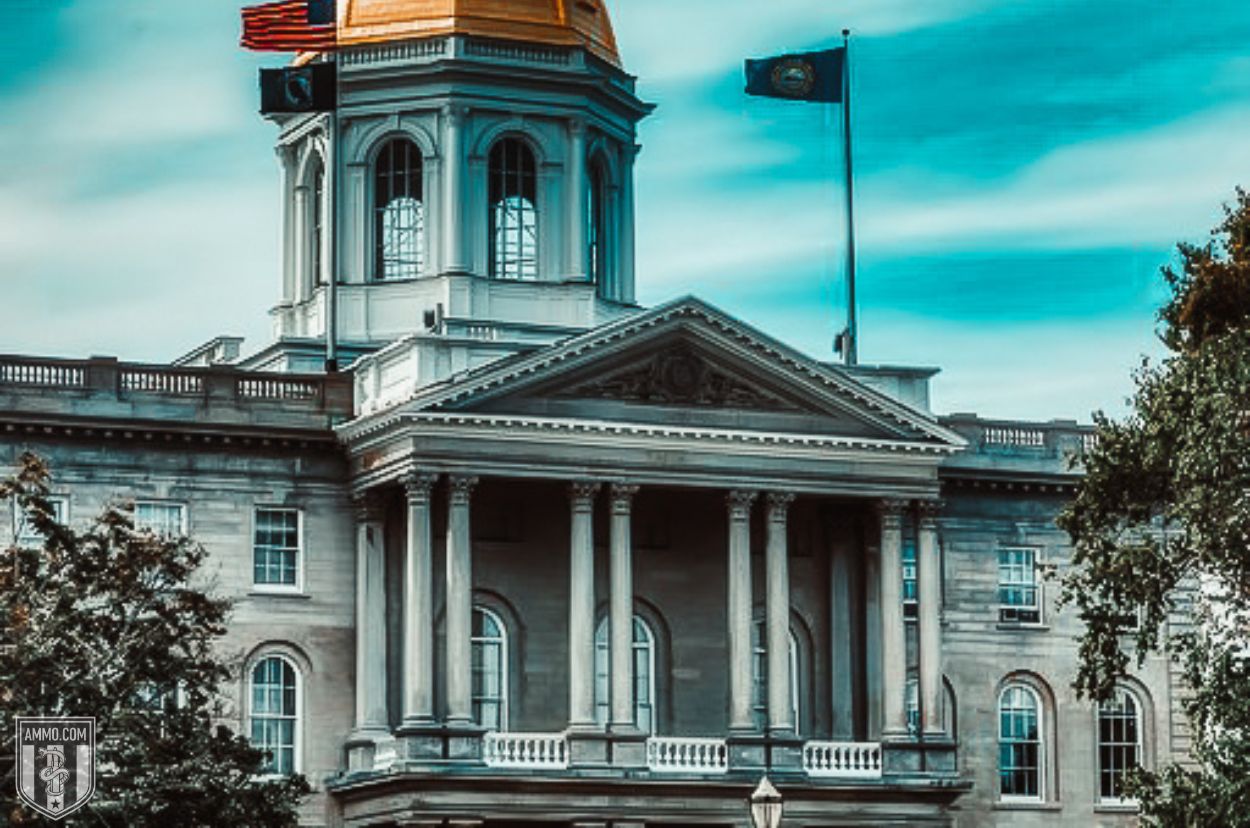
New Hampshire is a Constitutional Carry state with incredibly relaxed gun laws and low crime rates. Any citizen over 18 years old who is lawfully permitted to possess a firearm can open and concealed carry. New Hampshire residents can travel to 29 other states with a pistol and revolver license94. The state also honors all 50 states’ permits.
Residents won’t need to attend firearms safety courses, go through a fingerprinting process, or any other stringent tests to obtain a permit. The state also issues permits95 to out-of-state residents, although they’re only valid in NH. Purchasers are required to pass federal background checks in accordance with federal law.
But what’s better is that New Hampshire currently doesn’t have a state sales tax96. So you won’t pay additional taxes on firearms purchases. Those finding themselves in a self-defense situation may be protected from prosecution if they are protecting life or property, with no duty to retreat.
Although New Hampshire’s governor, Kelly Ayotte, has expressed some support for strengthening mental health policies, the governor’s history on gun control legislation is consistent with a pro-2A governor.
#1 West Virginia
In 2026, West Virginia is easily the most gun-friendly state! Those over the age of 21 enjoy Constitutional Carry freedoms (open and concealed), while those over 18 can apply for a provisional CHL. The state offers CHLs (Carry Handgun Licenses) that are valid in 38 other states, while those traveling from all 50 states are permitted to carry firearms with their state’s licenses. Residents will need to pass a gun safety course to obtain a CHL.
West Virginia doesn’t require additional background checks (aside from federal ones), and there’s no need to register firearms. Citizens may also be protected from criminal and civil liability under the state’s stand-your-ground laws. There’s also no duty to retreat, and the state doesn’t collect taxes on firearm sales.
West Virginia’s Governor, Patrick Morrisey, supports Second Amendment rights and supports legislation that protects manufacturers while campaigning for residents’ gun rights.
Ranking Factors: What Did We Measure?
There is a philosophical divide that underpins debate on legal gun ownership in the U.S. To understand that divide, it's useful to keep one key metric in mind: Civilians possess an estimated 500 million guns in the U.S., according to the NSSF97. How many of those guns are legally owned vs. illegally owned isn't clearly defined yet how lawmakers calibrate their efforts to uphold the rights codified in our Bill of Rights and promote public safety must start with that metric in mind.
Why is this? Because on one side you have lawmakers who celebrate passing more laws restricting legal gun ownership irrespective of their past efforts and often do so citing heinous acts which are already illegal as justification for their additional legislative efforts. Based on their actions, it's fair to conclude this side doesn't like civilians legally owning guns - and they want fewer guns in America, period. Thus they make it harder for their constituents to legally exercise their Constitutional right to keep and bear arms.
On the other side, you have lawmakers who believe in empowering their constituents to protect themselves and their property from illegal acts. Violating a restraining order is a crime in all 50 states. Yet how the victim defends themself against the perpetrator belies a hard truth: Are they allowed to protect themselves from an illegal act with a firearm they legally own? It often depends on where they live in.
In certain states, you have lawmakers seeking to expand legal access to firearm ownership because they believe that "the only thing which stops a bad guy with a gun is a good guy with a gun". In other states, you have lawmakers who believe that more laws, not more legally-owned guns in the hands of their constituents, is the best option to combat violent crime.
Once you understand this philosophical divide, then ranking the U.S. states according to their recent legislative efforts in support of legal gun ownership becomes a clearer task.
We believe that more legally-owned guns being permitted for use in more places by those who are not convicted felons, severely mentally ill, or substance abusers leads to less violent crime - and thus we've investigated the laws, the taxes, and the lawful usability of firearms to bring you the answer as to which states are the best for legal gun ownership by analyzing the following factors:
- Current Gun Laws
- Current Purchase Laws
- Current CCW Guidelines
- Reciprocity between other states
- Sales Tax
- Current Governor’s voting history
- Stand Your Ground Laws
Your ability to legally use your gun when you need to is as important as your ability to purchase it. If we consider only purchasing requirements, we neglect carrying requirements and use of force thresholds. Thus it's important to look at each state's current laws for language regarding Stand Your Ground and Duty to Retreat because they are defined differently.
It's also important to note that, while the Supreme Court of the United States ruled it Constitutional to implement some gun laws, the high court has also made it clear that placing unnecessary hardships on those who wish to exercise their Second Amendment rights is unconstitutional.
Unfortunately, the court used broad terminology and some states still have a plethora of laws, regulations, and restrictions placed on firearm owners. However, many states are moving toward open carry or permitless carry laws, but only time will tell if the states on this list will remain here, or move to our Worst States for Gun Ownership list.
Sources
Sign up to get our latest data studies delivered straight to your inbox.

Infographics
- Are Guns & Ammo The New Gold? Why More Americans Are Arming Themselves
- The Greatest Gun Salesman In America: President Barack Obama
- Shooting Straight: How Both Presidential Candidates Have Changed On Gun Control
- President Obama: (Still) The Greatest Gun Salesman in America
- An Inconvenient Truth: How The Obama Administration Became Earth's Largest Arms Dealer
- Armed Drones: President Obama's Weapon of Choice
- COVID-19 Data Study: Ammunition Sales Continue to Soar in Response to Coronavirus Panic
- Data Study: 18 Months of Ammo Sales during a Pandemic, Protests, and the Biden Presidency
- Data Study: U.S. Ammo Sales Surge Following Russian Invasion of Ukraine
- Most Gun-Friendly States
- Worst States to be a Gun Owner
- Children & Firearms: Definitions and Demographics Make All the Difference
- Urban Violent Crime & Legal Gun Ownership
- Gun-Free School Zone Laws & School Shootings
- Gun Control Laws and Enforcement Trends
- Gun Ownership by State
- How Many Gun Owners are in America?
- Concealed Carry Crime Stats
- Accidental Shooting Statistics: A Review of Unintentional Firearm Deaths
- America's Stolen Guns: A Silent Contributor to Gun Crimes in the U.S.
- Gun Violence Statistics: Comprehensive Look at the Data
- Gun Laws vs. Crime Rates: A Comprehensive Analysis
- Gun Death Statistics by Caliber: A Review of Calibers and Crime
- Anti-Gun Control Arguments: Facts Gun Control Lobby Suppress
- Guns in the Home Statistics: The Effects of Firearms in the Home
- Gun Deaths in the US: Analyzing At-Risk Demographics
- How Many Guns in the U.S.: All About America's Firearms
- Gun Facts in the U.S.: The Reality of Firearms in America
- Defensive Gun Use Statistics: America's Life-Saving Gun Incidents
- Correlation Between Mass Shootings and Prescription Drugs
- Gun Ownership by Gender: Closing the Gender Gap
- Murders by Weapon Type: Statistics
- Gun Violence Among Black Americans: Statistics
- The Ultimate Hunting Caliber Chart: Best Cartridge Per Species
- How Old Do You Have to be to Buy a Gun: A State Guide
- Most Popular Guns in the U.S.: The Must-Have Guns
- Stray Bullet Deaths: Accident and Injury Statistics
- Mass Shooters by Race: Demographics of Assailants
- Ammunition Limits By State: How Much Ammo Can You Buy?
- Why Do Americans Own Guns?
- How Many Americans Want Stricter Gun Laws?
- How Many Households in the U.S. Have a Gun?
- What Percentage of Gun Deaths are Suicides?
- Average Age of Mass Shooters in the U.S.
- Firearm Ownership in America by Year
- US Firearms Deaths Per Year: A Collective Report
- Percentage of Americans Owning Guns
- Texas Gun Ownership: Total Numbers, Trends, and Most Popular Guns
- Gun Ownership Statistics Colorado: Trends & Numbers
- Hunting Accident Statistics (Causes & Trends Per Year)
- Banned Guns & Ammo List: A Review by State
- 3D Printed Gun Laws By State
- How To Build a Home Shooting Range: The Ultimate Guide
- States With the Highest Murder Rates
- Best Self-Defense Weapons for Women
- Easiest States to Buy a Gun
- Cities with the Lowest Crime Rate
- Oregon Homicide Rates
- Chicago Homicide Rate
- How Much Does a Suppressor Reduce Noise
- Texas Homicides: Statistics and Trends
- California Homicides: Rates Per 100K
- Florida Murder Rate: Statistics and Trends
- Gun Ownership by Political Party
- Mass Shooters by Gender
- U.S. Hunting and Fishing Statistics
- Where Are Silencers Illegal? State Suppressor Laws
- How Loud is a Gunshot?
- What States Have the Strictest Gun Control?
- Causes of Mass Shootings in the U.S.
- Ammo Manufacturers List
- How Criminals Get Guns