What States Have the Strictest Gun Control in 2026?
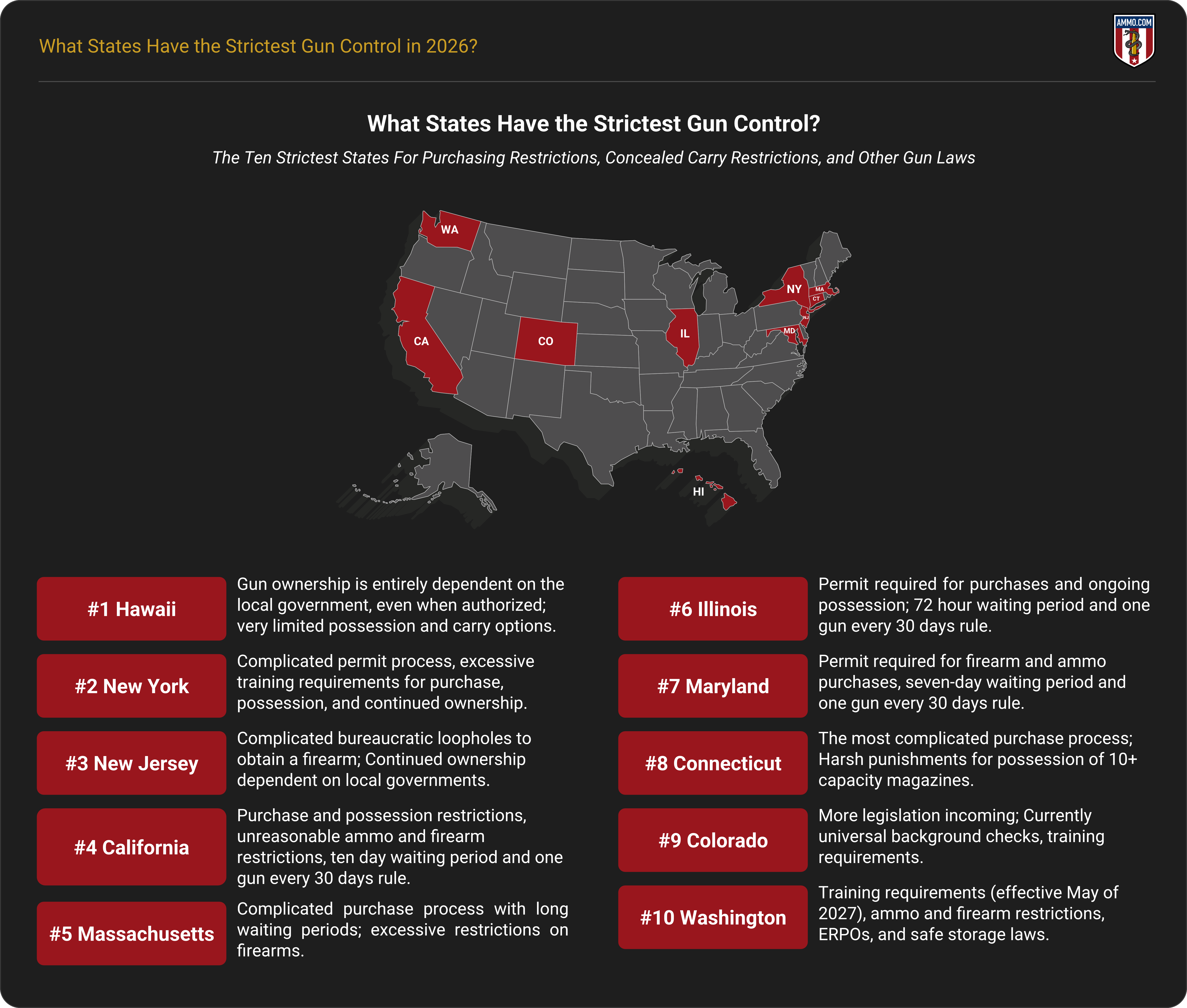
Report Highlights: Gun laws vary by state. Some states have such strict laws that it seems almost impossible to exercise the right to keep and bear arms within their borders.
-
Hawaii has the strictest gun control in the U.S. due to its extreme purchasing and carry restrictions.
-
California, Massachusetts, New Jersey, and New York round out the top five states with the strictest gun control due to restrictions on purchasing, carrying, and possession.
-
Colorado and Washington ranked 9th and 10th because some restrictive legislation had not gone into effect at the time of writing.
Ammo.com provides accurate information from reputable sources. You can view the sources cited in this article.
Methodology
Several U.S. states have restrictive gun laws. States on this list are the strictest according to four parameters:
- Purchasing restrictions – Obstacles to firearm ownership, including purchase permits, waiting periods, background checks, and additional requirements (fingerprinting, renewal timeframes, etc.).
- Accessory, ammunition, and firearm bans or restrictions – The state’s total number of bans and restrictions, as well as how they are implemented and which firearms, ammunition, and magazines they govern.
- Concealed carry restrictions – The process of acquiring a license, the duration of the license, and the state’s reciprocity with other jurisdictions.
- Other gun laws – The scope of the state’s gun control laws, including extreme risk protective orders (ERPOs), safe storage laws, ghost gun bans, dealer requirements, and others.
States are ranked by their cumulative restrictiveness across all categories. Laws that have passed but aren’t yet enacted at the time of writing are noted, but given reduced weight.
All information in this article comes from state government websites and other trusted sources.
States With the Strictest Gun Control Laws
#10: Washington
The trees aren’t the only thing growing in the Evergreen State. Gun control laws grow there, too.
Washington has universal background checks, which require background checks for all firearm purchases. In 2025, a law was passed requiring anyone who wants to purchase a firearm to complete a live-fire training course and obtain a permit (takes effect in May 2027). This state also has a 10-day waiting period before buyers can take possession of their firearm.
Washington restricts the sale, manufacture, and import of certain semi-automatic rifles with detachable magazines. Selling or distributing magazines with a capacity of more than 10 rounds is prohibited, as are several firearm parts (e.g. bump stocks, binary triggers, and other rapid-fire devices). “Ghost guns” are banned in Washington, while 3D-printed firearms are restricted.
Open carry is legal in Washington for anyone over 21 and legally allowed to possess a firearm. A Concealed Pistol License is required for concealed carry, which may be authorized by local law enforcement after an application process. This state honors permits from 10 other states, so visitors may be allowed to conceal carry.
Washington has safe storage laws. Gun owners may face criminal liability should a prohibited person or minor unlawfully discharge their firearm. The state also issues ERPOs that allow family members and law enforcement to petition the court to remove an individual’s firearms.1, 13, 14, 16
#9: Colorado
The Centennial State may currently rank ninth on this list, but at the rate its legislators are going, it’s on the fast track to the top.
Coloradans must submit to the government for nearly every aspect of gun ownership. The state requires universal background checks for all firearm transfers. To purchase a semi-automatic firearm with a detachable magazine in Colorado, you must first complete a training course. Upon completion of the course, you receive a card authorizing a purchase attempt. Then, you need to submit to background checks. You’ll only get a firearm if the dealer obtains authorization from the state (not just the federal government). When you purchase it, you have to wait three days before picking it up.
A Concealed Handgun Permit is required for concealed carry in public places. To obtain a permit, residents must complete an eight-hour training course with live-fire training. Like other states on this list, Colorado has many sensitive locations where even permit holders aren’t allowed to carry. Colorado honors 33 other states’ concealed carry permits, so there’s a good chance visitors can carry.
The state recently adopted new firearm restrictions, including heavy restrictions on detachable magazines for semi-automatic firearms. Magazines with a capacity over 15 rounds cannot be purchased or transferred. Retailers in other states are prohibited from selling such magazines to Colorado residents.
If a minor or prohibited person resides in a home with a firearm present, the state’s safe storage laws require it to be locked in a container out of plain view.
Even if you jump through every hoop, your gun ownership status remains dependent on the state’s ERPO laws, which allow family members, law enforcement officers, educators, medical professionals, and behavioral health center personnel to petition to have firearms removed.1, 12
#8: Connecticut
Ironically, the Constitution State is one of the chief aggressors against the Second Amendment.
Before purchasing a firearm or ammunition, Connecticut residents need to follow the state’s process to obtain a permit. That process is exhaustive and complicated.
Connecticut requires a mix of temporary and 5-year permits for various activities. It assigns an Eligibility Certificate for long gun purchases, an Eligibility Certificate for pistol or revolver purchases, and a permit to carry. This state employs universal background checks and caps handgun purchases at three per month.
Connecticut has a comprehensive “assault weapons” ban on specific firearms, including semi-automatic rifles and pistols with detachable magazines plus one prohibited feature. Possession of unregistered magazines is a Class D felony. Magazines with a capacity of more than 10 rounds are banned. So too are ghost guns, as well as any semi-automatic firearm that can potentially be converted to automatic.
Open carry is banned in Connecticut. A Connecticut Pistol Permit is available to those who are legally allowed to carry a concealed handgun and have received permission from local law enforcement. Applicants for a 60-day temporary permit must obtain a training certificate, submit to a background check and fingerprinting, and provide a government ID and passport-style photo. While the 60-day permit is still valid, the applicant must apply for the 5-year permit (which also acts as an Eligibility Certificate for firearm and ammunition purchases). Either permit is still subject to laws banning concealed carry in certain locations (schools, government buildings, etc.).
Connecticut’s expansive safe storage laws dictate how firearms must be secured regardless of the presence of minors. In addition to ERPO legislation, the state has a Deadly Weapon Offender Registry requiring anyone convicted of an offense with a deadly weapon to register their personal information and appear before law enforcement annually.1, 10, 11
#7: Maryland
Maryland ratified the Bill of Rights in 1798. If current legislators had their way, their state would have omitted the Second Amendment.
Prospective gun and ammunition buyers in Maryland must obtain state permission before proceeding with the purchase. Buyers must obtain a Handgun Qualification License before purchasing a handgun, which requires a background check, fingerprinting, and mandatory training classes. Buyers must wait 7 days before taking possession of a firearm, and are limited to purchasing one regulated firearm every 30 days. All firearm transfers in Maryland are subject to the state’s universal background check laws.
This state has banned “assault weapons,” “assault pistols,” and “copycat guns.” Federal Firearms License (FFL) dealers in Maryland can only sell firearms listed on an approved roster. “Ghost guns” are banned, as are magazines with a capacity of over 10 rounds.
Gun owners must comply with the state’s safe storage laws by ensuring all firearms are secured within their homes or vehicles. ERPOs allow family members, housemates, education administrators, and medical professionals to file petitions for the removal of firearms.9
#6: Illinois
The Prairie State is notorious for two things: gun control and gun violence. Unfortunately, the former has yet to stop the latter.
Whether you want to purchase or possess a firearm or ammunition in Illinois, you need a Firearm Owner’s Identification (FOID) card, which requires a background check. Illinois requires universal background checks, which in turn necessitate FFL dealer involvement in all private sales. State law requires purchasers to wait 72 hours before taking possession of a new gun. Handguns may only be purchased once every 30 days.
A FOID card doesn’t exempt residents from Illinois’ many restrictions on certain firearms and accessories. The state restricts the transfer of “assault rifles” and .50 caliber rifles (though new restrictions do include a grandfather provision). Suppressors, rifle magazines with a capacity of more than 10 rounds, and handgun magazines with a capacity of more than 15 rounds are prohibited.
Illinois requires residents to acquire a separate Concealed Carry License (CCL) before packing heat on the street. This license requires 16 hours of training and does not permit open carry. Like most states on this list, Illinois defines multiple sensitive locations where CCL holders cannot carry their firearms.
Illinois’ safe storage laws require all firearms to be locked and secured when minors or prohibited people are around. Continued gun ownership is dependent on ERPO laws, and the state can revoke or suspend any FOID card.8
#5: Massachusetts
Massachusetts has fallen far from its rebellious roots. The state that once harbored the greatest pro-liberty party of all time now has restrictions galore.
The Bay State requires licenses to purchase and possess firearms. Before going to a gun store, a resident must take a firearm safety course, submit to a background check, log their fingerprints, and obtain approval from local law enforcement. It can take one or two months to receive a Firearm Identification Card, which allows residents to purchase or possess certain types of long guns (e.g. bolt, pump, or lever action). The state’s License to Carry (LTC) is required before purchasing pistols, handguns, or semi-automatic firearms. All firearm transfers must be reported to the authorities and accompanied by a universal background check.
Upon obtaining approval to purchase a firearm, it’s time to decide which state-sanctioned model you’ll have. Massachusetts has a roster of handgun models that dealers are permitted to sell. “Assault weapons” and “ghost guns” are prohibited. Trigger modification devices, “copycat guns”, and magazines with a capacity of more than 10 rounds are also restricted.
If you want to conceal carry your gun in public, you’ll need an LTC. Like other states on this list, there’s a growing list of sensitive locations where LTCs aren’t valid. Massachusetts does not honor other states’ concealed carry permits or licenses.
Massachusetts regulates how firearms are stored in homes and vehicles under safe storage laws. It also has ERPO legislation authorizing courts to confiscate firearms if the owner is deemed a threat to themself or others.1, 4, 5
#4: California
The Golden State strongly opposes lead and brass.
If you enjoy bureaucratic rigamarole, then you’ll love California’s purchasing laws. Before visiting an FFL dealer (which is also heavily regulated), you’ll need a Firearm Safety Certificate proving you’ve successfully completed a training course. State legislation requires universal background checks before each purchase. You’ll have to wait 10 days from the purchase date to actually acquire your firearm. If you want to buy multiple firearms, you’ll have to wait 30 days between each purchase. You also need to pass a background check to purchase ammunition.
After you’ve received authorization to make a purchase, you’re restricted by the state’s gun bans and limitations. California restricts “assault weapons”, and many newer semi-automatic handgun models are blocked due to microstamping requirements. Magazines that hold more than 10 rounds are banned, as are suppressors, trigger modifications, and .50 BMG rifles. If you want to make a firearm for personal use, the state’s “ghost gun” legislation requires background checks before purchasing barrels and receivers.
After you’ve obtained your firearm and ammunition, you’ll have to take more training courses to apply for a Concealed Carry Weapons license. Should the state choose to issue a permit to you, you still cannot carry in any of the state’s long list of prohibited places (parks, libraries, hospitals, churches, financial institutions, etc.). You’ll need to apply for a concealed carry permit again in three or four years (depending on the date of acquisition). California doesn’t honor other states’ concealed carry permits or licenses, so visitors don’t have an option to carry in public.
Have you done everything the state has required of you, and now have an approved firearm and ammunition? Don’t get comfortable. California legislates how and where you can store your firearm in your own home via safe storage legislation. Your status as a gun owner will forever be subject to ERPO laws, which authorize even employers and coworkers to report you for firearm confiscation.1, 2
#3: New Jersey
The Garden State has a bumper crop of gun control legislation. Understanding which permits are needed to purchase a firearm in New Jersey is only half the battle. The other half is actually getting them.
If you’d like to purchase a rifle, shotgun, or ammunition, you’ll need to complete an online application, submit fingerprints, and get approval from local law enforcement before obtaining a Firearms Purchaser Identification Card (FID). If you want a handgun, you’ll need to pass a background check, submit to a mental health records search (if you moved to NJ within the past 10 years), provide fingerprints, and get approval before obtaining a Permit to Purchase. These permits last only 180 days, and you need one for every handgun you want to buy.
New Jersey’s strict gun laws include a myriad of bans and restrictions. Like many others, this state bans “assault weapons”, magazines with a capacity of more than 10 rounds, and “ghost guns.” New Jersey also imposes microstamping requirements on new handgun models and restricts transportation and public use of hollow point ammunition.
You obtained your FID and Permit to Purchase; now you want to conceal carry your firearm in public places. Before doing so, you must undergo additional background checks and training, submit a passport-type photo, and submit to a mental health records search to obtain a Permit to Carry. It is valid for only two years, and isn’t valid in any of the state’s sensitive locations. The state doesn’t honor any other state’s concealed carry permits, either.
When you’re a gun owner in New Jersey, the state has authority over how your guns are stored in your home and vehicle. Your status as a gun owner is also dependent on ERPO laws, which authorize law enforcement and family members to petition for removal.6
#2: New York
The Empire State is empirically opposed to the Second Amendment.
You’ll have to take an 18-hour training course and obtain approval for a New York Pistol License (NYPL) before purchasing a handgun. Every firearm transfer (with the exception of those within immediate family) must involve an FFL dealer and follow a background check. Those authorized to sell ammunition must run a background check on the purchaser before handing it over.
You can’t purchase just any accessories, ammunition, or firearms in New York. The state has banned “assault weapons,” magazines with a capacity of more than 10 rounds, suppressors, and armor-piercing ammunition. “Ghost guns” are also illegal, as is manufacturing your own firearms.
After you’ve obtained your gun, you may be able to carry it in public places with your NYPL. Just beware of New York’s long list of sensitive locations (government and healthcare locations, education locations, entertainment locations, etc.). New York does not honor other states’ concealed carry permits. Visitors can’t legally carry without first obtaining an NYPL.
New York City has even more restrictions, but residents of other areas still experience significant government overreach regarding firearm ownership requirements. The state’s safe storage laws dictate how firearms must be stored in homes and vehicles. Its ERPO laws authorize law enforcement officers to seize firearms following petitions from family members.1, 3
#1: Hawaii
The Aloha State has said “aloha” to the Second Amendment and “aloha” to circumventing Supreme Court orders.
Before purchasing a firearm, you’ll need a Permit to Acquire, which can’t be issued within 14 days of submitting the application. The state has only 20 days to approve or deny it. You’ll need a permit for long gun purchases (valid for one year) and a permit for each handgun purchase. These permits require four hours of classroom training and two hours of live-fire training. Before a local police department issues a permit, applicants must submit to a mental health background check, a criminal background check, and fingerprinting, as well as produce a recent photo. You’ll need to register your firearms within five days of purchase. FFL dealers are required to view a state-issued ID before selling ammunition.
Choosing which firearm to buy is relatively simple, given that this state has banned so many features across all firearm types. “Assault rifles,” “assault shotguns,” and “assault pistols” are banned. So too are .50 caliber rifles, and handguns with a melting point lower than 800°F. Magazines with a capacity of more than 10 rounds are banned (even if they’re older), as are suppressors.
After you’ve obtained a firearm and some ammunition, it’s time to consider carrying in public places. You’ll need a License to Carry (LTC), which requires training, a criminal background check, two passport-sized color photos, and a mental health background check. Even if you’re issued an LTC, the state’s list of sensitive places makes it challenging to carry a firearm in public or on private property. If you’re visiting Hawaii, your state’s concealed carry permit is not valid.
Hawaii has safe storage laws requiring firearms to be locked and secured away from unauthorized individuals. Worse yet, the state reserves the right to revoke your Permit to Acquire for cause. If this happens, you must surrender all firearms in your possession to law enforcement.1, 7
States With the Strictest Ammunition Laws
#1: Maryland
Maryland requires permits for ammunition purchases. The state also bans “high-capacity” magazines (more than 10 rounds) and various types of ammunition.
#2: Connecticut
Connecticut requires a permit for purchasing ammunition. The state also bans “high-capacity” magazines (more than 10 rounds).
#3: Illinois
Illinois requires a FOID card for all ammunition purchases. The state also restricts magazine capacities (more than 10 rounds for rifles; more than 15 rounds for handguns), as well as armor-piercing and other types of ammunition.
#4: New Jersey
New Jersey requires an FID for ammunition purchases. The state also heavily restricts the use of hollow point bullets and “large-capacity” magazines (more than 10 rounds).
#5: Hawaii
Hawaii does not require a permit for ammunition purchases, but it does heavily regulate ammunition. Ammunition cannot be shipped to individuals in Hawaii. Handgun magazines are limited to 10 rounds, and various bullets are banned (teflon coated, armor piercing, etc.).
Strictest Gun Law States vs. Gun Deaths
Among the 10 states with the strictest gun laws in the U.S., gun death rates ranged from 3.8 to over 16 per 100,000 people from 2018 to 2024. These states had a collective average gun death rate of 8.4 per 100,000 people. Colorado (16.5 per 100,000), Illinois (13.0 per 100,000), Maryland (12.7 per 100,000), and Washington (11.8 per 100,000) had rates well above the national average.15
Hawaii (4.4 per 100,000), Massachusetts (3.8 per 100,000), New Jersey (4.7 per 100,000), and New York (4.8 per 100,000) had the lowest gun death rates of the 10 strictest gun law states from 2018 through 2024.15
California (8.2 per 100,000) and Connecticut (6.1 per 100,000) fell in the middle of the range during the same period.
Note: Gun deaths include suicides, homicides, justifiable homicides, unintentional shootings, legal intervention, and operations of war per the CDC WONDER database.
Wrap-Up
The strictest gun law states in the U.S. are Hawaii, New York, New Jersey, California, Massachusetts, Illinois, Maryland, Connecticut, Colorado, and Washington. From purchasing to carrying in public to permissible firearms to ongoing ownership, the states in this article have missed virtually zero opportunity to regulate.
Sources
- Concealed Carry & Reciprocity Lawsusconcealedcarry.com
- Overview of Key California Firearm Lawsoag.ca.gov
- Gun Safety in NYS: Resources for Gun Ownersgunsafety.ny.gov
- Massachusetts Firearm Lawsmass.gov
- NJ Gun Lawsnj.gov
- Hawaii Gun Lawshawaiirifleassociation.org
- Current Gun Laws in Illinoisoneaimil.org
- Maryland Department of State Police: Firearm FAQsmdsp.maryland.gov
- Connecticut: Summary of State Gun Lawscga.ct.gov
- Colorado Gun Lawspublicsafety.colorado.gov
- Washington State: Firearmsatg.wa.gov
- Washington: Unsafe Storage of Firearmsapp.leg.wa.gov
- CDC WONDER: Underlying Cause of Death (2018-2024)wonder.cdc.gov

Infographics
- Are Guns & Ammo The New Gold? Why More Americans Are Arming Themselves
- The Greatest Gun Salesman In America: President Barack Obama
- Shooting Straight: How Both Presidential Candidates Have Changed On Gun Control
- President Obama: (Still) The Greatest Gun Salesman in America
- An Inconvenient Truth: How The Obama Administration Became Earth's Largest Arms Dealer
- Armed Drones: President Obama's Weapon of Choice
- COVID-19 Data Study: Ammunition Sales Continue to Soar in Response to Coronavirus Panic
- Data Study: 18 Months of Ammo Sales during a Pandemic, Protests, and the Biden Presidency
- Data Study: U.S. Ammo Sales Surge Following Russian Invasion of Ukraine
- Most Gun-Friendly States
- Worst States to be a Gun Owner
- Children & Firearms: Definitions and Demographics Make All the Difference
- Urban Violent Crime & Legal Gun Ownership
- Gun-Free School Zone Laws & School Shootings
- Gun Control Laws and Enforcement Trends
- Gun Ownership by State
- How Many Gun Owners are in America?
- Concealed Carry Crime Stats
- Accidental Shooting Statistics: A Review of Unintentional Firearm Deaths
- America's Stolen Guns: A Silent Contributor to Gun Crimes in the U.S.
- Gun Violence Statistics: Comprehensive Look at the Data
- Gun Laws vs. Crime Rates: A Comprehensive Analysis
- Gun Death Statistics by Caliber: A Review of Calibers and Crime
- Anti-Gun Control Arguments: Facts Gun Control Lobby Suppress
- Guns in the Home Statistics: The Effects of Firearms in the Home
- Gun Deaths in the US: Analyzing At-Risk Demographics
- How Many Guns in the U.S.: All About America's Firearms
- Gun Facts in the U.S.: The Reality of Firearms in America
- Defensive Gun Use Statistics: America's Life-Saving Gun Incidents
- Correlation Between Mass Shootings and Prescription Drugs
- Gun Ownership by Gender: Closing the Gender Gap
- Murders by Weapon Type: Statistics
- Gun Violence Among Black Americans: Statistics
- The Ultimate Hunting Caliber Chart: Best Cartridge Per Species
- How Old Do You Have to be to Buy a Gun: A State Guide
- Most Popular Guns in the U.S.: The Must-Have Guns
- Stray Bullet Deaths: Accident and Injury Statistics
- Mass Shooters by Race: Demographics of Assailants
- Ammunition Limits By State: How Much Ammo Can You Buy?
- Why Do Americans Own Guns?
- How Many Americans Want Stricter Gun Laws?
- How Many Households in the U.S. Have a Gun?
- What Percentage of Gun Deaths are Suicides?
- Average Age of Mass Shooters in the U.S.
- Firearm Ownership in America by Year
- US Firearms Deaths Per Year: A Collective Report
- Percentage of Americans Owning Guns
- Texas Gun Ownership: Total Numbers, Trends, and Most Popular Guns
- Gun Ownership Statistics Colorado: Trends & Numbers
- Hunting Accident Statistics (Causes & Trends Per Year)
- Banned Guns & Ammo List: A Review by State
- 3D Printed Gun Laws By State
- How To Build a Home Shooting Range: The Ultimate Guide
- States With the Highest Murder Rates
- Best Self-Defense Weapons for Women
- Easiest States to Buy a Gun
- Cities with the Lowest Crime Rate
- Oregon Homicide Rates
- Chicago Homicide Rate
- How Much Does a Suppressor Reduce Noise
- Texas Homicides: Statistics and Trends
- California Homicides: Rates Per 100K
- Florida Murder Rate: Statistics and Trends
- Gun Ownership by Political Party
- Mass Shooters by Gender
- U.S. Hunting and Fishing Statistics
- Where Are Silencers Illegal? State Suppressor Laws
- How Loud is a Gunshot?
- What States Have the Strictest Gun Control?
- Causes of Mass Shootings in the U.S.
- Ammo Manufacturers List
- How Criminals Get Guns