Causes of Mass Shootings: A 2026 Review
Report Highlights: Mass shootings have increased substantially in the U.S. over the past four decades. This report analyzes the behavioral patterns of mass shooters.
-
Between 1966 and 2025, 81.2% of shooters were in a documented crisis before the event.
-
While 51.0% of mass shooters had prior symptoms of mental illness, 68.2% had a history of domestic violence or targeted at least one member of their family.
-
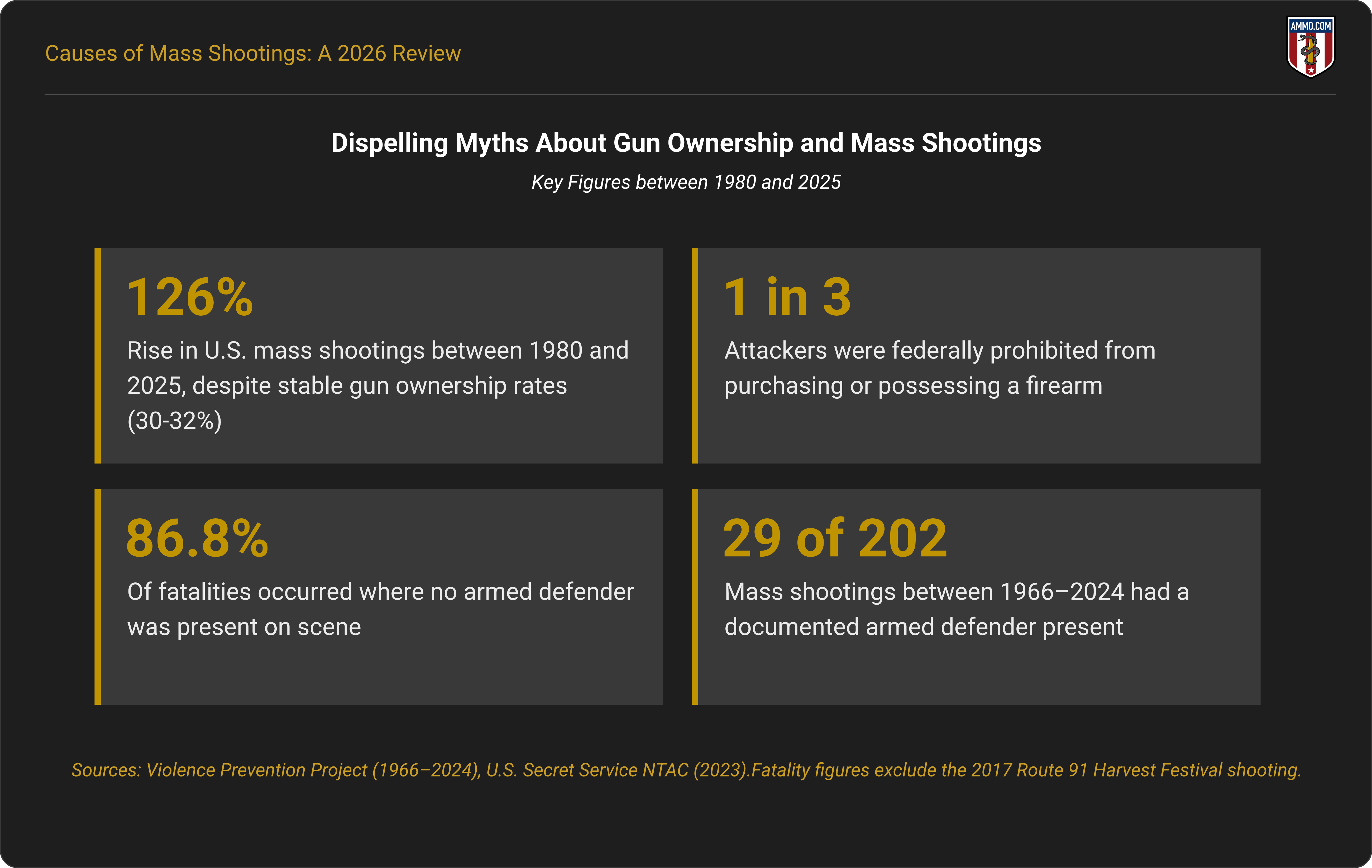
Gun ownership has remained stable (30%-32% of the U.S. population) between 1980 and 2025, while mass shootings have increased by 126.0%.
Ammo.com provides accurate data from reputable sources. You can view the sources used in this article.
Methodology
This report draws on behavioral and environmental information from mass-shooting databases, peer-reviewed literature, and government reports. The Violence Prevention Project (VPP) defines mass shootings as four or more fatalities unconnected to family or dispute-related violence. Mother Jones' shooter database catalogs mass and spree shootings with three or more fatalities, including family and dispute-related violence in public places. The U.S. Secret Service (USSS) National Threat Assessment Center's definition of mass attacks includes attacks in which no firearms were used; this is noted where data are cited.
This analysis counts shooters rather than incidents because the primary behavioral patterns leading up to an act of violence are individual attributes. In incidents with multiple shooters, each shooter's behavioral patterns were examined.
The 2017 Route 91 Harvest music festival was the deadliest mass shooting in U.S. history. This shooting was treated as an outlier in the sections below due to the circumstances of the event and the increased number of fatalities and injuries.
Several variables coded in the VPP apply to multiple shooters simultaneously. Percentages may not sum to 100 due to multiple factors in a single shooter. This report relies heavily on behavioral evidence, which may not be available for several shooters. Missing behavioral patterns may not mean the behavior wasn't present. They simply indicate there was no evidence of it.
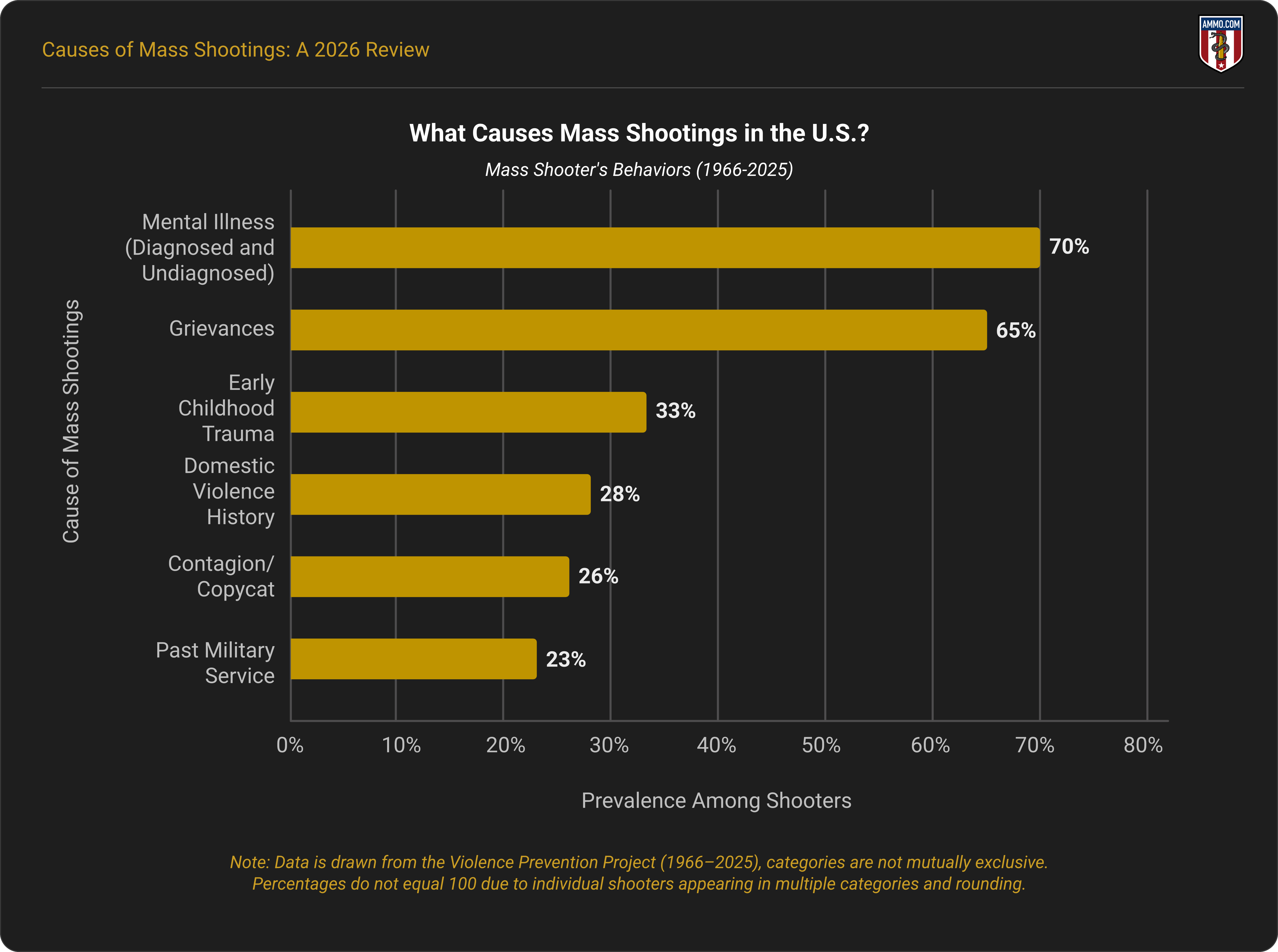
Mental Health & Suicidal Ideations
Data on varying levels of mental illness exist in databases and research literature. Across databases, more than half of mass shooters had prior signs of mental illness, such as depression, while smaller portions experienced psychosis.
Of the 160 mass and spree shooters identified by Mother Jones between 1982 and 2026, 81 (51%) had a prior history of mental illness. Seventeen shooters (11%) had no prior signs of mental illness, and 62 (39%) of the shooters' mental health history was unknown.2
The VPP examined 202 mass shooters between 1966 and 2025. Of those, 141 (70%) had a documented mental health issue (diagnosed or undiagnosed). Seventy-three (36%) intended to die during the shooting. Sixty-six (33%) had a prior history of suicidality. There was no evidence of suicidality in 63 (31%) shooters.1, 6
Most shooters (81.2%) displayed signs of crisis, including recent stressors, triggering events, inability to perform daily tasks, mood swings, unusual calm or happy, abusive behavior, aggravation, isolation, paranoia, depression, or previous contact with mental health professionals or law enforcement.1
Of the 202 shooters listed in the VPP database, 164 (81% of shooters) showed signs of crisis. Of those, 63 (38.4%) had been showing signs for years, 50 (30.5%) for months, 24 (14.6%) for weeks, and 23 (14.0%) for days. Timeframe data for three shooters were unavailable.1
According to a USSS report released in 2023, 58% of attackers who targeted civilians in public places had a history of mental health symptoms. Of those, 62% experienced depression, 25% had suicidal thoughts, and 28% had a history of psychosis (e.g. paranoia, delusions, and hallucinations). Although these attacks varied in weapon type, the findings align with other research, which shows that more than half of those who attacked innocent civilians in public spaces had suicidal ideations, while a few experienced psychosis.3
Grievances (Social/Personal)
Of the 202 mass shooters in the VPP database, 132 (65.3%) had at least one grievance (hate/prejudice, employment, relationship, and interpersonal conflict) listed for their motive. Employment-related grievances were recorded in 43 shooters (21.3%).1
Grievance-related motives also included 40 with an interpersonal conflict (19.8%), 34 with hate or prejudice (16.8%), and 27 with relationship grievances (13.4%).
The Mother Jones database does not track grievances. The USSS National Threat Assessment Center's 2023 report suggests that of the 173 public attacks in the U.S. between 2016 and 2020, 68% of attackers did not target a specific individual. Only 32% of attackers had at least one specific target.3
Contagion/Copycat Effects
Research suggests that mass shootings are often a result of a contagion or copycat effect, where one attack inspires one or more subsequent attackers. A 2015 study by Towers et al. found that each mass shooting incites an average of at least 0.22 additional shootings within 13 days.7
Another study by Boyd and Molyneux (2021) expanded on Towers' methodology and found that the contagion effect may be up to three times greater than originally estimated. Roughly 77% of shootings studied occurred after the elevated-risk window of 13 days previously cited in the Towers study.4
The VPP's database shows that 53 of the 202 mass shooters (26.2%) between 1966 and 2025 had an interest in other mass shooters, while 15 were identified as seeking fame.1
Early Childhood Trauma/Domestic Abuse
According to the VPP's database, about 68% of mass shooters had documented proof of early childhood trauma or abuse. However, the shooters were much more likely to have a documented history of being a violent aggressor than they were to have experienced violence.1, 6
More than half (62.8%) of shooters had a documented history of violence, including domestic violence (27.9%).
According to Geller, Booty, and Crifasi (2021), who used a broad definition of mass shootings, 68.2% of mass shootings with three or more fatalities were perpetrated by someone who was targeting family member(s) or had a documented history of domestic violence.5
Past Military Service
Documented prior military service was associated with 47 of 202 (23.3%) mass shooters between 1966 and 2025.1 An additional six shooters (3.0%) reportedly had joined the military but did not complete training.
Mass shooters who served in the military had a collective average of 7.3 fatalities and 7.4 injuries. Those who signed up for military service but did not complete training had a collective average of 6.3 fatalities and 6.2 injuries.1
Those who had no prior military experience had a fatality rate similar to those who did serve (7.1 average), but a much higher injury rate (12.5 average).
Prior military service alone does not indicate a higher likelihood of mass shootings. Civilian mass shooters with no prior military experience have similar fatality rates as their veteran counterparts.
Dispelling Myths About Gun Ownership and Mass Shootings
Though its firearm ownership rate has remained stable in recent years, the rate of mass shootings in the U.S. has increased. Furthermore, the effects of armed defenders on mass shootings remain to be seen (due to the low likelihood that an armed defender will be present when a mass shooter acts). However, factors contributing to mass shootings have made themselves evident.
Gun Ownership Rate and Mass Shooting Prevalence in the U.S.
The rate of gun ownership in the U.S. remained relatively stable (30% to 32%) between 1980 and 2025. The rate of mass shootings from 1980 to 2025 increased by 126%. In the 1980s, there were 2.3 mass shootings per year, compared to 5.5 shootings per year in the 2010s, and 5.2 per year in the 2020s.
Firearm Acquisition and Mass Shootings
Most shooters cataloged in the VPP database obtained their weapons legally (64.0%).1 According to the USSS National Threat Assessment Center report released in 2023, only one-third of attackers were federally prohibited from purchasing or possessing a firearm.3
Fatalities in Mass Shootings Where Armed Defenders Were Present
Between 1966 and 2025, there were 1,446 fatalities and 2,246 injuries related to mass shootings (defined as targeted shootings with four or more fatalities in public places where family and dispute-related violence were excluded).1
Of these documented shooters, one accounted for 25.1% of all victims (the 2017 Route 91 Harvest music festival in Las Vegas). Excluding that single shooter, 86.8% of the remaining fatalities and 81.4% of the remaining injuries took place where no armed defenders were on scene.
There were 29 shootings between 1966 and 2025 where a documented armed defender was present at the time of the shooting. Of those, 21 involved law enforcement or professional armed defenders, 7 involved armed civilians, and 1 included a combination of professional and civilian defenders on scene. The remaining shootings occurred in areas where no armed defenders were present.1
Excluding the 2017 Route 91 Harvest festival in Las Vegas, in which the shooter fired from an elevated position into a crowd of 22,000 people, incidents where armed professionals were on-scene averaged 6.2 fatalities and 9.4 injuries per shooter. Incidents where only armed civilians were on-scene averaged 7.6 fatalities and 9.1 injuries per shooter.
Incidents with no armed defenders on scene averaged 7.0 fatalities and 6.5 injuries per shooter. The single incident where armed civilians and professionals were on-scene had the lowest rate of fatalities (5.0) and injuries (4.0).1
Note: Only shootings with four or more fatalities in a public place were counted as mass shootings in this category. Cases where armed defenders deterred or stopped a shooter before reaching the fatality threshold are not counted in this section.
Wrap-Up
Mass shootings in the U.S. have been increasing in frequency and fatalities since the 2010s. Behavioral patterns such as mental health crises, leakage (telling someone they're going to commit an act of violence), family violence, and grievances are common precursors to these violent acts. The contagion effect also appears to increase the rate of mass shooting incidents.
Research is sparse on the effects of armed defenders on mass shooting fatalities and injuries. Evidence does suggest that firearm access is not a quantifiable measure of an individual's likelihood to commit a targeted attack.
Sources
- Violence Prevention Project: Mass Shooter Databasetheviolenceproject.org
- Mother Jones: US Mass Shootings, 1982-2026motherjones.com
- Mass Attacks in Public Spaces 2016-2020secretservice.gov
- The role of domestic violence in fatal mass shootings in the United States, 2014-2019pubmed.ncbi.nlm.nih.gov
- Violence Prevention Project: Key Findingstheviolenceproject.org
- Contagion in Mass Killings and School Shootingsjournals.plos.org

Infographics
- Are Guns & Ammo The New Gold? Why More Americans Are Arming Themselves
- The Greatest Gun Salesman In America: President Barack Obama
- Shooting Straight: How Both Presidential Candidates Have Changed On Gun Control
- President Obama: (Still) The Greatest Gun Salesman in America
- An Inconvenient Truth: How The Obama Administration Became Earth's Largest Arms Dealer
- Armed Drones: President Obama's Weapon of Choice
- COVID-19 Data Study: Ammunition Sales Continue to Soar in Response to Coronavirus Panic
- Data Study: 18 Months of Ammo Sales during a Pandemic, Protests, and the Biden Presidency
- Data Study: U.S. Ammo Sales Surge Following Russian Invasion of Ukraine
- Most Gun-Friendly States
- Worst States to be a Gun Owner
- Children & Firearms: Definitions and Demographics Make All the Difference
- Urban Violent Crime & Legal Gun Ownership
- Gun-Free School Zone Laws & School Shootings
- Gun Control Laws and Enforcement Trends
- Gun Ownership by State
- How Many Gun Owners are in America?
- Concealed Carry Crime Stats
- Accidental Shooting Statistics: A Review of Unintentional Firearm Deaths
- America's Stolen Guns: A Silent Contributor to Gun Crimes in the U.S.
- Gun Violence Statistics: Comprehensive Look at the Data
- Gun Laws vs. Crime Rates: A Comprehensive Analysis
- Gun Death Statistics by Caliber: A Review of Calibers and Crime
- Anti-Gun Control Arguments: Facts Gun Control Lobby Suppress
- Guns in the Home Statistics: The Effects of Firearms in the Home
- Gun Deaths in the US: Analyzing At-Risk Demographics
- How Many Guns in the U.S.: All About America's Firearms
- Gun Facts in the U.S.: The Reality of Firearms in America
- Defensive Gun Use Statistics: America's Life-Saving Gun Incidents
- Correlation Between Mass Shootings and Prescription Drugs
- Gun Ownership by Gender: Closing the Gender Gap
- Murders by Weapon Type: Statistics
- Gun Violence Among Black Americans: Statistics
- The Ultimate Hunting Caliber Chart: Best Cartridge Per Species
- How Old Do You Have to be to Buy a Gun: A State Guide
- Most Popular Guns in the U.S.: The Must-Have Guns
- Stray Bullet Deaths: Accident and Injury Statistics
- Mass Shooters by Race: Demographics of Assailants
- Ammunition Limits By State: How Much Ammo Can You Buy?
- Why Do Americans Own Guns?
- How Many Americans Want Stricter Gun Laws?
- How Many Households in the U.S. Have a Gun?
- What Percentage of Gun Deaths are Suicides?
- Average Age of Mass Shooters in the U.S.
- Firearm Ownership in America by Year
- US Firearms Deaths Per Year: A Collective Report
- Percentage of Americans Owning Guns
- Texas Gun Ownership: Total Numbers, Trends, and Most Popular Guns
- Gun Ownership Statistics Colorado: Trends & Numbers
- Hunting Accident Statistics (Causes & Trends Per Year)
- Banned Guns & Ammo List: A Review by State
- 3D Printed Gun Laws By State
- How To Build a Home Shooting Range: The Ultimate Guide
- States With the Highest Murder Rates
- Best Self-Defense Weapons for Women
- Easiest States to Buy a Gun
- Cities with the Lowest Crime Rate
- Oregon Homicide Rates
- Chicago Homicide Rate
- How Much Does a Suppressor Reduce Noise
- Texas Homicides: Statistics and Trends
- California Homicides: Rates Per 100K
- Florida Murder Rate: Statistics and Trends
- Gun Ownership by Political Party
- Mass Shooters by Gender
- U.S. Hunting and Fishing Statistics
- Where Are Silencers Illegal? State Suppressor Laws
- How Loud is a Gunshot?
- What States Have the Strictest Gun Control?
- Causes of Mass Shootings in the U.S.
- Ammo Manufacturers List
- How Criminals Get Guns