What Prevents Mass Shootings? Warning & Prevention Statistics
Mass shootings in the U.S. are preventable attacks. The attackers often show signs of distress and exploit key security failures.
-
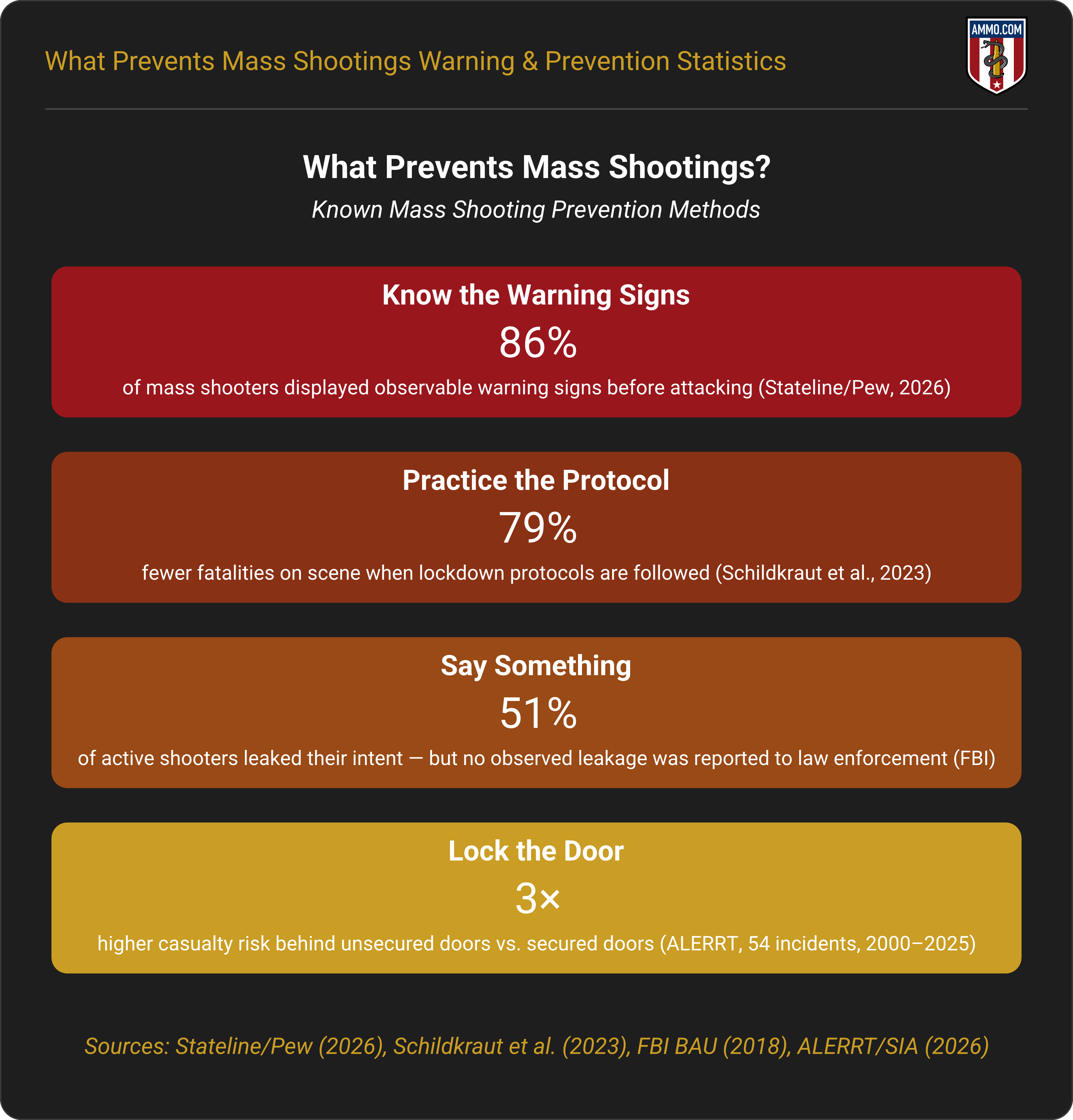
Between 1999 and 2024, 86% of attackers displayed observable warning signs before the attack.
-
When followed and supported by security infrastructure, lockdowns during mass shootings resulted in 79% fewer fatalities on scene, 63% fewer deaths overall, and 59% fewer casualties (including injured).
-
Despite there being an estimated 500 million firearms in the U.S. and inconclusive evidence on the effects of gun control on mass shootings, these attacks are being stopped through civilian reporting, awareness, and intervention.
Ammo.com provides reliable information from reputable sources. The sources in this article can be viewed here.
Methodology
This article draws on peer-reviewed research, government reports, and verified news sources to examine factors that prevent school and mass shootings in the U.S. Data are attributed to the specific study and methodology wherever possible, as the definitions and parameters of mass shootings vary.
Where mass shooting information was lacking, school shootings were examined and noted accordingly. Averted shootings are not widely studied or reported. Ammo.com compiled a list of 30 averted shootings between 2016 and 2026 to cross-reference key preventative measures in research to real-world situations. This list is not comprehensive, but does align with other research.
What Prevents Mass Shootings?
Mass shooting prevention requires a variety of interventions, including identifying, reporting, and taking appropriate actions. Most mass shooting and school shooting research is reactionary. However, preemptive reaction to key indicators preceding nearly every active shooter case could have prevented shots from ever being fired.
Warning Signs and Intervention
The FBI identified 160 active shooter incidents in the United States between 2000 and 2013, defining an active shooter as one or more individuals actively engaged in killing or attempting to kill people in a populated area. A follow-up study examined 63 of those shooters in depth. Among them, 88% of active shooters age 17 and younger leaked their intent to commit violence, while 51% of adult active shooters did the same. 1, 16
Most shooters spent time planning an attack. In the 34 cases where the time spent planning could reasonably be determined, more than a quarter (26%) spent one to two months planning their attacks, while only 12% spent less than 24 hours doing the same. 1
According to the United States Secret Service (USSS) Averting Targeted School Violence report, which analyzed 67 averted plots involving 100 student plotters, plotters in the majority of instances (70%) exhibited between two to four observable planning behaviors. Weapons-related planning accounted for the most prominent planning behavior (85%), followed by planning how to execute the attack (73%), documenting plans (57%), and researching prior attacks (31%). 3 A review of mass shootings between 1999 and 2024 suggests that 86% of mass shooters displayed observable behaviors before the attack. 12
Identifying the warning signs and intervention alone do not prevent all mass shootings. However, there is evidence that awareness and reporting can save lives. Sandy Hook Promise’s Say Something program has reportedly prevented 19 school shootings since its inception in 2016. 2
Did Anyone Know Before a School Shooting?
According to a USSS report released in 2021, plotters shared their plans to attack with others before 94% of averted school violence events. The plotters were most likely to communicate intent to friends, classmates, or peers (69%), followed by adults (19%). 3
How Did They Get Their Gun?
The Violence Project and National Institute of Justice examined 172 mass shootings (i.e. 4+ innocent civilians killed unconnected to family or gang violence) from 1966 to 2019. Of those with firearm acquisition details available, 77% of shooters legally purchased at least some of the firearms used. 4
Similarly, the Mother Jones database lists 160 mass shootings (i.e. 3+ victims killed in an indiscriminate event excluding conventionally motivated crimes) between August 1982 and May 2026. Of those, the shooters’ method of firearm acquisition was listed in 71 events. Purchasing from a retail source was the most common acquisition point (51 incidents), followed by theft (6) and acquisition from family members (5). 5
In three incidents, attackers acquired their firearms from mixed sources (stolen/purchased from retailers), while firearms issued by the National Guard or a local sheriff’s department were used in two. Firearms were rarely purchased from gun shows or online (2) and from individuals in private sales (2). In one event, the attackers received their firearms through a third-party source (straw purchase). In another, the attacker built the weapon used in the shooting. 5
In a USSS review of 67 averted school attack plots, one or more plotters had potential access to at least one weapon in 76% (51) of cases. Firearms specifically were within reach in 43 cases (64%). These attacks were foiled before the plotters could act, but in 30 of those 43 cases (70%) the plotter had access to a family member’s firearm in the home, and in 27 (63%) that access was unimpeded. Firearms were locked in a gun safe or other access-controlled location preceding 13 averted attacks, but plotters still managed to gain access in seven cases. 3
Behavioral changes
Most mass shooters and plotters exhibit concerning behaviors in the years and days leading up to an attack. In an FBI report covering active shooter incidents from 2000 to 2013, shooters displayed an average of four to five observable concerning behaviors. These behaviors consist of mental health issues, problematic interpersonal interactions, and leakage (communicating intent). 1
Between 1966 and 2025, 81.2% of mass shooters (4+ victims killed unconnected to family or crime-related violence) exhibited behaviors consistent with a mental health crisis before carrying out an attack.
The Mother Jones database listed 160 mass and spree shooters between 1982 and 2026. Of those, 51% had a prior history of mental illness, 11% showed no prior signs of mental illness; 39% of shooters’ mental illness histories were not listed. 5
For a closer look at who carries out these attacks, see our analysis of the average age of mass shooters.
Security Protocols and Lockdown Drills
While most research regarding infrastructure and security relates to school shootings, it can be applied to many places targeted by mass shooters. Lockdown protocols result in 79% fewer fatalities reported on scene, 63% fewer deaths overall, and 59% fewer casualties (injuries). 6
The Advanced Law Enforcement Rapid Response Training Center’s analysis of 54 K–12 school active shooter events between 2000 and 2025 examined the 66 doors that perpetrators interacted with. Among the doors with both a known security status and a known victim outcome, 10 of 20 unsecured doors (50%) were associated with a casualty, compared with just 3 of 18 secured doors (16.7%). Of the 47 doors whose status was known, 29 (61.7%) were unlocked or propped open at the time of the attack. 7
Applied to real-world situations, these studies’ findings remain consistent: lockdown protocols and locked doors save lives. At Evergreen High School (2025), staff initiated lockdown protocol within 42 seconds of the subject firing the first shot, locking the shooter outside of the building. Two were injured; none were killed. 7
At Apalachee High School (2024), the subject left his classroom to retrieve a firearm, but was unable to return to his intended target (a classroom). The school’s automatic locking doors and panic button system had student resource officers on his location within one minute. Four were killed; nine were injured.
We saw the extent of injuries in the wake of school security failures at Robb Elementary, where 21 died after three exterior doors were left unlocked or propped open. 7 We saw the result of security failures again at Marjory Stoneman Douglas High School, where the subject entered through an unlocked door before killing 17 and injuring just as many.
In The Covenant School shooting, a subject shot out the glass panels of an exterior door and crawled through, and no lock in the building was ever defeated mechanically. Smoke from her weapon then set off the building’s fire alarm, and students and faculty began a standard fire evacuation until teachers realized the emergency was an active shooter and reversed course into a lockdown. Investigators believe the rooms she searched were the ones that were unlocked and unoccupied. Six were killed, and she did not reach additional victims. 15
Physical barriers are only half the question. Our report on gun free zones and school shootings examines the policy side of the same problem.
Reducing Contagion/Copycat Effect in the Media
Although mass shooters are not a monolith, some sought fame or were inspired by past shooters. A 2015 study by Towers et al. suggests that each mass killing incident inspires 0.30 additional incidents within 13 days. 8 A 2021 study expanded Towers’ methodology and suggested that previous attacks could inspire 0.45 to 0.89 incidents. 9
At least 149 experts have signed a joint call for media organizations to stop publishing the names of mass shooters. According to criminologists, the contagion effect creates a competition to kill, provides a model for future shooters, and encourages others. 10
We covered the incentives driving that coverage in how American media perpetuates mass shootings.
Averted Mass Shootings in the U.S.
One issue with mass shooting prevention research is that a mass shooting is not defined as such when the attack is thwarted. Behind every attack that never occurs is intervention, whether it be a tip, institution, or bystander. Because these attacks never happen, they rarely make headlines.
To fill the research gaps, we examined documented foiled and failed attacks across the U.S., drawing on FBI and DOJ press releases, local law enforcement statements, and verified news reporting. Our findings include attacks stopped by armed law enforcement and security personnel, armed and unarmed civilians, anonymous tip lines, social media reporting, friends and family members reporting, and weapons malfunctions across many public places.
These cases are consistent with previous research: attacks are most commonly foiled by someone in the plotter’s inner circle who saw and said something.
A student who reported messages sent in a Discord server prevented a Valentine’s Day massacre at Mooresville High School in Indiana (2025). Concertgoers noticed a plotter’s suspicious behavior and stopped them from entering a music festival with 25,000 attendees in Washington (2022). A citizen overheard two plotters’ conversation and stopped them from opening fire on a July 4th celebration with more than 2,500 attendees in Virginia (2022). In August 2026, a tip about Telegram messages between two middle schoolers led authorities to uncover homemade firearms and explosives, ultimately preventing yet another attack.
Armed civilians stopped attackers in multiple shootings, including at a church in Texas in 2019 and a mall in Indiana in 2022. Most recently, armed civilians confronted and diverted an active shooter in an In-N-Out Burger parking lot in Idaho (2026), though three people were killed and the attacker died by suicide. Weapon malfunctions ended attacks in a Tennessee office building, subway in Brooklyn, and Las Vegas luxury high-rise lobby over the past ten years. Unarmed civilians stopped attacks in a Nashville Waffle House and a Colorado nightclub.
These cases are not a comprehensive list of thwarted attacks in the U.S., but they do highlight how actions, awareness, and preparedness can affect outcomes. Researchers Michael Rocque, James Alan Fox, and their colleagues suggested that for nearly every single attack between 2000 and 2019, two more were thwarted (97 attacks versus 194 foiled/failed). 11
For the wider picture on civilians who intervene, see our research on defensive gun use statistics.
Gun Control and Mass Shootings
Most mass shooters in the U.S. legally purchased at least some of the firearms they used (77%), with more than half obtaining their guns from a retail source (60%). Of 171 incidents between 1999 and 2024, nearly one-third of attackers were already prohibited from purchasing or possessing firearms. 4, 12 Both of those things can be true at once. Retail purchases run through the Brady Act’s National Instant Criminal Background Check, but a check only catches what the system holds – when a disqualifying record such as a prior mental health adjudication, domestic violence, a felony, or substance abuse never reaches NICS, a prohibited buyer clears the check anyway.
It would seem there would be no mass shootings in the U.S. if there were no firearms. However, either of those circumstances is an unlikely reality. Per recent estimates, there are more than 500 million firearms in the U.S. and 15 million more entering the civilian market annually.
Mass shootings have continued increasing despite federal gun control limitations on civilian ownership, manufacturing, and sales. Gun access in the form of household ownership has declined from 51% in 1990 to 45% in 2022, yet the number of mass shootings has increased.
Despite calls for “common sense gun control” to stop mass shootings, the evidence is inconclusive on the effects of purchasing restrictions, registrations, bans, child access laws, and concealed or permitless carry laws. 13, 14
For the state-by-state picture, see our ranking of the states with the strictest gun control.
Wrap-Up
There’s no single solution to ending mass shootings in the U.S. However, the underlying causes and shooters’ behaviors mean these attacks are not completely random and unpredictable acts of violence. The data consistently show that attackers display warning signs and communicate their intent before carrying out an attack.
No single policy, technology, or protocol will prevent every attack. Lockdown drills are effective when properly implemented and executed. Tip lines work when someone takes the threat seriously enough to call them. The key difference in outcomes between a plotted mass shooting and one that results in injuries is most often determined by the actions of those who notice an attacker and react accordingly.
Sources
-
Sandy Hook Promise: Say Something sandyhookpromise.org
-
USSS Averting Targeted School Violence (2021) secretservice.gov
-
Contagion in Mass Killings and School Shootings journals.plos.org
-
“Don’t name them” – Criminologist asks journalists to help stop mass shootings journalistsresource.org

Infographics
- Are Guns & Ammo The New Gold? Why More Americans Are Arming Themselves
- The Greatest Gun Salesman In America: President Barack Obama
- Shooting Straight: How Both Presidential Candidates Have Changed On Gun Control
- President Obama: (Still) The Greatest Gun Salesman in America
- An Inconvenient Truth: How The Obama Administration Became Earth's Largest Arms Dealer
- Armed Drones: President Obama's Weapon of Choice
- COVID-19 Data Study: Ammunition Sales Continue to Soar in Response to Coronavirus Panic
- Data Study: 18 Months of Ammo Sales during a Pandemic, Protests, and the Biden Presidency
- Data Study: U.S. Ammo Sales Surge Following Russian Invasion of Ukraine
- Most Gun-Friendly States
- Worst States to be a Gun Owner
- Children & Firearms: Definitions and Demographics Make All the Difference
- Urban Violent Crime & Legal Gun Ownership
- Gun-Free School Zone Laws & School Shootings
- Gun Control Laws and Enforcement Trends
- Gun Ownership by State
- How Many Gun Owners are in America?
- Concealed Carry Crime Stats
- Accidental Shooting Statistics: A Review of Unintentional Firearm Deaths
- America's Stolen Guns: A Silent Contributor to Gun Crimes in the U.S.
- Gun Violence Statistics: Comprehensive Look at the Data
- Gun Laws vs. Crime Rates: A Comprehensive Analysis
- Gun Death Statistics by Caliber: A Review of Calibers and Crime
- Anti-Gun Control Arguments: Facts Gun Control Lobby Suppress
- Guns in the Home Statistics: The Effects of Firearms in the Home
- Gun Deaths in the US: Analyzing At-Risk Demographics
- How Many Guns in the U.S.: All About America's Firearms
- Gun Facts in the U.S.: The Reality of Firearms in America
- Defensive Gun Use Statistics: America's Life-Saving Gun Incidents
- Correlation Between Mass Shootings and Prescription Drugs
- Gun Ownership by Gender: Closing the Gender Gap
- Murders by Weapon Type: Statistics
- Gun Violence Among Black Americans: Statistics
- The Ultimate Hunting Caliber Chart: Best Cartridge Per Species
- How Old Do You Have to be to Buy a Gun: A State Guide
- Most Popular Guns in the U.S.: The Must-Have Guns
- Stray Bullet Deaths: Accident and Injury Statistics
- Mass Shooters by Race: Demographics of Assailants
- Ammunition Limits By State: How Much Ammo Can You Buy?
- Why Do Americans Own Guns?
- How Many Americans Want Stricter Gun Laws?
- How Many Households in the U.S. Have a Gun?
- What Percentage of Gun Deaths are Suicides?
- Average Age of Mass Shooters in the U.S.
- Firearm Ownership in America by Year
- US Firearms Deaths Per Year: A Collective Report
- Percentage of Americans Owning Guns
- Texas Gun Ownership: Total Numbers, Trends, and Most Popular Guns
- Gun Ownership Statistics Colorado: Trends & Numbers
- Hunting Accident Statistics (Causes & Trends Per Year)
- Banned Guns & Ammo List: A Review by State
- 3D Printed Gun Laws By State
- How To Build a Home Shooting Range: The Ultimate Guide
- States With the Highest Murder Rates
- Best Self-Defense Weapons for Women
- Easiest States to Buy a Gun
- Cities with the Lowest Crime Rate
- Oregon Homicide Rates
- Chicago Homicide Rate
- How Much Does a Suppressor Reduce Noise
- Texas Homicides: Statistics and Trends
- California Homicides: Rates Per 100K
- Florida Murder Rate: Statistics and Trends
- Gun Ownership by Political Party
- Mass Shooters by Gender
- U.S. Hunting and Fishing Statistics
- Where Are Silencers Illegal? State Suppressor Laws
- How Loud is a Gunshot?
- What States Have the Strictest Gun Control?
- Causes of Mass Shootings in the U.S.
- Ammo Manufacturers List
- How Criminals Get Guns