How Midterms May Affect Gun Control in Your State (November 2026)
Many Democratic politicians support gun control in the U.S. The Democratic Party experienced state-level wins across the nation in November 2026.
-
Nine states (Arizona, Georgia, Michigan, Minnesota, Nevada, North Carolina, Pennsylvania, Texas, and Wisconsin) face a heightened risk of gun control changes after the November 2026 midterm elections.
-
Seven states (Alaska, Iowa, Kansas, Kentucky, New Hampshire, Ohio, and Vermont) have split control between the governor and legislature, making new laws unlikely, but not impossible.
-
Democrats retained full control of 16 states where more gun control may pass, while Republicans retained full control of 18 where gun control is unlikely.
Ammo.com provides information from reputable sources. You can view the sources used in this article here.
Methodology
This report analyzes each state’s ability to enact gun control laws, categorized into four types, based on the outcome of the 2026 midterms. It does not predict whether legislation could pass, only whether it is possible.
Each state has three lawmaking bodies: the governor, state House/Assembly, and Senate. A governor who made pro-gun control statements, campaigned for gun control, or previously supported gun control legislation is marked with a checkmark and listed as such in the table and paragraphs below.
Governors with a mixed record of gun control support include those who previously supported or campaigned on gun control, but also had a history of supporting pro-gun legislation. These governors are marked with a half-moon symbol in the table below. Governors with a mixed record count as supporting gun control, but a state is rated red only if its governor clearly supports gun control measures.
A legislative chamber supports gun control if Democrats hold a majority of its seats, as many gun control and violence prevention groups support Democrats.1 Chambers run by bipartisan coalitions do not count. Nebraska’s single-chamber legislature counts as both chambers.
A bill must pass both chambers, so states with only one supportive chamber would need some votes from the other party. Some Republican state lawmakers have supported gun-control measures, so party control does not decide every vote.
Color ratings:
- ● Red (most at risk): All three lawmaking bodies (the governor, state House, and state Senate) support gun control.
- ● Orange (at risk): Two of the three lawmaking bodies support gun control.
- ● Yellow (unlikely, but possible): One of the three lawmaking bodies supports gun control.
- ● Green (likely stable): None of the lawmaking bodies support gun control.
Governors’ positions come from campaign websites, public statements, and news coverage, cited below. Endorsements from advocacy groups are noted only as context. Party control was drawn from Associated Press race calls, state results pages, and MultiState. Sources are linked below.
Limitations:
- Election results are current as of November 20, 2026, and are unofficial until certified.
- The U.S. Supreme Court has agreed to hear challenges to “assault weapons” bans in Cook County, Illinois, and Connecticut. Its ruling could affect similar laws in every state.
- Voters can also create gun laws through citizen ballot initiatives. This analysis does not account for that route.
- Party control does not guarantee every lawmaker in that party supports a given bill.
- Washington, D.C. is not included.
How Midterms May Affect Your State
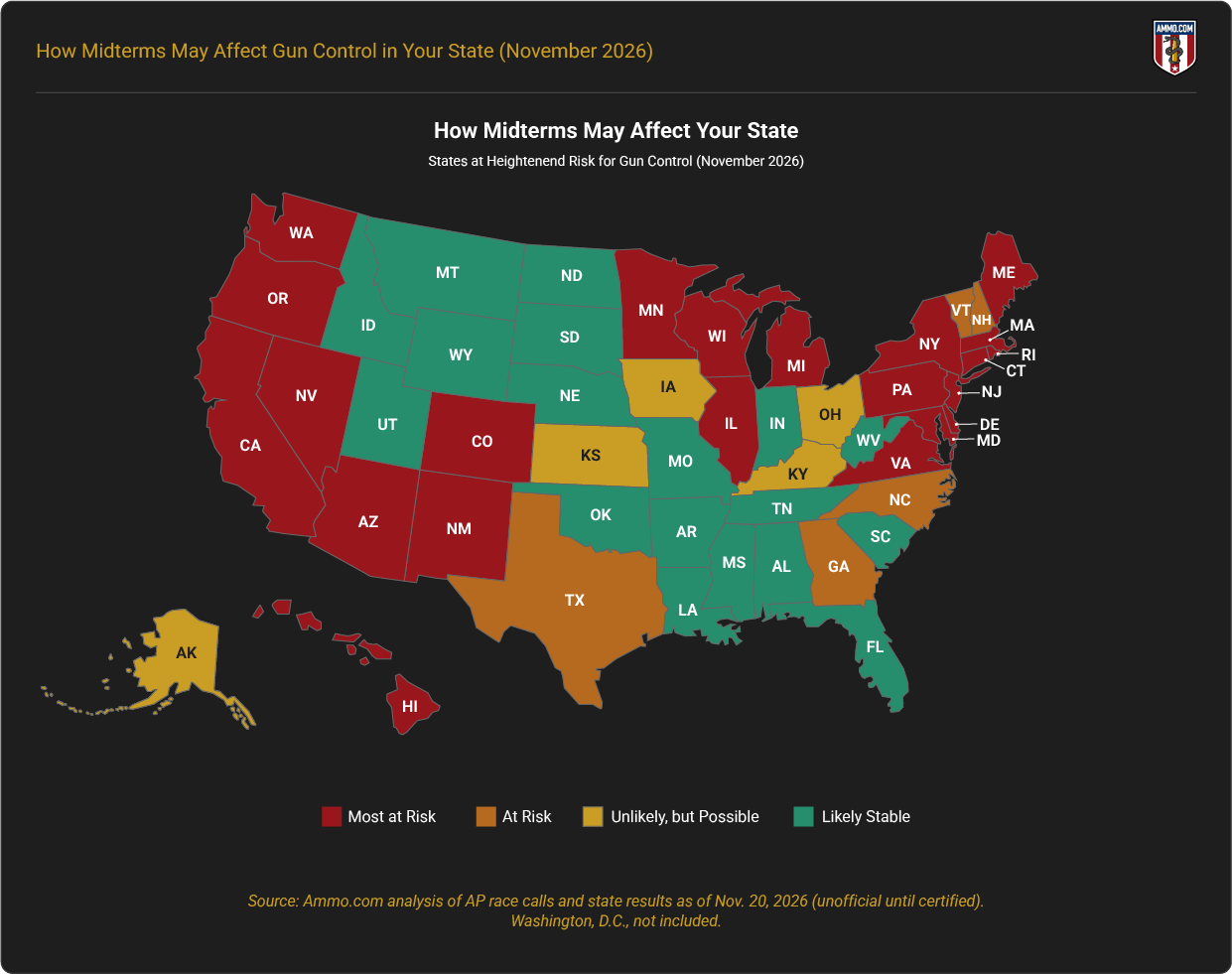
Table codes: D = Democratic majority, R = Republican majority, C = bipartisan coalition, T = tied chamber. ✓ = supports gun control, ✗ = does not, ◐ = mixed record.
States Where New Gun Laws Could Pass After Midterms
Most statehouses remained stable, with no shifts in Democratic or Republican control, across the U.S. after the November 3, 2026, midterms. Although gun control legislation can cross party lines, a governor’s position on policy matters most, because governors can sign or veto any gun bill the legislature passes.
Democrats already held the governor’s office and both legislative chambers in 16 states (California, Colorado, Connecticut, Delaware, Hawaii, Illinois, Maine, Maryland, Massachusetts, New Jersey, New Mexico, New York, Oregon, Rhode Island, Virginia, and Washington), and continue holding power in those states. Many of these states already have some of the strictest gun control policies in the country, and could pass more.2
Republicans kept full control in 18 states (Alabama, Arkansas, Florida, Idaho, Indiana, Louisiana, Mississippi, Missouri, Montana, Nebraska, North Dakota, Oklahoma, South Carolina, South Dakota, Tennessee, Utah, West Virginia, and Wyoming). New gun control policies in these states are unlikely.2
In five states (Alaska, Iowa, Kansas, Kentucky, and Ohio), only one of the governors show any support for gun control. In Kansas and Ohio, the incoming governors support new gun control legislation, but Republicans control the legislature.7, 8 In Alaska and Kentucky, the governors have mixed records on gun policy.3, 4, 5, 9, 10 Iowa’s new Democratic governor, Rob Sand, has expressed support for both the Second Amendment and gun control laws such as red flag laws.6 Gun control is unlikely in these states, but not completely out of the question.
Some states have seen a shift in their state legislatures but are not listed below. These are special cases because of veto power and the governors’ previous positions. New Hampshire Democrats will control the state’s House and Senate in December 2026, but Governor Kelly Ayotte can veto any gun control bills and has a strong record of supporting Second Amendment rights.31 Vermont’s Republican governor Phil Scott won a sixth term, but Democrats regained veto-proof supermajorities in both legislative chambers. Scott signed major gun restrictions in 2018, but has since stated that Vermont does not need more gun control.32
The states below are where the balance of power has shifted toward legislative bodies more likely to support gun control. Each has at least two of the three lawmaking bodies (the governor, House, and Senate) that support it, making these states worth watching.
Arizona
As of November 2026, Arizona has relatively relaxed gun control policies. The state has permitless carry and does not have waiting periods, purchase licensing, universal background checks, red flag laws, magazine-capacity limits, safe storage laws, or “assault weapons” bans.11, 14
Governor Katie Hobbs retained office after the elections and expressed support for “common-sense gun reform” in a June 2022 tweet. Hobbs also has a history of vetoing gun bills that would have allowed concealed carry on college campuses.13
Control of both legislative chambers will shift from Republicans to Democrats after the November elections. Where the previous state House and Senate did not support gun control legislation, the new Democratic trifecta may. Bills that previously failed in a Republican-controlled legislature, including restrictions on some semi-automatic firearms, magazine-capacity limits, universal background checks, permit and training requirements for concealed carry, and waiting periods for firearm purchases, may be reintroduced and passed under the new balance of power.12
Georgia
In 2026, Georgia was one of the best states for gun owners, with permitless carry and no waiting periods, purchase licensing, universal background checks, red flag laws, magazine-capacity limits, safe storage laws, or “assault weapons” bans.15
Governor-elect Keisha Lance Bottoms called on Congress to “enact commonsense gun safety legislation immediately” in 2019. She also campaigned for universal background checks and red flag laws in 2026.16, 17
Before the midterm election results, Republicans in Georgia had a 99-80 lead in the House with one vacant seat. After elections, Democrats have won at least 91 seats, the minimum for a majority, with one race headed to a December 1 runoff. Republicans retained a slight majority in the state Senate with a 29-27 margin, so any gun control bill would need Republican votes to pass.18
Michigan
In 2026, Michigan already had many gun control laws, including a red flag law, universal background checks, safe storage laws, purchase licenses, and no permitless carry. The state does not have “assault weapon” bans, magazine-capacity limits, or waiting periods, and the minimum age to purchase a pistol in a private sale is 18.19
Secretary of State Jocelyn Benson won the 2026 gubernatorial race in Michigan. In 2020, she issued a directive banning the open carry of firearms within 100 feet of polling places on Election Day, which state courts blocked. In May 2026, Benson vowed to support “commonsense laws that keep Michigan communities safe.”20
As of November 2026, the unofficial midterm results gave Democrats a trifecta in Michigan. With three additional Senate seats, 11 additional House seats, and a governor who actively campaigned on tighter gun control legislation, Michigan could potentially see more gun control measures.21
Minnesota
Before the 2026 midterm elections, Minnesota already had some gun control measures such as red flag laws and universal background checks, but no “assault weapons” bans or magazine-capacity limits.22, 25
Democrat Amy Klobuchar will replace Democrat Governor Tim Walz in January 2027. As a U.S. Senator, Klobuchar supported the Bipartisan Safer Communities Act. On the campaign trail, Klobuchar prioritized gun control measures such as safe storage standards and an “assault weapons” ban.23
As of November 2026, Democrats in Minnesota have an unofficial trifecta, gaining six additional Senate seats and 10 additional House seats in the midterm elections. A bill that would have implemented an “assault weapon” ban and magazine capacity limit stalled in the House in 2026. With a new Democratic majority, similar legislation may advance.24, 25
Nevada
Before the 2026 midterms, Nevada had universal background checks and a red flag law, and required permits for concealed carry. Although there were “ghost gun” bans, there wasn’t a ban on “assault weapons”, magazine-capacity limits, or waiting periods.26, 27
The state’s outgoing governor, Joe Lombardo, previously vetoed gun control bills that were introduced and passed by the state Assembly and Senate. The newly elected governor, Aaron Ford, has a more supportive position on gun control, previously supporting “ghost gun” bans and the state’s universal background checks.28, 29, 30
Ford joins other Democratic state Assembly members and Senators, making the state another trifecta where more gun control legislation may be possible in the coming years.2
North Carolina
In 2026, North Carolina did not have waiting periods, purchase licensing, universal background checks, red flag laws, magazine-capacity limits, or an “assault weapon” ban. The state did require a permit for concealed carry.33
Governor Josh Stein, elected in 2024, will remain in office through January 2029. In 2025, both chambers passed a bill to implement constitutional carry. Stein vetoed the bill. The state Senate overrode Stein’s veto, and the bill stalled in the House.34
As of November 2026, North Carolina Democrats picked up four state Senate seats and 22 House seats, with two House races still uncalled. Because a tied Senate vote goes to Democratic Lieutenant Governor Rachel Hunt, a gun control bill would need just one Republican senator’s vote after January 2027.35
Pennsylvania
Before the November 2026 midterms, Pennsylvania already had some gun-related restrictions, such as requiring a permit to carry a concealed weapon and universal background checks on handguns. The state did not have an “assault weapon” ban, a red flag law, magazine capacity limits, or universal background checks for long guns.36
Governor Josh Shapiro retained office after the 2026 election and has previously supported gun control. Shapiro, along with state House Democrats, previously attempted to pass a red flag law and expand universal background checks to long guns. This legislation was stalled in the state Senate.37
Democrats picked up nine state House seats and three state Senate seats as of November 2026. The state requires a simple majority to pass a gun control bill, which Democrats have in the Pennsylvania legislature.38
Texas
In 2026, Texas had constitutional carry, a ban on red flag laws, and no universal background checks, waiting periods, or magazine-capacity limits. The state also didn’t have an “assault weapon” ban.39, 40
Governor-elect Gina Hinojosa did not campaign on gun control, but has criticized elected officials for failing to protect children from “weapons of war.” Texas’ new governor is an Everytown-backed “gun-sense” candidate who tweeted in 2018 that Supreme Court nominee Brett Kavanaugh was an activist judge, citing his dissent in a gun case, Heller v. District of Columbia.41
The Democrats flipped the state House after picking up at least 20 seats in the November 2026 midterms. The state Senate held a Republican majority after the election, meaning gun control is unlikely, but not completely out of the question should Senate Republicans support the legislation.42
Wisconsin
As of November 2026, Wisconsin didn’t have universal background checks, a red flag law, waiting periods, magazine-capacity limits, or an “assault weapon” ban. Although permits were required to carry a concealed firearm in public, the state had few restrictions on possession or purchase.43
Governor-elect David Crowley campaigned on gun violence prevention. According to Milwaukee Neighborhood News Service, his platform called for universal background checks, a firearm takeback, and free gun locks as means to accomplish his goals.44
The two legislative chambers in Wisconsin flipped from Republican to Democratic during the November 2026 midterms. As of January 2027, Democrats will have a trifecta in the state, and more gun control may be possible.45
Wrap-Up
Some state elections in November 2026 made gun control more likely. Shifts from Republican legislative bodies to Democratic ones often result in the introduction and passage of new gun control laws, especially when governors also support more gun control.
Sources
- 2026 General Election Resultsmultistate.us
- JKT wins governor’s race, flipping seat blue in Dunleavy referendumalaskasnewssource.com
- Which Candidates Get A+ from NRA for Second Amendment Rights?mustreadalaska.com
- Sand favors red-flag laws, UBCs for gunswestbranchtimes.com
- 2026 Kansas Governor Voters Guideguides.vote
- Gov. Beshear Provides Team Kentucky Updatekentucky.gov
- Arizona Gun Control Lawsfindlaw.com
- Georgia: Keisha Lance Bottoms for Governorkeishaforgovernor.com
- Georgia 2026 Election Resultsmultistate.us
- Michigan Gun Control Lawsfindlaw.com
- Michigan 2026 Election Resultsmultistate.us
- Minnesota: Klobuchar for Governoramyklobuchar.com
- Minnesota: 2026 Election Resultsmultistate.us
- Minnesota: Semi-Automatic and Magazine Bangunowners.mn
- Nevada Gun Control Lawsfindlaw.com
- Lombardo vetoes trio of gun control billsnevadacurrent.com
- 2026 Nevada Governor Voters Guideguides.vote
- Governor Phil Scott Signs Violence Reduction & Gun Safety Legislationgovernor.vermont.gov
- North Carolina Gun Control Lawsfindlaw.com
- North Carolina: 2026 Election Resultsmultistate.us
- Pennsylvania Gun Control Lawsfindlaw.com
- Pennsylvania: 2026 General Election (Unofficial Returns)electionreturns.pa.gov
- Texas Gun Control Lawsfindlaw.com
- Candidate Profile: Gina Hinojosademocratsworkforamerica.org
- Texas: 2026 Election Resultsmultistate.us
- Wisconsin Gun Control Lawsfindlaw.com
- Crowley and Tiffany Have Very Different Views on Guns and Gun Violenceurbanmilwaukee.com
- Wisconsin: 2026 Election Resultsmultistate.us
Sign up to get our latest data studies delivered straight to your inbox.

Infographics
76 data studies and reference lists, grouped by topic. Pick a topic, tap to open its studies:
Gun Ownership & Culture
3 topics
National Numbers 7
Who Owns & Why 3
Gun Laws & Politics
3 topics
State Laws & Rankings 9
- Most Gun-Friendly States
- Banned Guns & Ammo List: A Review by State
- 3D Printed Gun Laws By State
- Ammunition Limits By State: How Much Ammo Can You Buy?
- Worst States to be a Gun Owner
- Easiest States to Buy a Gun
- Where Are Silencers Illegal? State Suppressor Laws
- What States Have the Strictest Gun Control?
- How Old Do You Have to be to Buy a Gun: A State Guide
Policy & Public Opinion 5
Presidents & Politics 6
- The Greatest Gun Salesman In America: President Barack Obama
- President Obama: (Still) The Greatest Gun Salesman in America
- An Inconvenient Truth: How The Obama Administration Became Earth's Largest Arms Dealer
- Shooting Straight: How Both Presidential Candidates Have Changed On Gun Control
- Armed Drones: President Obama's Weapon of Choice
- How Midterms May Affect Gun Control in Your State
Crime, Violence & Self-Defense
4 topics
Gun Deaths & Injuries 9
- Gun Death Statistics by Caliber: A Review of Calibers and Crime
- Accidental Shooting Statistics: A Review of Unintentional Firearm Deaths
- Children & Firearms: Definitions and Demographics Make All the Difference
- Guns in the Home Statistics: The Effects of Firearms in the Home
- Stray Bullet Deaths: Accident and Injury Statistics
- Gun Deaths in the US: Analyzing At-Risk Demographics
- US Firearms Deaths Per Year: A Collective Report
- Gun Violence Statistics: Comprehensive Look at the Data
- What Percentage of Gun Deaths are Suicides?
Homicide & Crime Rates 9
- Murders by Weapon Type: Statistics
- Gun Violence Among Black Americans: Statistics
- Texas Homicides: Statistics and Trends
- Florida Murder Rate: Statistics and Trends
- California Homicides: Rates Per 100K
- States With the Highest Murder Rates
- Cities with the Lowest Crime Rate
- Oregon Homicide Rates
- Chicago Homicide Rate
Mass Shootings 6
Ammo, Hunting & Gear
3 topics
Ammo & Gun Market 9
- Most Popular Guns in the U.S.: The Must-Have Guns
- Gun Manufacturers List
- Most Common Ammo in the World
- Ammo Manufacturers List
- Data Study: U.S. Ammo Sales Surge Following Russian Invasion of Ukraine
- Are Guns & Ammo The New Gold? Why More Americans Are Arming Themselves
- COVID-19 Data Study: Ammunition Sales Continue to Soar in Response to Coronavirus Panic
- Data Study: 18 Months of Ammo Sales during a Pandemic, Protests, and the Biden Presidency
- Ammo Panic Buying: Midterms & Government Warnings Nearly Triple Ammo Sales