5.56 Twist Rate Chart: What Your AR Actually Likes to Shoot
Here's the 5.56 twist rate chart you came for. Find your bullet weight on the left, then read across to your barrel's twist. The short version is simple. Fifty-five and 62 grain ammo shoots in just about any AR, while the heavy 69 to 77 grain match stuff wants a 1:8 or 1:7 barrel. Remember: everything in ballistics is a compromise.
Be purpose driven in your compromise. I personally tend to shoot 55 grain and heavier. So, I stick to faster twist rates. If you only plan on close-range varmint work or plinking, you might make a different decision.
I run 1:8 and 1:7 rifles, and between them, they've shot everything from cheap 55 grain ball to heavy match. I even made sure my Stevens Model 200 bolt gun in .223 had a 1:7 twist, so it could shoot anything I fed it. That's the experience this guide is built on.
Below the chart, you'll find my picks for every twist and every use, from range day to home defense. Shop all 5.56 ammo when you're ready.
5.56 Twist Rate Chart
| Bullet Weight | 1:7 Twist | 1:8 Twist | 1:9 Twist |
|---|---|---|---|
| 40 Grain | Not Recommended | OK | Good |
| 45 Grain | OK | OK | Good |
| 50 Grain | OK | OK | Good |
| 55 Grain | Good | Good | Good |
| 62 Grain | Good | Good | Good |
| 64 Grain | Good | Good | Good |
| 69 Grain | Good | Good | OK |
| 70 Grain | Good | Good | OK |
| 75 Grain | Good | Good | Depends |
| 77 Grain | Good | Good | Not Recommended |
| 80 Grain | OK | Not Recommended | Not Recommended |
Good means the bullet will stabilize and shoot well. OK means it should work, but isn't ideal. Not Recommended means “expect accuracy problems or worse.”
I left 1:12 off the chart because it's mostly found on older rifles. If that's what you've got, stay at 55 grain and lighter.
Bullet length matters more than weight. Twist rate actually stabilizes a bullet based on its length, not its weight. Weight is just the easy shortcut. Two bullets can weigh the same and still want different twists.
Take that "Depends" box at 1:9 and 75 grain. Speer's 75 grain Gold Dot is short for its weight, and Speer's twist recommendation says it works in a 1:9 or faster. A long, sleek 75 grain match bullet is a whole different deal, and wants a 1:8 or faster. When in doubt, check the box or the manufacturer's page.
On the other end, 40 grain is "Not Recommended" in a 1:7 because thin-jacketed varmint bullets can actually come apart from the extra spin.
Top 4 Picks for Every 5.56 Twist Rate
| Ammo | Award | Details |
|---|---|---|
| Winchester USA 55 Grain FMJ M193 Top Pick | Best Overall | Jump to Details → |
| Speer Gold Dot 55 Grain Soft Point | Best Self-Defense Ammo for 5.56 | Jump to Details → |
| PMC X-TAC 55 Grain FMJ-BT | Best Range Ammo for 5.56 | Jump to Details → |
| Black Hills 77 Grain OTM | Honorable Mention (1:7 and 1:8 Only) | Jump to Details → |
5.56 Recommended Ammo
| Product | Bullet Weight |
Bullet Type |
Velocity | Works In (Twist) |
Best For |
|---|---|---|---|---|---|
| Winchester USA M193 | 55 Grain | FMJ | 3,180 fps | 1:7, 1:8, 1:9 | General Purpose, Training |
| Speer Gold Dot (.223 Rem) | 55 Grain | Bonded Soft Point | 3,220 fps | 1:7, 1:8, 1:9 | Home Defense |
| PMC X-TAC | 55 Grain | FMJ-BT | 3,120 fps | 1:7, 1:8, 1:9 | Range, Bulk |
| Black Hills OTM | 77 Grain | Open Tip Match | 2,750 fps | 1:7, 1:8 Only | Long Range, Precision |
Winchester USA 55 Grain FMJ M193: Best Overall


Winchester USA 5.56x45 Ammo - 1000 Rounds of 55 Grain FMJ M193 Ammunition
21 In stock now
Specs
- Bullet Type: Full Metal Jacket
- Bullet Weight: 55 Grains
- Muzzle Velocity: 3,180 fps
- G1 Ballistic Coefficient: 0.255
- Case: Brass
- Spec: M193
Pros and Cons
- Shoots in 1:7, 1:8, and 1:9 barrels
- Affordable by the case
- Almost always on the shelf
- FMJ only, so don't hunt with it or use it for home defense
Why I Chose It
This load has run through my 1:8 and my 1:7 and never missed a beat. It's built to M193 spec, the same 55 grain ball the military has used for decades, so it'll shoot in a 1:9 too. No matter what's stamped on your barrel, this ammo will work.
It's also the kind of ammo you can actually afford to practice with. Winchester USA is easy to find, consistent box to box, and priced right by the case. If you're only buying one 5.56 load, buy this. See our full list of the best M193 ammo for more options.
Speer Gold Dot 55 Grain Soft Point: Best Self-Defense Ammo for 5.56
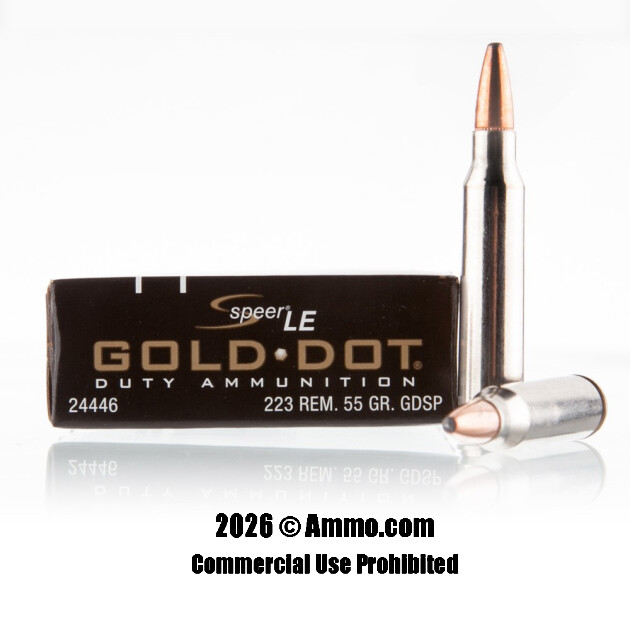


Speer Gold Dot 223 Ammo - 500 Rounds of 55 Grain SP Ammunition
Out of stock
Specs
- Bullet Type: Bonded Gold Dot Soft Point
- Bullet Weight: 55 Grains
- Muzzle Velocity: 3,220 fps
- Bullet Length: 0.725"
- G1 Ballistic Coefficient: 0.222
- Case: Nickel-Plated Brass
- Chambering: .223 Rem (Safe in Any 5.56 Chamber)
Pros and Cons
- Bonded core and jacket hold together for consistent penetration
- Built on Speer's Gold Dot law enforcement design
- 55 grain shoots in any twist rate
- Costs more than range ammo
- Loaded as .223 Rem, so it runs a little slower than 5.56 full-pressure loads
Why I Chose It
Gold Dot has earned its reputation with law enforcement, and the rifle version brings that bonded build to your AR. The jacket and core are fused together, so the bullet holds together and drives deep instead of coming apart during barrier penetration or impact.
The biggest reason it's my self-defense pick is the 55 grain weight. It shoots in any twist on the chart, so if you don't know what your barrel is, you're still covered. Since it's loaded as .223 Rem, it's safe to fire in any 5.56 chamber.
Running a 1:9 or faster? Speer also makes a 75 grain Gold Dot, which they say works in a 1:9 or faster. That's the chart earning its keep: one twist rate, one heavier defensive option. For more choices, see our picks for the best 5.56 ammo for home defense.
Now you know what your barrel likes. Go stock up on it. Get on our list for 5.56 deals by the case and restock alerts, so you're not stuck buying whatever's left on the shelf.
Subscribers Save Up to 15% on Ammo
PMC X-TAC 55 Grain FMJ-BT: Best Range Ammo for 5.56
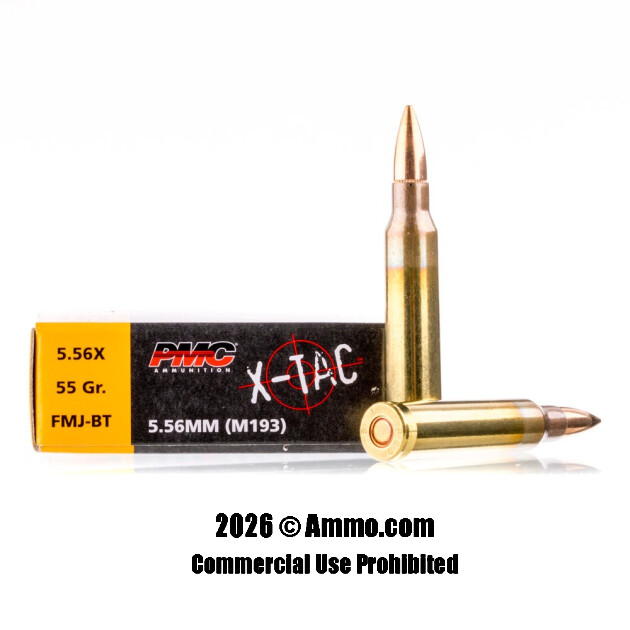


PMC 5.56x45 Ammo - 1000 Rounds of 55 Grain FMJ-BT Ammunition
77 In stock now
Specs
- Bullet Type: Full Metal Jacket Boat Tail
- Bullet Weight: 55 Grains
- Muzzle Velocity: 3,120 fps
- Bullet Length: 0.740"
- G1 Ballistic Coefficient: 0.243
- Case: Brass
Pros and Cons
- Boat tail bullet for a little better consistency downrange
- Available in bulk cases and sealed battle packs
- Shoots in any twist rate
- FMJ only, not for hunting or defense
- Not a precision match load
Why I Chose It
This is what you buy when you're going to burn through a pile of rounds. PMC X-TAC comes in bulk cases and battle packs, so you can stock up and keep shooting. For range ammo, running every time and not gunking up your rifle matters a lot more than tiny groups.
That 0.740" bullet length is worth remembering. It's the reason a 55 grain bullet shoots in anything. Short bullets are easy to stabilize, even in a 1:9. Stretch that bullet out to a long 77 grain match design, and it needs a lot more spin to stay pointed straight.
Shop more PMC ammo, or save even more with bulk 5.56.
Black Hills 77 Grain OTM: Honorable Mention

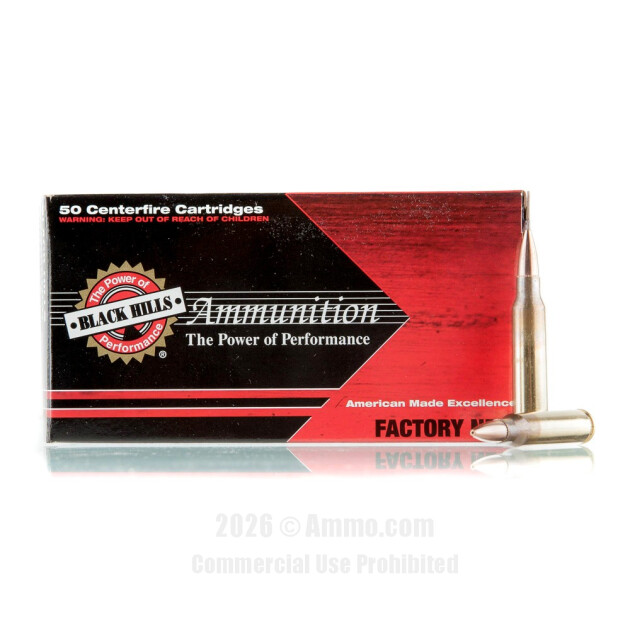
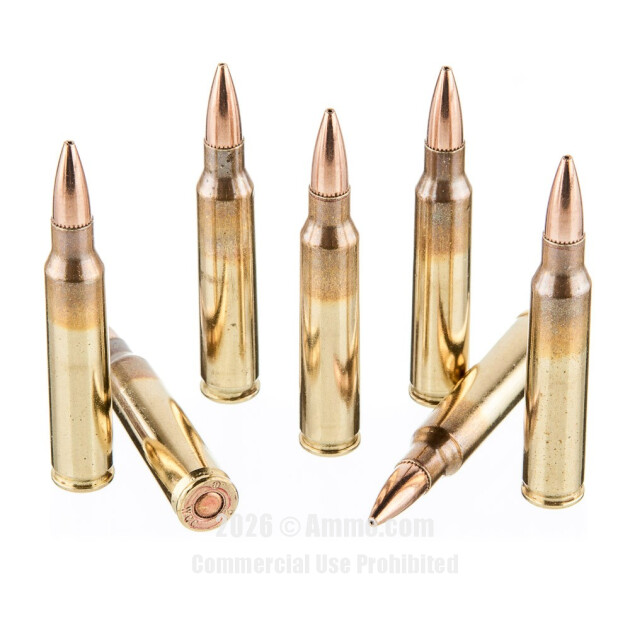
Black Hills Ammunition 5.56x45 Ammo - 50 Rounds of 77 Grain OTM Ammunition
Out of stock
Specs
- Bullet Type: Open Tip Match
- Bullet Weight: 77 Grains
- Muzzle Velocity: 2,750 fps
- Case: Brass
- G1 Ballistic Coefficient: 0.372
- Twist Required: 1:8 or Faster
Pros and Cons
- Long, streamlined match bullet built to reach out
- Bucks the wind better than 55 grain
- Excellent accuracy from the right barrel
- 1:7 or 1:8 only, so it won't stabilize in a 1:9
- Costs a lot more than ball ammo
Why I Chose It
This is the heavy end of the chart, and it's where a faster twist really pays off. Black Hills loads a long, sleek 77 grain match bullet that holds its speed and fights the wind far better than 55 grain ball. This is just great ammo. Black Hills does it right.
My 1:8 and 1:7 rifles handle heavy match loads like this without a hiccup, and that's the best argument I can make for buying a faster twist. A 1:9 owner simply can't run this ammo well. If you want to stretch your AR past 300 yards, you need the barrel to do it.
Let me make this crystal clear: run it in a 1:8 or 1:7 only. Find more loads from Black Hills.
How I Chose These
I picked these loads based on what I've run through my 1:8 and 1:7 ARs over the years. I watched for three things: whether the ammo cycled reliably, how well it grouped, and whether I saw any keyholing (bullets hitting the target sideways, a sure sign they aren't stable).
I've never owned a 1:9 barrel, so anything on this page about 1:9 comes from the manufacturers and the twist math, not my own range time. That's why the chart leans on published recommendations for the slower twist.
How to Choose Ammo for Your 5.56 Twist Rate
Self-Defense
Fifty-five to 62 grain bonded soft points work in any twist, which makes them the safe bet for a home defense rifle. Got a 1:8 or 1:7? You can step up to heavier defensive loads like 75 or 77 grain if you want more weight. That 77 grain Black Hills is a great option here.
Training
Fifty-five grain M193 or 62 grain M855 by the case is the way to go. Both run in 1:7 through 1:9 barrels. Check out our 62 grain green tip and bulk AR-15 ammo to keep your cost per round down. For a side-by-side look at the two loads, see M193 vs. M855.
Competition and Target Shooting
A 1:9 shoots 55 grain match ammo just fine. But if you're stretching past 300 yards or fighting the wind, you want 69 to 77 grain bullets out of a 1:8 or 1:7. That's where those faster barrels really shine. Compare loads in our 5.56 ballistics charts.
Suppressed Shooting
Most 5.56 is supersonic, so it's still loud with a suppressor. Twist rate doesn't change much here. Just buy clean-burning ammo so your can and upper stay cleaner.
If you’re interested in making your suppressed rifle run reliably and quietly, you can purchase subsonic ammunition. We have Armscor subsonic 77 Grain OTM in 5.56x45 here.
Carbine Shooting
16-inch barrels give up some velocity, and a slower bullet needs a little more spin to stay stable. That's one more reason a 1:8 or 1:7 makes sense on a carbine. Shop all AR-15 ammo.
How to Read a Twist Rate Chart
A 1:7 twist means the rifling makes one full turn every 7 inches. The lower the number, the faster the spin. Faster spin holds a longer bullet steady in flight.
A barrel's twist rate is usually stamped right on it, often near the muzzle or under the handguard. If you want to check a specific bullet, plug its length and weight into Berger's twist rate calculator. It runs on the Miller formula, so it's less accurate with flat base bullets.
Which Twist Rate Should You Buy?
If you're shopping for a barrel or upper, here's my take: I run 1:8 and 1:7, and I haven't found a load I wanted to shoot that they wouldn't handle.
- 1:8: The best choice for most shooters. It handles everything from 55 grain ball to 77 grain match.
- 1:7: The mil-spec twist. Go this route if you plan to shoot a lot of heavy bullets.
- 1:9: Only if you'll never leave 55 and 62 grain.
When in doubt, go faster. For more on picking a bullet weight, see our guide to the best grain for 5.56.
Alternatives
This same chart works for .223 Rem, since it uses the same bullets. Just know that a lot of older .223 bolt guns have slower twists, so check yours before buying heavy bullets. Shop .223 ammo or see our picks for the best .223 ammo.
Varmint hunters with a 1:9 can drop down to 40 to 50 grain bullets, which that twist handles well. Check out our lighter varmint loads for coyotes and other critters.
FAQ
What's the best twist rate for 5.56?
1:8 is the best twist for most shooters. It stabilizes everything from 55 grain ball to 77 grain match bullets.
What twist rate do I need for 77 grain?
77 grain bullets need a 1:8 or faster twist. Black Hills, for example, calls for 1:8 or faster on its 77 grain OTM.
Can a 1:9 twist shoot 62 grain?
Yes. A 1:9 shoots 62 grain bullets well, including M855 green tip.
Is 1:7 too fast for 55 grain?
No. 55 grain shoots fine out of my 1:7, so don't let the "overspin" myth scare you off. The only real exception is very light, thin-jacketed varmint bullets, which can come apart.
Does barrel length change twist rate?
No. Twist rate is set by the rifling and stays the same no matter how long the barrel is. A shorter barrel does lower velocity, though, which is one more reason to lean toward a faster twist on a carbine.
What twist rate does M855 need?
M855's 62 grain bullet stabilizes in 1:7, 1:8, and 1:9 barrels.
Final Thoughts
The 5.56 twist rate chart comes down to a simple rule: 55 and 62 grain ammo shoots in just about anything, while heavy match bullets need a 1:8 or faster. My 1:8 and 1:7 rifles back that up, handling everything from cheap ball to heavy match.
When in doubt, go faster. And if you just want one load that works in any AR, grab Winchester USA M193 55 grain and start shooting.
Now that you've got the 5.56 twist rate chart down, shop 5.56 ammo and find the right load for your barrel.
Subscribers Save Up to 15% on Ammo
Join hundreds of thousands of shooters getting first access to limited-time sales, price drops, and 2A news – delivered weekly. Private, no spam, one-click unsubscribe.

Cartridge Recommendations
99 ammo recommendations, grouped by platform, use case and gun. Find your cartridge, tap to open its picks:
Handgun
12 cartridges
9mm 13
- Best 9mm Subsonic Ammo
- Best 9mm Ammo
- Best Ammo for Glock 19
- Best 9mm Home Defense Ammo
- Best Ammo for Glock 43x
- Best Exotic 9mm Ammo
- Best Ammo for Smith & Wesson M&P 9mm Shield
- Best Ammo For Taurus PT111 G2
- Best Ammo for Taurus G3c
- Best Grain for 9mm
- Best Ammo for Ruger Security 9
- Best Beretta APX 9mm Ammo
- Best Ammo for the Taurus GX4
45 ACP 6
38 Special 3
357 Magnum 1
357 SIG 1
380 ACP 1
44 Magnum 1
Rifle
17 cartridges
223 Remington 2
5.56 NATO 5
308 Winchester 4
300 Blackout 5
300 Win Mag 3
7.62x39 3
6.5 Creedmoor 3
30-06 Springfield 2
270 Winchester 1
7mm Rem Mag 1
7mm PRC 1
6.5 Grendel 1
5.45x39 1
350 Legend 1
45-70 Government 1
Shotgun
8 guides
Rimfire
6 guides
By Use Case
6 use cases
Deer Hunting 9
- Top 5 Best 30-06 Ammo for Deer Hunting
- Best 223 for Deer Hunting
- Best 308 Ammo for Deer Hunting
- Best 20 Gauge Ammo for Home Defense, Whitetail, and Upland Game
- Best 243 Ammo for Deer Hunting This Rifle Season
- Best 12 Gauge Ammo for Deer Hunting
- Best 300 Win Mag Ammo for Deer
- Best Caliber for Deer Hunting
- 4 Best Straight-Wall Cartridges for Deer
Other Hunting 19
- Best 308 Subsonic Ammo for Hunting
- Best 30-30 Ammo to Buy for Hunting, Target Shooting, and Defense
- Best 20 Gauge Ammo for Home Defense, Whitetail, and Upland Game
- Best 6.5 Creedmoor Hunting Ammo
- Best 308 Ammo For Hunting & Target Shooting
- Best 7.62x39 Hunting Ammo
- Best 5.56 Ammo for Coyote Hunting
- Best 270 Ammo for Hunting
- Best Duck Hunting Shells
- Best 45-70 Ammo For Hunting & Target Shooting
- Best 17 HMR Ammo for Varmint Hunting and Plinking
- Best 300 Blackout Ammo for Hog Hunting
- Best 300 Win Mag Ammo For Elk Hunting
- Best Coyote Cartridges
- Best Lead-Free Hunting Ammunition
- Best Cartridge for Elk Hunting
- Best Turkey Loads
- Best Moose Cartridges
- Best Big Game Caliber
Home Defense 4
Self-Defense & Carry 14
- Best 40 S&W Ammo For Self Defense & Target Practice
- Best 38 Special Ammo for Self Defense
- Best .22 LR Ammo for Self-Defense
- Best 380 Self-Defense Ammo
- Best 45 ACP Ammo For Self-Defense
- Best Handgun Ammo for Self-Defense in Common Calibers
- Best 5.7 Ammo for Self-Defense & Concealed Carry
- Best 7.62x39 Ammo for Self Defense
- Best .40 S&W Ammo for Self Defense
- Best Handgun Cartridge
- Best .357 SIG Defensive Ammo
- Best Cartridge for Self-Defense
- Best 45 ACP Hollow Points for Self-Defense
- Best Cartridge for Concealed Carry
Subsonic 3
By Gun
14 guides
- Best Ammo for Glock 19
- Best AR Calibers
- 5.56 Twist Rate Chart
- Best 410 Ammo For A Taurus Judge
- Best Ammo for Glock 43x
- Best Ammo for Smith & Wesson M&P 9mm Shield
- Best Ammo For Taurus PT111 G2
- Best Ammo for Taurus G3c
- Best Ammo for Ruger Security 9
- Best Ammo for 1911 45 ACP
- Best Beretta APX 9mm Ammo
- 4 Best AK-47 Ammo Picks [7.62x39]
- Best 300 Blackout Ammo for Your AR-15
- Best Ammo for the Taurus GX4


