408 CheyTac vs. 50 BMG: Which Is Master of the Mile?
Whether you’re looking for a new long-range cartridge or ending a debate about the best sniper cartridges, this article is for you. 408 CheyTac vs. 50 BMG is the prime example of extreme precision vs. brute force. The 408 Cheyenne Tactical has several distinct edges over the 50 Browning Machine Gun, but the 50 BMG punches back with advantages of its own.
As you continue reading, you’ll discover which long-distance cartridge is better for you.
Differences Between 408 CheyTac and 50 BMG
Even though the 50 BMG and 408 CheyTac were created for long-range engagements, they have some drastic differences that you must know about before deciding which is the better option for your shooting needs.
Let’s start with the benefits and drawbacks of each cartridge.
Pros and Cons of the 408 CheyTac and 50 BMG
| 408 CheyTac Pros | 408 CheyTac Cons | 50 BMG Pros | 50 BMG Cons |
|---|---|---|---|
| ✓ Flatter trajectory | ✗ Less powerful/energy | ✓ Easier and less expensive to reload | ✗ Heavier recoil |
| ✓ Less recoil | ✗ More expensive rifles and ammo (including reloading) | ✓ More powerful/energy | ✗ More affected by wind and elevation drop |
| ✓ Easier precision and accuracy | — | ✓ Better for punching through walls | — |
| ✓ Better for 2,500+ yard shots | — | ✓ Less expensive rifles and ammo | — |
What Is the Best Use Case for 408 CheyTac and 50 BMG?
While both cartridges made our best sniper caliber list, many shooters also weigh these options against the 338 Lapua vs 50 BMG to find the perfect balance of weight and power. The 408 CheyTac is better for long-range precision shooting because it has a flatter trajectory, less recoil, and greater resistance to wind drift. The 50 BMG is better suited for anti-materiel roles (i.e., destroying military equipment). It also excels at punching through walls, because it retains more energy out to 1,000 yards (though the 408 CheyTac conserves a higher percentage of its energy as distance to the target increases).
Cartridge Specs
| 408 CheyTac | 50 BMG | |
|---|---|---|
| Parent Case | 505 Gibbs/400 Taylor Magnum | 30-06 Springfield |
| Bullet Diameter | 0.408" | 0.510" |
| Neck Diameter | 0.438" | 0.560" |
| Base Diameter | 0.637" | 0.804" |
| Case Length | 3.040" | 3.910" |
| Overall Length | 4.547" | 5.450" |
| Case Capacity | 159.0 grains H2O | 292.8 grains H2O |
| Max Pressure | 63,817 psi (C.I.P) | 53,664 psi (C.I.P) |
408 CheyTac vs. 50 BMG Recoil
The 50 BMG's massive projectiles and enormous case capacity come at a high cost: tremendous recoil. When firing a 660 grain bullet at 2,910 fps muzzle velocity from a 32.7-pound Barrett Model 82 semi-auto rifle, the 50 BMG has 82.7 ft-lbs of recoil energy. That's like a sledgehammer to the shoulder, which is why it's always recommended to get professional training before firing such punishing ammo.
Compare that to the 408 CheyTac, which, when firing a 419 grain bullet at 3,000 fps muzzle velocity from a 31-pound rifle, "only" has 35.7 ft-lbs of recoil energy. This is still shoulder-bruising territory without proper shooting technique, but it's much more manageable than the 50 BMG. For reference, the average shooter typically finds anything over 15 ft-lbs of recoil energy difficult to manage.
Most shooters will find the recoil of the 408 CheyTac to be much more manageable and easier on their shoulders than the 50 BMG, but neither is well suited for recoil-sensitive shooters.
408 CheyTac vs. 50 BMG Ballistic Coefficient and Bullet Weights


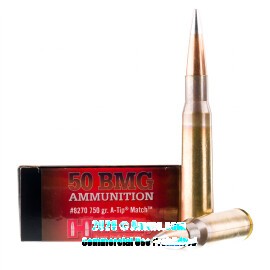
Hornady Match 50 BMG Ammo - 10 Rounds of 750 Grain A-Tip Match Ammunition
30 In stock now
Since both cartridges were designed for long-range shooting, it should come as no surprise that both boast extremely high ballistic coefficients (a numerical representation of aerodynamic efficiency; higher numbers represent bullets that conserve relatively greater momentum). Depending on the bullet weight, the 408 CheyTac G1 ballistic coefficient generally ranges from 0.880 to 0.949. The 419 grain bullet has the highest BC of 0.949, while the 390 grain bullet is slightly lower at 0.880.
Heavier 50 BMG bullets have a G1 BC that ranges from 0.640 to 1.050. The lighter 661 grain M33 ball bullet has a G1 BC of 0.640, whereas the 750 grain A-MAX is 1.050.
The 50 BMG owes its higher overall ballistic coefficients to its heavier projectiles. However, when we compare projectiles as close in weight as possible (there's still a large gap), the 408 CheyTac has the better ballistic coefficient.
408 CheyTac vs. 50 BMG Ammo and Rifle Cost/Availability
Good luck if you're looking to get into long-range shooting on a small budget. Big distance requires big money. A 408 CheyTac rifle will typically cost you anywhere from $6,000 to $17,000+, and ammo is about $10-$20 per round. You can reload to help reduce that cost, but the components aren't as readily available.
A 50 BMG rifle will generally cost you $2,000 to $9,000+. Factory ammo for the 50 BMG is much more affordable at $4-$12 per round. That price can be further reduced via reloading, as components are easier (and cheaper) to get your hands on.
The 50 BMG is more readily available and significantly less costly than the 408 CheyTac, but neither is inexpensive to fire.
408 CheyTac vs. 50 BMG Ballistics Charts
Check out the ballistics tables the Ammo.com team created to see how these two long-distance rounds compare to each other.
408 CheyTac Ballistics
Note: This information comes from ammo manufacturers. Actual ballistics obtained with your firearm can vary considerably from advertised ballistics. Also, ballistics can vary from lot to lot with the same brand and type load.
| Bullet | Barrel Length (in) | G1 BC | Velocity (fps) | Energy (ft-lbs) | Elevation (in) | |||||||||||||||
|---|---|---|---|---|---|---|---|---|---|---|---|---|---|---|---|---|---|---|---|---|
| 0yds | 200yds | 400yds | 600yds | 800yds | 1000yds | 0yds | 200yds | 400yds | 600yds | 800yds | 1000yds | 0yds | 200yds | 400yds | 600yds | 800yds | 1000yds | |||
| 419gr BFP | 36 | 0.949 | 2850 | 2657 | 2472 | 2294 | 2123 | 1960 | 7,558 | 6,568 | 5,684 | 4,896 | 4,195 | 3,576 | -3.0 | 18.8 | 20.8 | 0.0 | -47.3 | -125.5 |
| 419gr BFP | 36 | 0.949 | 2752 | 2563 | 2381 | 2207 | 2041 | 1882 | 7,047 | 6,112 | 5,277 | 4,534 | 3,875 | 3,294 | -3.0 | 20.4 | 22.5 | 0.0 | -51.1 | -135.6 |
| 446gr Match Solid | 36 | 1.115 | 2730 | 2569 | 2414 | 2264 | 2120 | 1981 | 7,382 | 6,538 | 5,773 | 5,079 | 4,451 | 3,887 | -3.0 | 20.1 | 22.0 | 0.0 | -49.1 | -129.3 |
50 BMG Ballistics
Note: This information comes from ammo manufacturers. Actual ballistics obtained with your firearm can vary considerably from advertised ballistics. Also, ballistics can vary from lot to lot with the same brand and type load. For a full breakdown of velocity, energy, and trajectory data across all major manufacturers, visit our 50 BMG ballistics page.
| Bullet | Barrel Length (in) | G1 BC | Velocity (fps) | Energy (ft-lbs) | Elevation (in) | |||||||||||||||
|---|---|---|---|---|---|---|---|---|---|---|---|---|---|---|---|---|---|---|---|---|
| 0yds | 200yds | 400yds | 600yds | 800yds | 1000yds | 0yds | 200yds | 400yds | 600yds | 800yds | 1000yds | 0yds | 200yds | 400yds | 600yds | 800yds | 1000yds | |||
| 660gr FMJBT | 36 | 0.701 | 2950 | 2684 | 2434 | 2197 | 1974 | 1765 | 12,756 | 10,563 | 8,685 | 7,077 | 5,711 | 4,568 | -3.0 | 18.8 | 21.2 | 0.0 | -50.1 | -136.1 |
| 740gr Solid Brass | 36 | 0.909 | 2930 | 2725 | 2529 | 2341 | 2161 | 1989 | 14,109 | 12,201 | 10,509 | 9,006 | 7,676 | 6,504 | -3.0 | 17.8 | 19.8 | 0.0 | -45.2 | -120.3 |
| 750gr A-MAX | 36 | 1.050 | 2815 | 2641 | 2474 | 2313 | 2158 | 2009 | 13,199 | 11,620 | 10,196 | 8,912 | 7,757 | 6,723 | -3.0 | 18.9 | 20.9 | 0.0 | -46.8 | -123.6 |
50 BMG vs. 408 Cheytac Effective Range
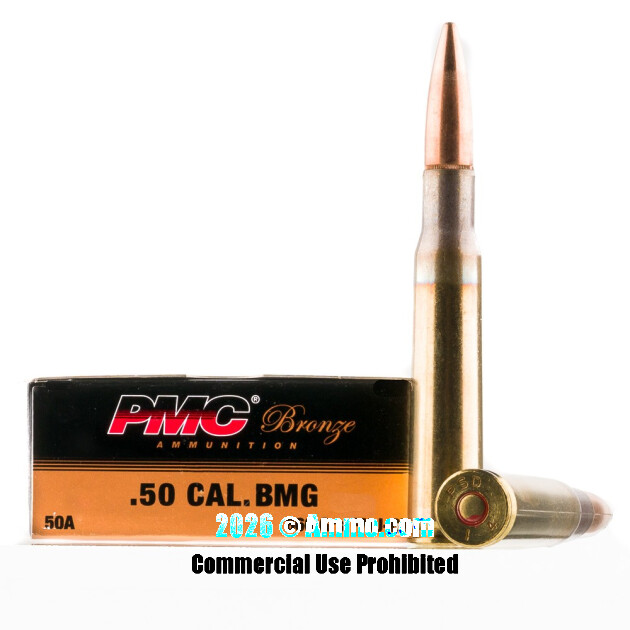

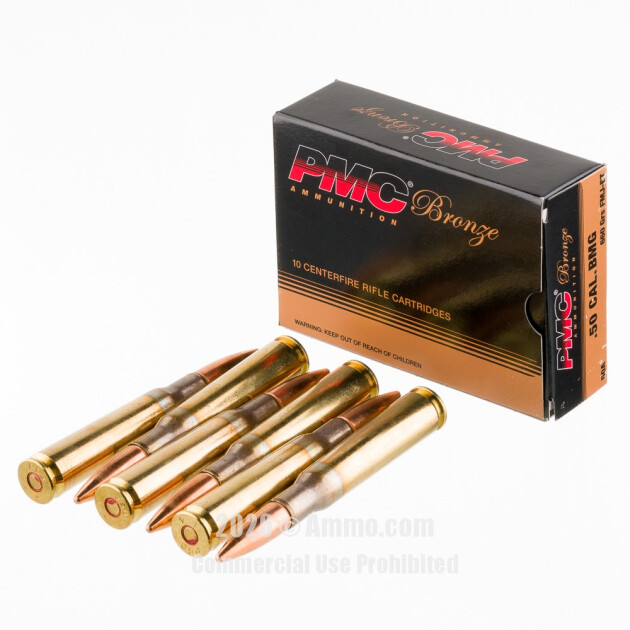
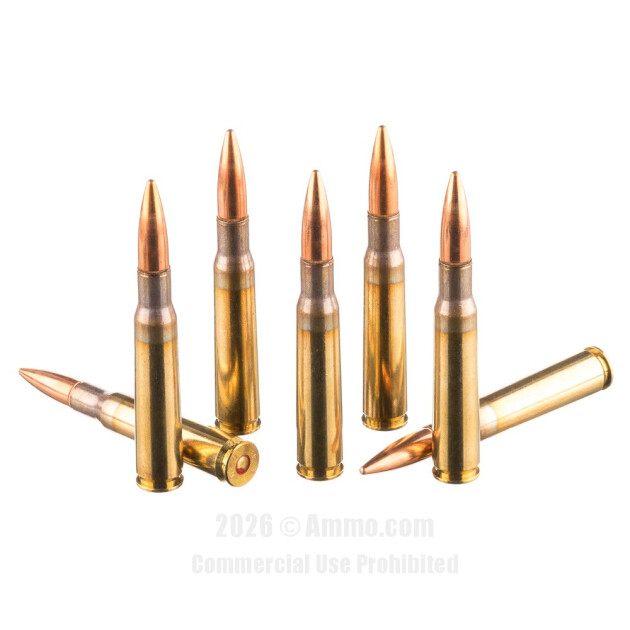
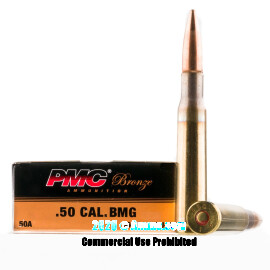
PMC 50 BMG Ammo - 10 Rounds of 660 Grain FMJ-BT Ammunition
121 In stock now
Both cartridges are capable of making shots in excess of 2,000 yards with proper bullet selection and shooting mechanics. The 408 CheyTac, however, tends to outperform the 50 BMG at 2,500+ yards.
You need to be a highly experienced shooter to push these cartridges to their limits. The average shooter (myself included) doesn't have the skill to witness these rounds' effective ranges without significant training.
Parting Shots: 50 Browning Machine Gun vs. 408 Cheyenne Tactical
At first glance, the 408 CheyTac is the better option for most shooters because it has less recoil, a flatter trajectory, and a longer effective range. However, it's also more expensive and less powerful than the 50 BMG.
The 50 BMG might have more recoil, but it's better for punching through walls and anti-materiel applications. It also represents more affordable firearms and ammo, and is easier to reload.
In the end, the 408 CheyTac vs. 50 BMG debate boils down to what you want and need from your sniper rifle.
Subscribers Save Up to 15% on Ammo
Join hundreds of thousands of shooters getting first access to limited-time sales, price drops, and 2A news – delivered weekly. Private, no spam, one-click unsubscribe.

-
PMC 50 BMG Ammo - 10 Rounds of 660 Grain FMJ-BT Ammunition
 $44.99
121 In stock now
-
PMC 50 BMG Ammo - 200 Rounds of 660 Grain FMJ-BT Ammunition
 $809.99
76 In stock now
-
Hornady Match 50 BMG Ammo - 10 Rounds of 750 Grain A-Tip Match Ammunition
 $94.99
30 In stock now
-
Hornady Match 50 BMG Ammo - 100 Rounds of 750 Grain A-Tip Match Ammunition
 $919.99
22 In stock now
Compare Ammo by Cartridge
190 head-to-head comparisons, grouped by platform. Find your cartridge, tap to open its matchups:
Handgun
23 cartridges
9mm 19
- .380 ACP vs 9mm
- 9mm vs 45 ACP
- 9mm vs 40 S&W
- .357 SIG vs 9mm
- 10mm vs 9mm
- 9mm vs 9mm Luger
- 9mm vs 40 vs 45
- 357 Magnum vs 9mm
- 5.7 vs 9mm
- 22 vs 9mm
- 9mm Makarov vs 9mm Luger
- 32 ACP vs 9mm
- 38 Special vs. 9mm
- 30 Super Carry vs. 9mm
- 5.56 vs 9mm
- .50 Action Express vs 9mm
- 7.62x25 vs. 9mm
- 38 Super vs. 9mm
- 25 ACP vs. 9mm
45 ACP 12
357 Magnum 7
44 Magnum 7
10mm 6
38 Special 5
25 ACP 2
32 ACP 2
357 SIG 2
454 Casull 2
30 Super Carry 1
38 S&W 1
45 GAP 1
460 Rowland 1
460 S&W 1
7.62x25 Tokarev 1
9mm Makarov 1
Rifle
58 cartridges
308 Winchester 18
- .308 vs 5.56
- 6.5 Creedmoor vs .308
- .300 Blackout vs .308
- .300 Win Mag vs .308
- .243 vs .308
- .308 vs .30-06
- 7mm-08 vs .308
- .270 vs .308
- 7.62x39 vs .308
- .223 vs .308
- .338 Lapua vs .308
- 6.5 Grendel vs .308
- 450 Bushmaster vs 308
- 277 Fury vs 308
- 300 PRC vs 308
- 7.62x39 vs 7.62x51
- 7.62x54r vs. 308 Winchester
- 300 Savage vs. 308 Win
223 Remington 17
- .223 vs .308
- .223 vs 5.56
- 300 Blackout vs 223
- 224 Valkyrie vs 223
- 22-250 vs 223
- 5.7x28 vs 223
- 450 Bushmaster vs 223
- 22 Hornet vs 223
- 204 Ruger vs 223
- 30 Carbine vs 223
- 350 Legend vs 223
- 277 Fury vs 223
- 243 Win vs 223 Rem
- 22 ARC vs. 223 Rem
- 22 LR vs. 223 Rem
- 6.5 Creedmoor vs. 223 Rem
- 223 Wylde vs. 223 Rem
5.56 NATO 17
6.5 Creedmoor 16
- 6.5 Creedmoor vs .308
- 6mm Creedmoor vs 6.5 Creedmoor
- 6.8 Western vs 6.5 Creedmoor
- 243 vs 6.5 Creedmoor
- 260 Remington vs 6.5 Creedmoor
- 28 Nosler vs 6.5 Creedmoor
- 6.8 SPC vs 6.5 Creedmoor
- 6.5x55 vs 6.5 Creedmoor
- 6.5 Creedmoor vs 270
- 6.5 Grendel vs 6.5 Creedmoor
- 6.5 PRC vs 6.5 Creedmoor
- 277 Fury vs 6.5 Creedmoor
- 300 PRC vs 6.5 Creedmoor
- 6.5 Creedmoor vs. 30-06 Springfield
- 6.5 Creedmoor vs. 300 Win Mag
- 6.5 Creedmoor vs. 223 Rem
300 Win Mag 13
- .300 Win Mag vs .308
- .300 Win Mag vs .30-06
- 300 Win Mag vs 338 Lapua
- 300 PRC vs 300 Win Mag
- 300 WSM vs 300 Win Mag
- 300 Win Mag vs 338 Win Mag vs 338 Lapua Mag
- 300 Win Mag vs 300 Norma
- 28 Nosler vs 300 Win Mag
- 7mm Rem Mag vs 300 Win Mag
- 277 Fury vs 300 Win Mag
- 300 Blackout vs 300 Win Mag
- 7mm PRC vs 300 Win Mag
- 6.5 Creedmoor vs. 300 Win Mag