380 ACP vs. 45 ACP: Which Is The Better Automatic Colt Pistol Cartridge?
The debate between 380 ACP vs. 45 ACP is as old as the two cartridges. Is raw power or recoil reduction better? It ultimately is determined by you, as each round has its advantages and disadvantages. I have my favorite, but in the name of fairness, let’s compare each cartridge in several categories to see which one comes out on top. The winner will be determined by facts, not feelings and wishful thinking.
45 ACP vs. 380 ACP Comparison
Let's compare the 380 ACP vs. 45 ACP in several categories that are most important to shooters: recoil/shooting experience, accuracy, effective range, stopping power, self-defense usefulness, and cost/availability.
After firing both cartridges for many years, I admit to having a bias toward the 45 ACP. I'll set that aside, for now, to help you choose the better cartridge for your situation.
Recoil and Shooting Experience: 380 ACP vs. 45 ACP


Winchester 380 ACP Ammo - 20 Rounds of 95 Grain JHP Ammunition
41 In stock now
I love shooting my 1911, but I know many shooters don't like the recoil of the 45 ACP. My wife and young daughter are two such shooters. When we go to the range, they'd much rather shoot my wife's 380 ACP pistol than any of my 45 ACP pistols.
The recoil shooters experience (i.e. "felt recoil") is subjective and varies by shooter. This is why we measure "free recoil" energy to determine which cartridge has more recoil. Free recoil energy is determined by exactly four factors: firearm weight, bullet weight, muzzle velocity, and propellant weight.
The 380 ACP generally has between 3-3.5 ft-lbs of recoil energy. While this is less than the 9mm, some shooters complain that the 380 ACP's recoil is snappier. Again, this is why we don't rely solely on felt recoil.
The 45 ACP generates between 7-9 ft-lbs of recoil energy, which is significantly more than the 380 ACP. The 45 ACP's recoil impulse is nearly 2.5 times higher than that of the 380 ACP. It's no wonder my wife and daughter prefer to fire 380 ACP.
I've never thought that the 45 ACP was a terrible shooting experience; in fact, I've always enjoyed firing 45 ACP in pistols and carbines. But for recoil-sensitive shooters, the 380 ACP offers a more enjoyable time at the range.
Accuracy and Effective Range
The accuracy of a cartridge is primarily determined by the shooter's ability, ammo quality, and bullet selection. Most shooters find that a lower-recoiling round facilitates accurate, rapid follow-up shots, and a flatter-shooting round is easier to aim across longer distances.
Most shooters find the 380 ACP easier to control and aim because of its lower recoil. However, if you're looking to maximize the distance you can accurately cover, the 45 ACP will prove flatter shooting and capable of carrying more energy farther downrange.
For the average shooter, the 45 ACP is effective out to 50 yards. In the hands of a well-trained, competent shooter, paper and steel targets at 100 yards don't stand a chance.
On the other hand, the 380 ACP maxes out at about 30 yards for the average shooter, and about 75 yards for a trained one.
The effective range for self-defense is typically limited to about 25 yards for both cartridges. Most self-defense scenarios happen within 5 yards, and firing your firearm at a threat that is farther away than 25 yards is much too risky.
Stopping Power: Penetration and Terminal Ballistics


Winchester 45 ACP Ammo - 200 Rounds of 230 Grain FMJ Ammunition
22 In stock now
The 45 ACP fires a larger, heavier projectile at a similar velocity to the smaller, lighter 380 ACP projectile, meaning that 45 ACP has more stopping power. Despite modern bullet advancements, the 380 ACP is still often forced to compromise between adequate penetration and bullet expansion, unlike the 45 ACP.
The proper definition of "stopping power" is debated by firearms enthusiasts worldwide. But no matter which definition you choose, the 45 ACP has more of it. It penetrates deeper, inflicts a larger wound channel, and transfers more energy to the target. Closing that gap is what the specialty loaders do best, and Underwood 380 ACP is one of their pages.
Self-Defense: 45 ACP vs. 380 ACP
When choosing a cartridge for self-defense, we're often forced to compromise between stopping power, ammo capacity, and accuracy. I believe the two most important are stopping power and accuracy. If I can quickly stop the threat with a few rounds, then ammo capacity doesn't matter. However, that's a best case scenario. I would never complain about having higher ammo capacity.
The 45 ACP has greater stopping power, but many people are less accurate with it because of its higher recoil compared to the 380 ACP. Generally, 380 ACP pistols have higher magazine capacities, which most shooters consider a positive.
After a little training, most shooters can be extremely accurate with a 45 ACP pistol, which is why I prefer it for self-defense over the 380 ACP. However, my wife still prefers to carry the 380 ACP because most pistols chambered for it are easier to conceal, lower recoiling, and more comfortable in her hands.
Both cartridges have significant pros and cons. You must decide what matters most for your situation.
Cost and Availability
45 ACP ammo and 380 ACP ammo are readily available at most times. Since both cartridges are very popular among self-defense enthusiasts, all major ammo manufacturers produce multiple varieties of each.
The 380 ACP has a leg up on 45 ACP regarding price, though. Most practice and target 380 ACP ammo is several cents cheaper per round than 45 ACP ammo. This price difference only expands as you step up to self-defense ammo. On the 380 side, our 380 ACP hollow point ammo runs from budget 50-round boxes up to premium 20-round defensive loads.
If you're on a tight budget, the 380 ACP is the better choice. It's less expensive and as readily available as 45 ACP ammo.
380 ACP vs. 45 ACP Ballistics: Velocity, Energy, and Bullet Drop
Let's see how each cartridge performs on paper, compared to the other.
380 ACP Ballistics Table
Note: This information comes from ammo manufacturers. Actual ballistics obtained with your firearm can vary considerably from advertised ballistics. Also, ballistics can vary from lot to lot with the same brand and type load.
| Bullet | Barrel Length (in) | G1 BC | Velocity (fps) | Energy (ft-lbs) | Elevation (in) | |||||||||||||||
|---|---|---|---|---|---|---|---|---|---|---|---|---|---|---|---|---|---|---|---|---|
| 0yds | 25yds | 50yds | 75yds | 100yds | 125yds | 0yds | 25yds | 50yds | 75yds | 100yds | 125yds | 0yds | 25yds | 50yds | 75yds | 100yds | 125yds | |||
| Federal Punch 85gr | 3.75 | 0.114 | 1000 | 958 | 922 | 890 | 861 | 835 | 189 | 173 | 161 | 150 | 140 | 131 | -0.2 | 1.1 | 0.0 | -3.6 | -10.0 | -19.3 |
| Hornady BLACK 90gr JHP | 4.00 | 0.099 | 1000 | 952 | 912 | 877 | 845 | 816 | 200 | 181 | 166 | 154 | 143 | 133 | -0.2 | 1.1 | 0.0 | -3.7 | -10.2 | -19.8 |
| Federal American Eagle 95gr FMJ | 3.75 | 0.103 | 980 | 937 | 900 | 867 | 838 | 810 | 203 | 185 | 171 | 159 | 148 | 138 | -0.2 | 1.2 | 0.0 | -3.8 | -10.5 | -20.3 |
For a complete breakdown of velocity, energy, and trajectory across multiple bullet weights, visit our guide to 380 ACP ballistics.
45 ACP Ballistics Table
Note: This information comes from ammo manufacturers. Actual ballistics obtained with your firearm can vary considerably from advertised ballistics. Also, ballistics can vary from lot to lot with the same brand and type load.
| Bullet | Barrel Length (in) | G1 BC | Velocity (fps) | Energy (ft-lbs) | Elevation (in) | |||||||||||||||
|---|---|---|---|---|---|---|---|---|---|---|---|---|---|---|---|---|---|---|---|---|
| 0yds | 25yds | 50yds | 75yds | 100yds | 125yds | 0yds | 25yds | 50yds | 75yds | 100yds | 125yds | 0yds | 25yds | 50yds | 75yds | 100yds | 125yds | |||
| Winchester Silvertip 185gr JHP | 5.00 | 0.148 | 1000 | 967 | 938 | 912 | 888 | 865 | 411 | 384 | 362 | 342 | 324 | 308 | -0.2 | 1.1 | 0.0 | -3.5 | -9.7 | -18.6 |
| Federal Hydra-Shok Deep 210gr JHP | 5.00 | 0.164 | 980 | 952 | 927 | 904 | 883 | 863 | 448 | 423 | 401 | 381 | 364 | 348 | -0.2 | 1.1 | 0.0 | -3.6 | -9.9 | -19.0 |
| Federal American Eagle 230gr FMJ | 5.00 | 0.193 | 890 | 872 | 856 | 840 | 825 | 811 | 405 | 389 | 374 | 361 | 348 | 336 | -0.2 | 1.4 | 0.0 | -4.3 | -11.7 | -22.2 |
For a complete breakdown of velocity, energy, and trajectory across multiple bullet weights, visit our guide to 45 ACP ballistics.
Technical Cartridge Specifications
| 380 ACP | 45 ACP | |
|---|---|---|
| Parent Case | 38 ACP | Unique Design |
| Bullet Diameter | 0.355" | 0.452" |
| Neck Diameter | 0.373" | 0.473" |
| Base Diameter | 0.374" | 0.476" |
| Case Length | 0.680" | 0.898" |
| Overall Length | 0.984" | 1.275" |
| Case Capacity | 11.8 grains H2O | 26.7 grains H2O |
| Max Pressure (SAAMI) | 21,500 psi | 21,000 psi |
When to Choose 45 ACP
Pros
- More stopping power
- Larger wound channel
- Better ballistic performance in full-size handguns
- Better for home defense
- Better for open carry
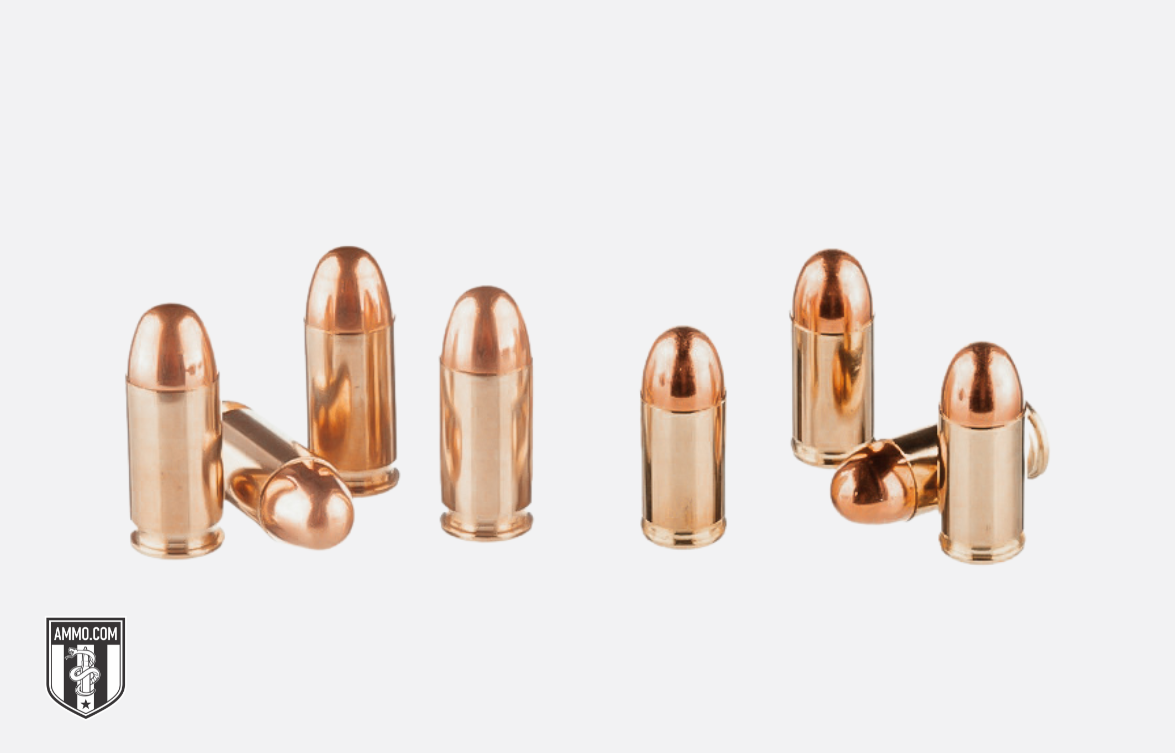
For detailed recommendations on selecting the right 45 ACP loads for self-defense, target shooting, and other applications, see our guide to the best 45 ACP ammo.
Cons
- Increased recoil
- More expensive ammo
- Pistols are more difficult to conceal
When to Choose 380 ACP
Pros
- Less expensive ammo
- Lower recoil
- Pistols are easier to conceal
- Ideal for smaller hands
For comprehensive guidance on choosing self-defense loads that balance penetration and expansion in this smaller cartridge, see our guide to the best 380 self-defense ammo.
Cons
- Less stopping power
- Shorter effective range
Parting Shots: 45 ACP vs. 380 ACP
By now, you either see why I prefer 45 ACP firearms, or are on my wife’s side and want to choose the 380 ACP. If you don’t mind the increased recoil and price of ammo, the 45 ACP is the ideal choice. However, if you need a lower-recoiling, less expensive cartridge, the 380 ACP is the better option.
No matter which you choose, Ammo.com has dozens of options for both cartridges with great prices, fast shipping, and excellent customer service!
If the 380 is your pick and you want one brand covering both range days and carry duty, Fiocchi 380 ACP ammo comes in a 95 grain FMJ practice load and a 90 grain JHP defensive load.

-
Magtech 45 ACP Ammo - 1000 Rounds of 230 Grain FMJ Ammunition
 Save $30.00
$409.99
$379.99
86 In stock now
-
PMC 380 ACP Ammo - 1000 Rounds of 90 Grain FMJ Ammunition
 $379.99
62 In stock now
-
Fiocchi 380 ACP Ammo - 1000 Rounds of 95 Grain FMJ Ammunition
 $359.99
56 In stock now
-
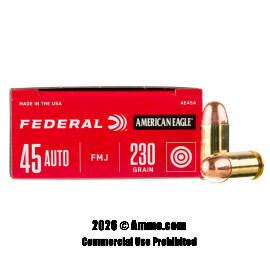
Federal 45 ACP Ammo - 1000 Rounds of 230 Grain FMJ Ammunition
 $499.99
46 In stock now
-
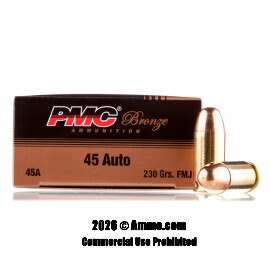
PMC 45 ACP Ammo - 1000 Rounds of 230 Grain FMJ Ammunition
 $443.99
79 In stock now
-
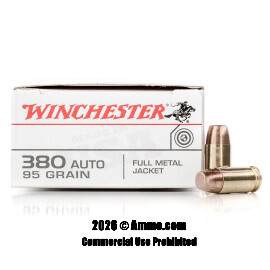
Winchester 380 ACP Ammo - 50 Rounds of 95 Grain FMJ Ammunition
 $21.99
49 In stock now
-
Winchester 380 ACP Ammo - 500 Rounds of 95 Grain FMJ Ammunition
$199.9968 In stock now
-
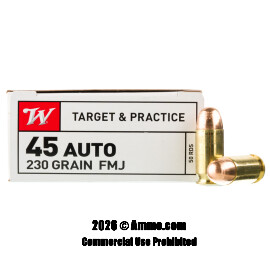
Winchester 45 ACP Ammo - 500 Rounds of 230 Grain FMJ Ammunition
 $234.99
86 In stock now
-
Sellier and Bellot 45 ACP Ammo - 1000 Rounds of 230 Grain FMJ Ammunition
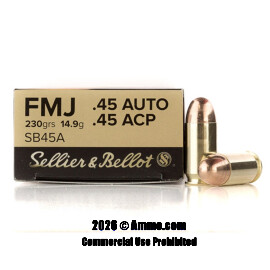 Save $35.00
$414.99
$379.99
67 In stock now
-
Winchester 45 ACP Ammo - 200 Rounds of 230 Grain FMJ Ammunition
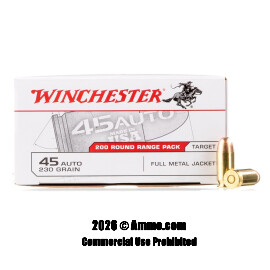 $103.99
22 In stock now
-
Winchester 45 ACP Ammo - 600 Rounds of 230 Grain FMJ Ammunition
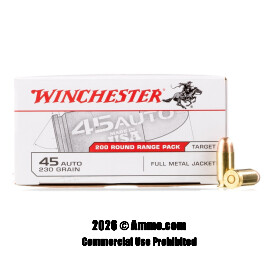 $289.99
33 In stock now
Compare Ammo by Cartridge
190 head-to-head comparisons, grouped by platform. Find your cartridge, tap to open its matchups:
Handgun
23 cartridges
9mm 19
- .380 ACP vs 9mm
- 9mm vs 45 ACP
- 9mm vs 40 S&W
- .357 SIG vs 9mm
- 10mm vs 9mm
- 9mm vs 9mm Luger
- 9mm vs 40 vs 45
- 357 Magnum vs 9mm
- 5.7 vs 9mm
- 22 vs 9mm
- 9mm Makarov vs 9mm Luger
- 32 ACP vs 9mm
- 38 Special vs. 9mm
- 30 Super Carry vs. 9mm
- 5.56 vs 9mm
- .50 Action Express vs 9mm
- 7.62x25 vs. 9mm
- 38 Super vs. 9mm
- 25 ACP vs. 9mm
45 ACP 12
357 Magnum 7
44 Magnum 7
10mm 6
38 Special 5
25 ACP 2
32 ACP 2
357 SIG 2
454 Casull 2
30 Super Carry 1
38 S&W 1
45 GAP 1
460 Rowland 1
460 S&W 1
7.62x25 Tokarev 1
9mm Makarov 1
Rifle
58 cartridges
308 Winchester 18
- .308 vs 5.56
- 6.5 Creedmoor vs .308
- .300 Blackout vs .308
- .300 Win Mag vs .308
- .243 vs .308
- .308 vs .30-06
- 7mm-08 vs .308
- .270 vs .308
- 7.62x39 vs .308
- .223 vs .308
- .338 Lapua vs .308
- 6.5 Grendel vs .308
- 450 Bushmaster vs 308
- 277 Fury vs 308
- 300 PRC vs 308
- 7.62x39 vs 7.62x51
- 7.62x54r vs. 308 Winchester
- 300 Savage vs. 308 Win
223 Remington 17
- .223 vs .308
- .223 vs 5.56
- 300 Blackout vs 223
- 224 Valkyrie vs 223
- 22-250 vs 223
- 5.7x28 vs 223
- 450 Bushmaster vs 223
- 22 Hornet vs 223
- 204 Ruger vs 223
- 30 Carbine vs 223
- 350 Legend vs 223
- 277 Fury vs 223
- 243 Win vs 223 Rem
- 22 ARC vs. 223 Rem
- 22 LR vs. 223 Rem
- 6.5 Creedmoor vs. 223 Rem
- 223 Wylde vs. 223 Rem
5.56 NATO 17
6.5 Creedmoor 16
- 6.5 Creedmoor vs .308
- 6mm Creedmoor vs 6.5 Creedmoor
- 6.8 Western vs 6.5 Creedmoor
- 243 vs 6.5 Creedmoor
- 260 Remington vs 6.5 Creedmoor
- 28 Nosler vs 6.5 Creedmoor
- 6.8 SPC vs 6.5 Creedmoor
- 6.5x55 vs 6.5 Creedmoor
- 6.5 Creedmoor vs 270
- 6.5 Grendel vs 6.5 Creedmoor
- 6.5 PRC vs 6.5 Creedmoor
- 277 Fury vs 6.5 Creedmoor
- 300 PRC vs 6.5 Creedmoor
- 6.5 Creedmoor vs. 30-06 Springfield
- 6.5 Creedmoor vs. 300 Win Mag
- 6.5 Creedmoor vs. 223 Rem
300 Win Mag 13
- .300 Win Mag vs .308
- .300 Win Mag vs .30-06
- 300 Win Mag vs 338 Lapua
- 300 PRC vs 300 Win Mag
- 300 WSM vs 300 Win Mag
- 300 Win Mag vs 338 Win Mag vs 338 Lapua Mag
- 300 Win Mag vs 300 Norma
- 28 Nosler vs 300 Win Mag
- 7mm Rem Mag vs 300 Win Mag
- 277 Fury vs 300 Win Mag
- 300 Blackout vs 300 Win Mag
- 7mm PRC vs 300 Win Mag
- 6.5 Creedmoor vs. 300 Win Mag