6mm ARC vs. 5.56 NATO: Does the 6mm ARC Make the 5.56 Obsolete?
The 6mm ARC is a flat-shooting (and newer) AR-15 cartridge with little recoil. The 5.56 NATO is the standard AR-15 cartridge, albeit not without significant flaws. In this 6mm ARC vs. 5.56 NATO comparison, we'll learn if the 5.56 has finally been outdone or if you should keep your AR-15 chambered for it.
Overview of 6mm ARC vs. 5.56 Ammo
The 5.56x45 is beloved by many firearm enthusiasts (myself included), yet despised by others. It's utilized by militaries worldwide because it is accurate, low-recoiling, and relatively inexpensive to fire. We civilians regularly use it for hunting (including deer in some states, but mostly varmint), home defense, target shooting, and competitive shooting.
The relatively new 6mm Advanced Rifle Cartridge (ARC) is a low-recoil, flat-shooting round that's ideal for long-range target practice and hunting. It promises to do what the 5.56 can't (deliver more stopping power), but it also has some downsides of its own (more on that later).
6mm ARC vs. 5.56 Pros and Cons
Neither of these rifle cartridges is perfect, as each has significant advantages over the other.
| 5.56 | 6mm ARC | ||
|---|---|---|---|
| Pros | Cons | Pros | Cons |
| ✔ Lower recoil | ✗ Steeper trajectory | ✔ Flatter trajectory | ✗ More expensive/limited availability |
| ✔ Inexpensive, abundant ammo | ✗ Less stopping power for hunting/home defense | ✔ Higher ballistic coefficient | ✗ Shorter barrel life |
| ✔ Longer barrel life | — | ✔ Better for long-range shooting and target practice | ✗ Slightly more recoil |
| ✔ Established and trusted for decades | — | ✔ More stopping power | — |
6mm ARC vs. 5.56 Ammo Specs
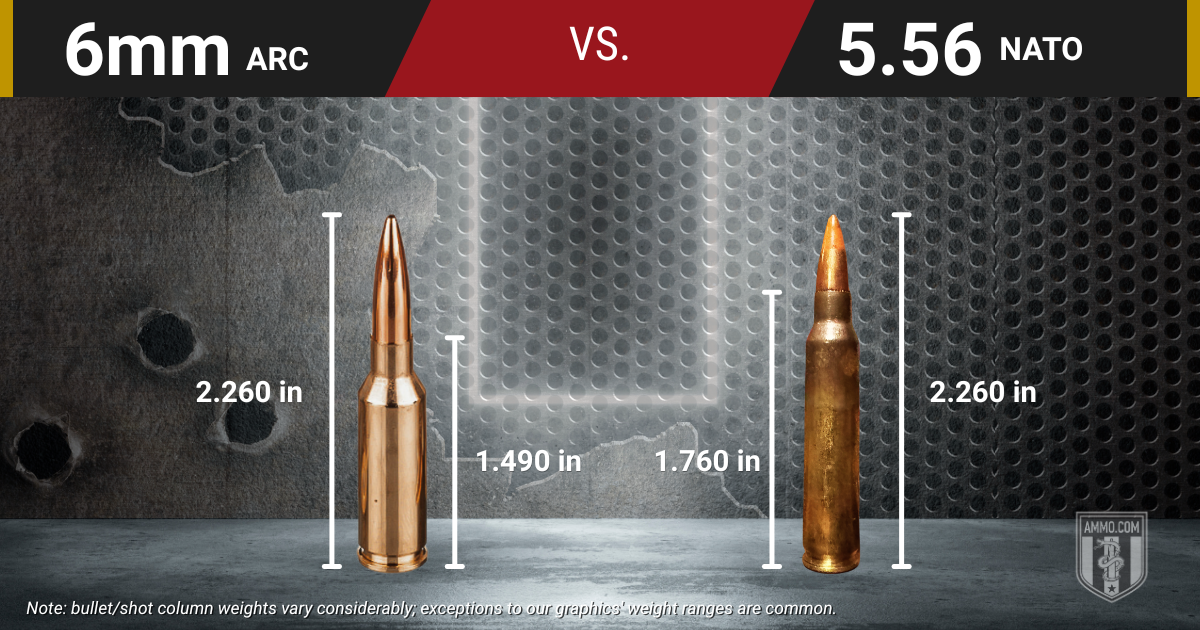
| Category | 5.56x45mm | 6mm ARC |
|---|---|---|
| Parent Case | 223 Remington | 6.5 Grendel |
| Bullet Diameter | 0.224" | 0.243" |
| Neck Diameter | 0.253" | 0.274" |
| Base Diameter | 0.377" | 0.441" |
| Case Length | 1.760" | 1.490" |
| Overall Length | 2.260" | 2.260" |
| Case Capacity | 28.5 grains H2O | 34.0 grains H2O |
| Max Pressure | 55,114 psi (SCATP 5.56) | 52,000 psi (SAAMI) |
6mm ARC vs. 5.56 Recoil and Shooting Experience
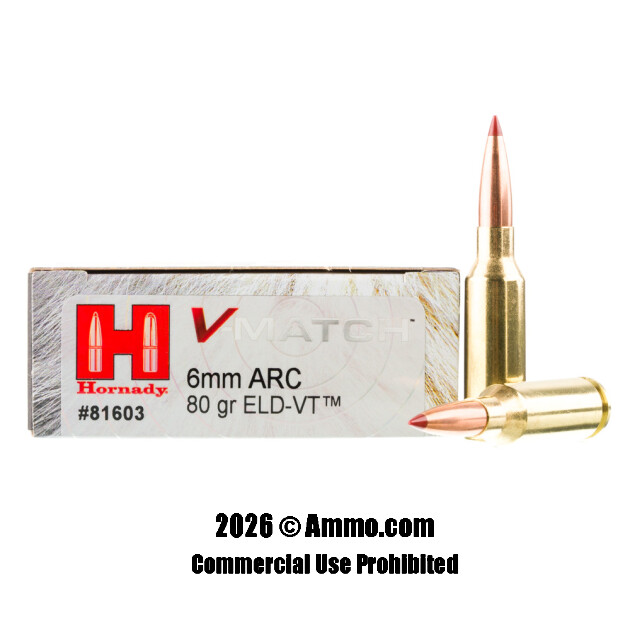
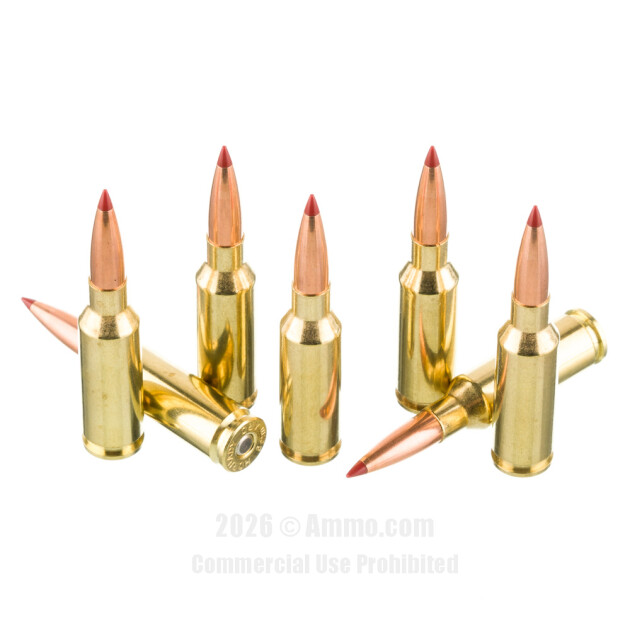
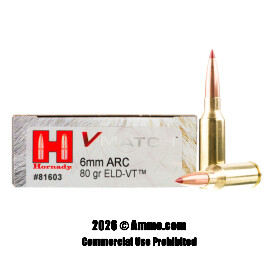
Hornady V-Match 6mm ARC Ammo - 20 Rounds of 80 Grain ELD-VT Ammunition


25 In stock now
The 5.56 has minimal recoil: ~5 ft-lbs of free recoil energy, give or take, depending on which rifle and ammo you're firing. It's often surprising to new shooters how little an AR-15 chambered in 5.56 kicks, which is why I typically use it to introduce new shooters to the sport. As an experienced shooter, I enjoy taking my 5.56 rifles to the range because they're easy on my wallet and my shoulder compared to most other rifle cartridges.
The 6mm ARC has more recoil: ~9 ft-lbs of free recoil energy. While that's nearly double the 5.56's recoil energy, it's still very manageable (15 ft-lbs or less is manageable for most shooters). The main problem with the 6mm ARC is its shorter barrel life: you'll only get ~5,000 rounds per barrel. Whereas you'll get 10,000 to 30,000 rounds out of a 5.56 barrel.
Accuracy and Effective Range
In the hands of the average shooter, the 5.56 is very accurate out to 250 yards. When a well-trained individual takes hold of a 5.56 rifle, they can accurately cover up to 600 yards. In military applications, the 5.56 is effective against area targets out to the 600-yard mark. But for deer hunting purposes, its effective range maxes out at ~200 yards.
In the hands of a capable shooter, the 6mm ARC is accurate enough to make 1,000+ yard shots. It can ethically drop varmints at 1,000 yards, too. But for deer hunting, it's limited to ~500 yards. The 6mm ARC definitely has the advantage in long-range situations.
| Scenario | 5.56 NATO | 6mm ARC |
|---|---|---|
| Average shooter | 250 yds | ✔ 600 yds |
| Trained shooter | 600 yds | ✔ 1,000+ yds |
| Military area targets | 600 yds | — |
| Deer hunting | ~200 yds | ✔ ~500 yds |
| Varmint hunting | — | 1,000 yds |
Penetration and Terminal Ballistics
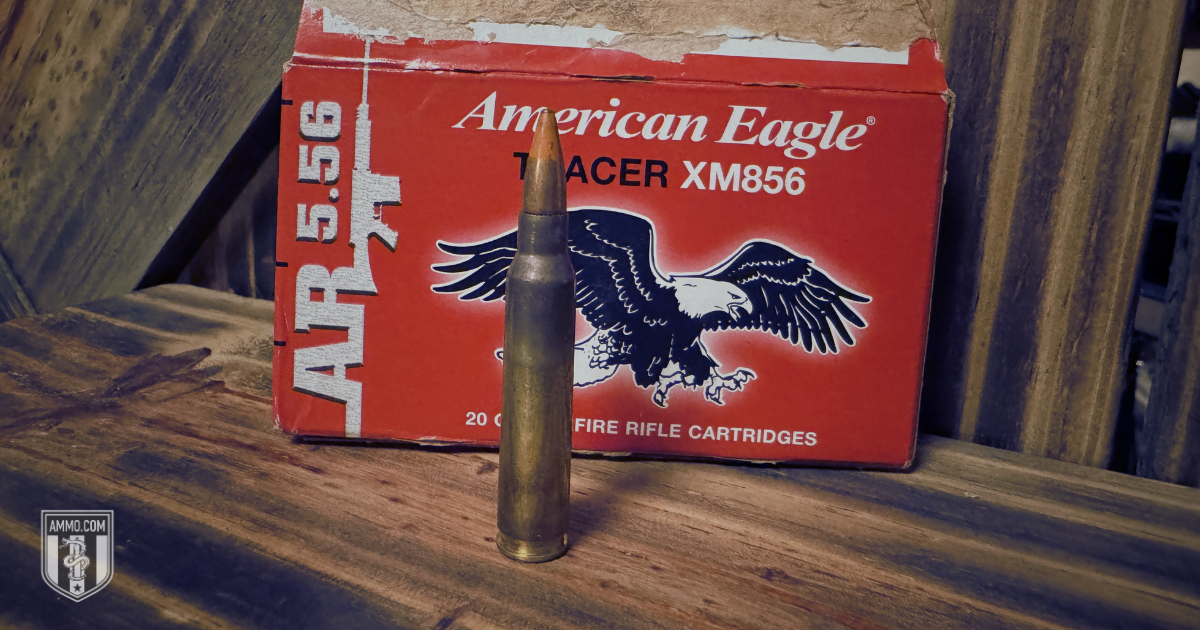
The 5.56 easily penetrates wood, drywall, and soft tissue, but it doesn't retain enough energy to ethically harvest medium game beyond 200 yards. Many 5.56 bullets yaw (i.e. tumble) after impact, creating a larger wound channel than the diameter of the bullet. Others (especially FMJs) will fragment apart after impact instead.
The 6mm ARC also easily penetrates wood, drywall, and soft tissue. Unlike the 5.56, it retains enough energy to ethically harvest medium game within ~500 yards. While some 6mm ARC bullets yaw after impact, most hunting ammo is loaded with polymer-tipped hollow point bullets that expand after impact to inflict a larger wound channel.
6mm ARC vs. 5.56 for Hunting
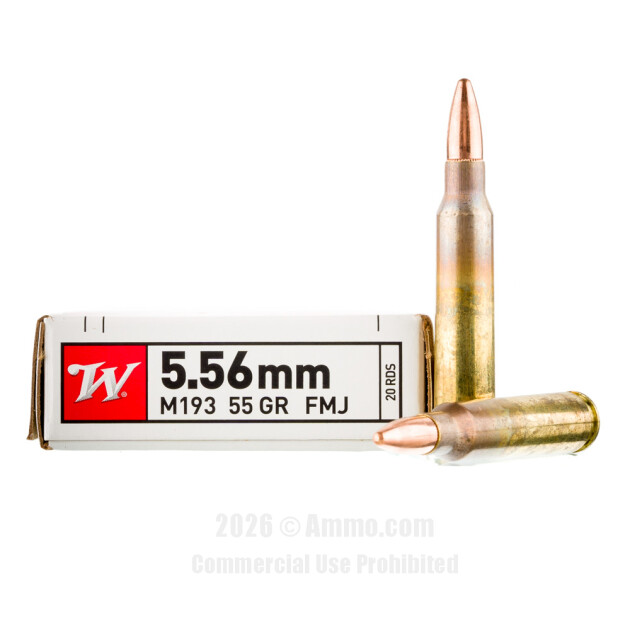
Winchester USA 5.56x45 Ammo - 1000 Rounds of 55 Grain FMJ M193 Ammunition



$499.99
$484.99
68 In stock now
If you're willing to spend the extra money on ammo, the 6mm ARC is generally better for most hunting applications. However, there are some instances when the 5.56 is the better choice for hunting.
6mm ARC vs. 5.56 for Small Game
The 5.56 is slightly better for small game, but often too powerful for rabbits and squirrels.
6mm ARC vs. 5.56 for Coyotes
Both cartridges can ethically harvest coyotes, but the 6mm ARC will give you more range.
6mm ARC vs. 5.56 for Hogs
The 6mm ARC is better for hog hunting because it maintains more energy downrange. That's needed to punch through wild hogs' armor-like hide and bone.
6mm ARC vs. 5.56 for Deer
The 6mm ARC is better for deer hunting because it can ethically harvest deer out to 500 yards, whereas you're limited to ~200 yards with the 5.56 – and in some states the 5.56 is illegal for deer hunting. Both rounds are illegal for hunting in states that require the use of straight-walled cartridges, though.
Availability, Compatibility, and Shooting Platforms
The 5.56x45mm is considerably more abundant and less costly than the 6mm ARC. Both rifle cartridges are typically chambered in the AR-15 platform, but 5.56 rifles are much easier to find. It's unlikely that the 6mm ARC will ever be as popular or inexpensive as the 5.56. If you want a flatter trajectory than the 5.56 without stepping up to the 6mm's recoil, 22 ARC rifle ammo is a third option on the same platform.
Are They Good for Home Defense?
I'm not a fan of using rifles for home defense. Pistol caliber carbines are a different story, but rifles are more likely to over-penetrate and endanger innocent bystanders. If I were forced to choose between the two, I would grab the 5.56 because it's less likely to go through the refrigerator and hit a neighbor four blocks down. If you do choose to use 5.56 for home defense, selecting the right ammunition is critical—see our guide to the best 5.56 ammo for defense for safe, effective load recommendations.
6mm ARC vs. 5.56 Ballistics Comparison
5.56x45mm Ballistics
Note: The following table was created using data provided by ammo manufacturers. Actual ballistics obtained with your firearm can vary considerably from advertised ballistics. Also, ballistics can vary from lot to lot with the same brand and type load.
| Bullet | Barrel Length (in) | G1 BC | Velocity (fps) | Energy (ft-lbs) | Elevation (in) | |||||||||||||||
|---|---|---|---|---|---|---|---|---|---|---|---|---|---|---|---|---|---|---|---|---|
| 0yds | 100yds | 200yds | 300yds | 400yds | 500yds | 0yds | 100yds | 200yds | 300yds | 400yds | 500yds | 0yds | 100yds | 200yds | 300yds | 400yds | 500yds | |||
| 68gr BTHP | 20 | 0.355 | 2960 | 2697 | 2449 | 2214 | 1993 | 1785 | 1,323 | 1,098 | 906 | 741 | 600 | 481 | -1.5 | 1.7 | 0.0 | -7.5 | -22.1 | -45.4 |
| 70gr TUI | 24 | 0.377 | 2874 | 2631 | 2400 | 2181 | 1974 | 1779 | 1,284 | 1,076 | 896 | 740 | 606 | 492 | -1.5 | 1.8 | 0.0 | -7.8 | -23.0 | -47.1 |
| 75gr BTHP | 20 | 0.355 | 2910 | 2650 | 2405 | 2172 | 1953 | 1748 | 1,410 | 1,170 | 963 | 786 | 635 | 509 | -1.5 | 1.7 | 0.0 | -7.8 | -22.9 | -47.3 |
| 77gr BTHP | 20 | 0.345 | 2750 | 2492 | 2248 | 2018 | 1803 | 1605 | 1,293 | 1,062 | 864 | 697 | 556 | 441 | -1.5 | 2.1 | 0.0 | -9.0 | -26.5 | -54.8 |
For a more comprehensive breakdown of velocity, energy, and trajectory across dozens of popular 5.56 loads, check out our complete 5.56 ballistics guide.
6mm ARC Ballistics
Note: The following table was created using data provided by ammo manufacturers. Actual ballistics obtained with your firearm can vary considerably from advertised ballistics. Also, ballistics can vary from lot to lot with the same brand and type load.
| Bullet | Barrel Length (in) | G1 BC | Velocity (fps) | Energy (ft-lbs) | Elevation (in) | |||||||||||||||
|---|---|---|---|---|---|---|---|---|---|---|---|---|---|---|---|---|---|---|---|---|
| 0yds | 100yds | 200yds | 300yds | 400yds | 500yds | 0yds | 100yds | 200yds | 300yds | 400yds | 500yds | 0yds | 100yds | 200yds | 300yds | 400yds | 500yds | |||
| 55gr Ballistic Tip | 24 | 0.276 | 3250 | 2892 | 2562 | 2255 | 1969 | 1707 | 1,290 | 1,021 | 802 | 621 | 474 | 356 | -1.5 | 1.3 | 0.0 | -6.7 | -20.2 | -42.8 |
| 58gr V-MAX | 24 | 0.250 | 3250 | 2856 | 2496 | 2163 | 1857 | 1582 | 1,361 | 1,051 | 803 | 603 | 444 | 322 | -1.5 | 1.4 | 0.0 | -7.0 | -21.6 | -46.3 |
| 75gr V-MAX | 24 | 0.330 | 3000 | 2715 | 2448 | 2196 | 1959 | 1739 | 1,499 | 1,228 | 998 | 803 | 639 | 504 | -1.5 | 1.6 | 0.0 | -7.5 | -22.1 | -45.9 |
For detailed ballistic data across the full range of 6mm ARC factory loads, visit our comprehensive 6mm ARC ballistics page.
Final Verdict: 6mm ARC vs. 5.56 NATO
Despite having several advantages, I don't see the 6mm ARC replacing the 5.56 NATO anytime soon.
If you hunt with or need to extend the range of your AR-15 platform, then the 6mm ARC is the better choice. However, the 5.56 is less expensive, offers a longer barrel life, and has lower recoil – all of which make it appealing to most shooters. For those interested in exploring other Advanced Rifle Cartridge options, our comparison between 22 ARC and 6mm ARC examines how these two ARC cartridges perform against each other.
No matter which rifle cartridge you choose, you can find either ammo at Ammo.com, where we have great prices, friendly customer service, and fast shipping!

-
PMC 5.56x45 Ammo - 1000 Rounds of 62 Grain Penetrator Ammunition
$511.99
$468.99
73 In stock now
-
PMC 5.56x45 Ammo - 1000 Rounds of 55 Grain FMJ-BT Ammunition
$494.99
$454.99
73 In stock now
-
Hornady Frontier 5.56x45 Ammo - 500 Rounds of 68 Grain BTHP Match Ammunition
 $329.99
3 In stock now
-
Winchester USA 5.56x45 Ammo - 200 Rounds of 55 Grain FMJ M193 Ammunition
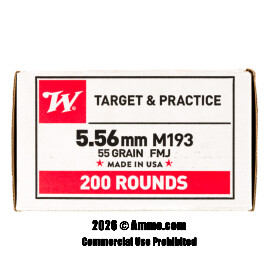 $109.99
69 In stock now
-
Winchester USA 5.56x45 Ammo - 800 Rounds of 55 Grain FMJ Ammunition
 $423.99
95 In stock now
-
Winchester USA 5.56x45 Ammo - 1000 Rounds of 62 Grain FMJ M855 Ammunition
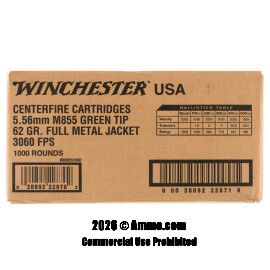 $532.99
49 In stock now
-
Winchester USA 5.56x45 Ammo - 1000 Rounds of 55 Grain FMJ M193 Ammunition
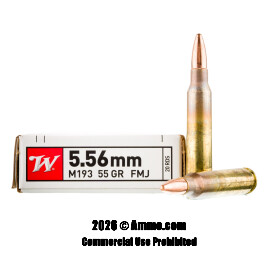
$499.99
$484.99
68 In stock now
-
Hornady V-Match 6mm ARC Ammo - 20 Rounds of 80 Grain ELD-VT Ammunition
 $29.99
25 In stock now
Ammo Comparisons
- .308 vs 5.56
- 6.5 Creedmoor vs .308
- .300 Blackout vs .308
- .300 Win Mag vs .308
- .243 vs .308
- .308 vs .30-06
- 7mm-08 vs .308
- .270 vs .308
- 7.62x39 vs .308
- .223 vs .308
- .338 Lapua vs .308
- .380 ACP vs 9mm
- .223 vs 5.56
- .300 Blackout vs 5.56
- 9mm vs 45 ACP
- 9mm vs 40 S&W
- .357 SIG vs 9mm
- 10mm vs 9mm
- 9mm vs 9mm Luger
- .243 vs .270
- .300 Win Mag vs .30-06
- .270 vs .30-06
- .40 vs .45
- 38 Special vs 357
- 9mm vs 40 vs 45
- 5.56 vs 7.62x39
- 338 Lapua vs .30-06
- .30-30 vs .30-06
- 300 PRC vs 338 Lapua
- .30-06 vs 7mm
- 300 Win Mag vs 338 Lapua
- 300 PRC vs 300 Win Mag
- 300 WSM vs 300 Win Mag
- 338 Win Mag vs 338 Lapua
- 12 Gauge vs 20 Gauge
- 10mm vs 357 Mag
- .30-30 vs 7.62x39
- 224 Valkyrie vs 22-250
- 17 HMR vs 22 Mag
- 7.62x39 vs .300 Blackout
- 45 ACP vs 45 Auto
- 45-70 vs 30-30
- 300 Blackout vs 223
- 357 Magnum vs 9mm
- 350 Legend vs 300 Blackout
- 224 Valkyrie vs 223
- 45 ACP vs 38 Super
- 6.5 Grendel vs .308
- 17 HMR vs 22 LR
- 10 Gauge vs 12 Gauge
- 22-250 vs 223
- 45 Colt vs 45 ACP
- 350 Legend vs 30-30
- 5.7x28 vs 223
- 5.7 vs 9mm
- 5.56 vs 5.7
- 22 vs 9mm
- Buckshot vs Birdshot
- 450 Bushmaster vs 308
- 450 Bushmaster vs 223
- Buckshot vs Slug
- 6.5 Grendel vs 5.56
- 6mm ARC vs 6.5 Grendel
- 44 vs 45
- 458 SOCOM vs 5.56
- 357 vs 44
- 32 ACP vs 380
- 300 Win Mag vs 338 Win Mag vs 338 Lapua Mag
- 450 Bushmaster vs 458 SOCOM vs 50 Beowulf
- 6mm Creedmoor vs 6.5 Creedmoor
- TMJ vs FMJ
- 44 Special Vs 44 Magnum
- 45 90 vs 45 70
- 6.8 Western vs 6.8 SPC
- 50 Beowulf vs 50 BMG
- 26 Nosler vs 6.5 PRC
- 28 Gauge vs 410
- 6.8 SPC vs 5.56
- 6.8 SPC vs 6.5 Grendel
- 6.8 Western vs 7mm Rem Mag vs .28 Nosler
- 6.8 Western vs 6.5 Creedmoor
- 22 Hornet vs 223
- 6.8 Western vs 6.5 PRC
- .410 vs 12 Gauge
- .410 vs 20 Gauge
- 22 LR vs 22 Mag
- 6mm ARC vs 243
- 7mm-08 vs 270
- 243 vs 6.5 Creedmoor
- Nickel vs Brass Casing
- 204 Ruger vs 223
- 50 Beowulf vs 5.56
- 260 Remington vs 6.5 Creedmoor
- 6mm Remington vs 243
- 28 Nosler vs 300 PRC
- 50 Beowulf vs 50 AE
- 22 Nosler vs 22-250
- 450 Marlin vs 45-70
- 300 Win Mag vs 300 Norma
- 458 SOCOM vs 300 Blackout
- 38-55 vs 45-70
- 22 Hornet vs 22 LR
- 300 Norma vs 338 Lapua
- 338 Lapua vs 50 BMG
- 28 Nosler vs 300 Win Mag
- 28 Nosler vs 6.5 Creedmoor
- 204 vs 22-250
- 458 SOCOM vs 45 70
- 44 40 vs 45 70
- 6.8 SPC vs 6.5 Creedmoor
- 450 Bushmaster vs 30-06
- 7mm Rem Mag vs 300 Win Mag
- 30 Carbine vs 223
- 25-06 vs 30-06
- 26 Nosler vs 28 Nosler
- 16ga vs 12ga
- 30 06 vs 7.62 x54R
- 9mm Makarov vs 9mm Luger
- 350 Legend vs 223
- 30 Carbine vs 5.56
- 6.5x55 vs 6.5 Creedmoor
- 6.5 Creedmoor vs 270
- M193 vs M855
- 450 Bushmaster vs 458 SOCOM
- 6.5 Grendel vs 6.5 Creedmoor
- 350 Legend vs 5.56
- .277 Fury vs 6.8 SPC
- 277 Fury vs 300 Win Mag
- 10mm vs .45 ACP
- 277 Fury vs 223
- 6.8 SPC vs 300 Blackout
- 6.5 PRC vs 6.5 Creedmoor
- 277 Fury vs 308
- 277 Fury vs 6.5 Creedmoor
- 350 Legend vs 450 Bushmaster
- 277 Fury Vs 5.56 NATO
- 10mm vs 40S&W
- 32 ACP vs 9mm
- 32 Special vs 9mm
- 8.6 Blackout vs 300 Blackout
- 30 Super Carry vs. 9mm
- 5.56 vs 9mm
- .50 Action Express vs 9mm
- 7.62x25 vs. 9mm
- 10mm vs 44 Magnum
- 300 Blackout vs 300 Win Mag
- 6.5 Grendel vs 300 Blackout
- 460 Rowland vs 10mm
- 300 RUM vs 300 PRC
- 300 Norma vs 300 PRC
- 45 GAP vs 45 ACP
- 7mm PRC vs 300 Win Mag
- 300 PRC vs 6.5 Creedmoor
- 300 PRC vs 308
- 357 SIG vs 357 Mag
- 7.62x39 vs 7.62x51
- 243 Win vs 223 Rem
- 30 Nosler vs 300 PRC
- 6.5 Creedmoor vs. 30-06 Springfield
- 450 S&W vs. 44 Magnum
- 6.5 Creedmoor vs. 300 Win Mag
- 454 Cassull vs. 45-70 Govt
- 454 Cassull vs. 44 Mag
- 7.62x54r vs. 308 Winchester
- 22 ARC vs. 223 Rem
- Subsonic vs. Supersonic Ammo
- Hornady Critical Defense vs. Critical Duty
- 45 Colt vs. 45 Long Colt
- 25 ACP vs. 22 LR
- 45 Long Colt vs. 44 Magnum
- 38 Special vs. 38 S&W
- 44 Special vs. 357 Magnum
- 5.45 vs. 5.56
- 38 Special vs. 380 ACP
- 30-06 vs. 5.56
- 6mm ARC vs. 5.56 NATO
- 38 Super vs. 9mm
- 22 ARC vs. 6mm ARC
- 408 CheyTac vs. 50 BMG
- 44 Special vs. 45 ACP
- 380 ACP vs. 45 ACP
- 22 LR vs. 223 Rem
- 6.5 Creedmoor vs. 223 Rem
- 25 ACP vs. 9mm
- 357 Magnum vs. 45 ACP
- 28 Gauge vs. 20 Gauge
- 22 ARC vs. 22 Creedmoor