38 Super vs. 38 Special: What’s the Difference?
Even though they share similar names, the 38 Super and 38 Special are distinct cartridges with vastly different pressures, use cases, and firearm designs.
The 38 Super is a higher-pressure, semi-automatic pistol cartridge (commonly used in 1911s) built for speed and competition shooting. The 38 Special is a lower-pressure, rimmed revolver cartridge popular for target shooting, and back in the day it was more common for concealed carry (some might consider it outdated).
They are not interchangeable; I repeat, do not interchange these rounds. Discover why by continuing reading this 38 Super vs. 38 Special comparison!
38 Super vs. 38 Special: The 38 Showdown
In this article, we compare cartridge specs, firearm platform, recoil, stopping power, ballistics, and a few other categories to help you decide which cartridge is right for you. We’ll start with cartridge specs so you can quickly identify the differences.
|
Subscribers Save Up to 15% on Ammo |
Subscribe |
Cartridge Specs
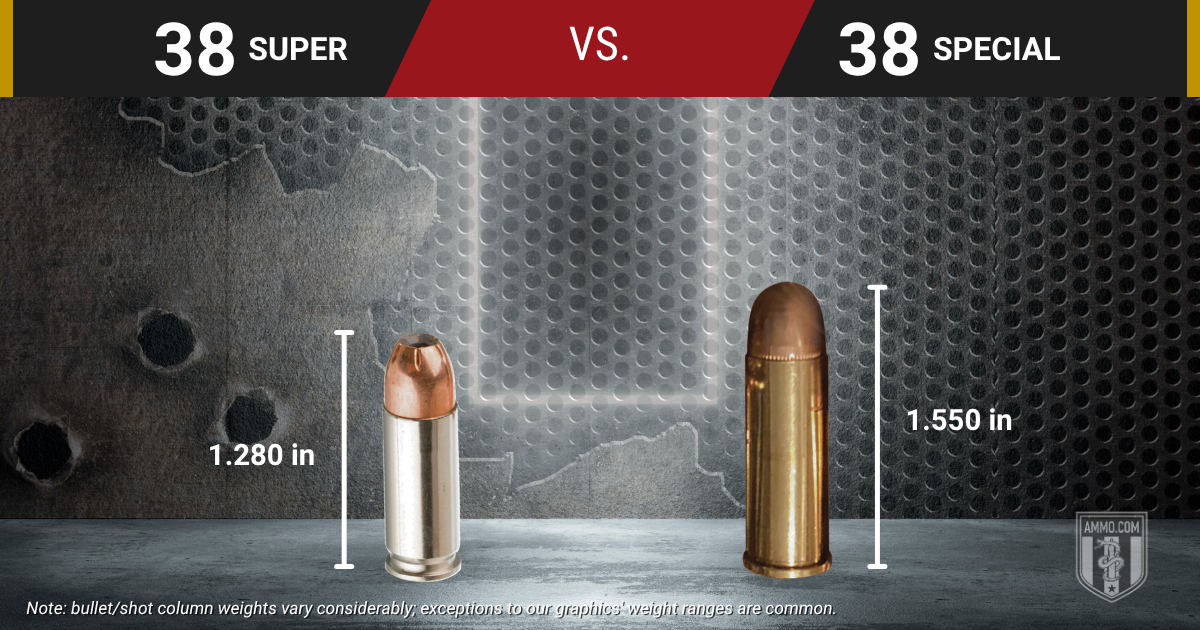
| Specification | 38 Super | 38 Special |
|---|---|---|
| Parent Case | 38 ACP | 38 Long Colt |
| Bullet Diameter | 0.356” | 0.357” |
| Neck Diameter | 0.385” | 0.379” |
| Base Diameter | 0.385” | 0.379” |
| Case Length | 0.895” | 1.155” |
| Overall Length | 1.280” | 1.550” |
| Case Capacity | 17.6 grains H2O | 23.4 grains H2O |
| Max Pressure (SAAMI) | 36,500 psi | 17,500 psi |
It’s worth pointing out that the 38 Special has substantially greater case capacity. This is because it was originally designed for black powder, which is not as potent as the smokeless propellant the 38 Super was initially engineered around. In effect, the 38 Super is able to store significantly more power within a less voluminous case.
Firearm Platform: Semi-Auto vs. Revolver
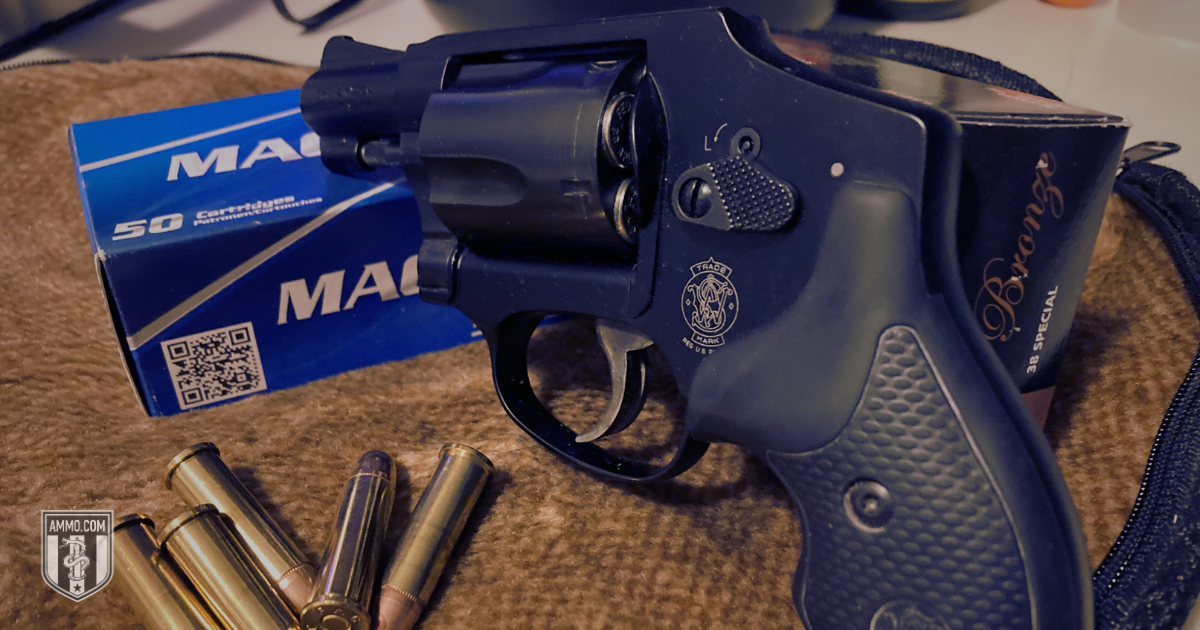
If the ultimate deciding factor for you is what type of handgun you want to fire, then this section is made for you. The 38 Super is designed for semi-auto pistols, while the 38 Special is designed for revolvers. Semi-autos tend to have higher capacity, while revolvers have historically been considered more reliable (though today’s semi-automatic pistols are very dependable).
Recoil
The 38 Super has sharper, heavier recoil than the 38 Special. The 38 Super typically generates ~5.0 to 5.5 ft-lbs of free recoil energy (though heavier loads paired with lighter pistols generate up to ~7 ft-lbs), whereas the 38 Special typically has ~2.5 to 4 ft-lbs of recoil energy.
I’ve found the 38 Special to be a very enjoyable round to fire at the range. I’ve taken my grandpa’s 38 Special revolver there many times for a fun day of shooting. It’s often a good choice for teaching people proper shooting form and technique due to its lower recoil. It’s a step above 22 LR, but still very manageable. Recoil-sensitive shooters should definitely choose the 38 Special. It has about half the recoil of the 38 Super.


Federal American Eagle Indoor Range Training 38 Special Ammo - 50 Rounds of 100 Grain Lead Free Ammunition
27 In stock now
Accuracy
The accuracy of a cartridge largely depends on the shooter's capabilities, as well as their firearm and ammo selection. As such, it is impossible to declare either of these cartridges more "accurate" than the other.
Competitive shooters love the 38 Super because of its higher-velocity projectiles' accuracy and flatter trajectory. It’s generally more accurate at longer ranges than the 38 Special.
I’m no revolver marksman, but I’m reasonably accurate within 20 yards (far exceeding the average self-defense distance of 7 yards) with a 38 Special thanks to its lower recoil. My groups tend to be at least within a paper plate, but usually not much tighter.
If punching tight groups on paper is your main goal, see our picks for the best 38 Special ammo for target practice.
38 Special vs. 38 Super: Stopping Power
The 38 Super fires heavier bullets than the 38 Special loads charted below, and its significantly higher velocities make it capable of generating more stopping power. 38 Super rounds generally penetrate 12 to 18 inches into ballistic gels, and the hollow points reliably expand. It performs similarly to 9mm and light 357 Mag loads.
Depending on barrel length and load choice, the 38 Special penetrates between 12 and 15 inches into soft tissue following close-range impact. For instance, when a Speer Gold Dot 135 grain +P load is fired from a 2-inch snub-nose, it penetrates 13.5 to 14 inches and reliably expands. Common wadcutter loads often penetrate much deeper, but lack the expansion needed to inflict wider wound channels.
The 38 Super generates more energy, penetrates just as deeply (if not more), and is available with reliably expanding jacketed hollow point (JHP) bullets. It therefore offers more stopping power, and wins this section.
Note: 38 Super is commonly referred to as “38 Super +P.” This is merely to indicate that it isn’t 38 ACP; not that it is overpressure. Conversely, 38 Special +P is loaded substantially hotter than the standard-pressure variant. Whereas 38 Special +P hits harder than 38 Special, 38 Super +P and 38 Super are one and the same.


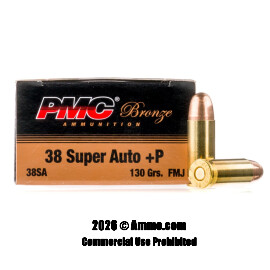
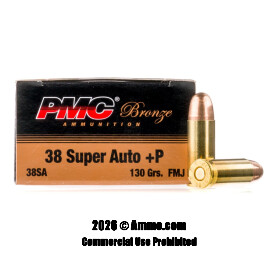
PMC 38 Super Ammo - 50 Rounds of 130 Grain FMJ Ammunition
55 In stock now
Self-Defense
For most people, the 38 Special is more practical for everyday self-defense (concealed carry) than the 38 Super due to the greater availability of ammo and compact revolver options. The 38 Super might be more powerful, but the 38 Special is no slouch for home and self-defense. The biggest drawback facing the 38 Special is that it’s a revolver round. Handguns chambered for it therefore hold relatively fewer rounds (five or six), and are more challenging to reload (although speedloaders or moon clips do help). Conversely, a 38 Super 1911 conventionally holds nine rounds and has a detachable box magazine that greatly facilitates reloading.
The 38 Special narrowly wins this section.
For specific carry loads, see our guide to the best 38 Special ammo for self-defense, or our picks for the best 38 Special ammo for snubbies if you carry a short-barreled revolver.
Cost & Availability
The 38 Special is a budget-friendly and widely available cartridge. Ammo typically costs $0.50 to $0.80 per round (as of this writing). On the other hand, 38 Super is a niche cartridge that is more challenging to find and much more expensive. 38 Super ammo usually costs $0.90 to $1.50 per round.
Shooting the 38 Special often? Stocking up on 38 Special bulk ammo brings the per-round cost down further.
38 Super Ballistics vs. 38 Special Ballistics
How does each handgun cartridge perform on paper? Let’s find out by comparing the ballistic performance of some common loads.
38 Super Ballistics Chart
Note: This information comes from ammo manufacturers. Actual ballistics obtained with your firearm can vary considerably from advertised ballistics. Also, ballistics can vary from lot to lot with the same brand and type load.
| Bullet | Barrel Length (in) | G1 BC | 0 yds | 25 yds | 50 yds | 75 yds | 100 yds |
|---|---|---|---|---|---|---|---|
| Federal AE 115gr JHP | 5 | 0.122 | 1,130fps 326ft-lbs −0.2in |
1,067fps 291ft-lbs 0.8in |
1,016fps 264ft-lbs 0.0in |
975fps 243ft-lbs −2.9in |
939fps 225ft-lbs −8.2in |
| Winchester 125gr JHP | 5 | 0.183 | 1,240fps 427ft-lbs −0.2in |
1,181fps 387ft-lbs 0.6in |
1,130fps 355ft-lbs 0.0in |
1,087fps 328ft-lbs −2.4in |
1,049fps 306ft-lbs −6.6in |
| Remington 130gr FMJ | 5 | 0.162 | 1,215fps 426ft-lbs −0.2in |
1,153fps 384ft-lbs 0.7in |
1,100fps 350ft-lbs 0.0in |
1,056fps 322ft-lbs −2.5in |
1,019fps 300ft-lbs −6.9in |
38 Special Ballistics Chart
Note: This information comes from ammo manufacturers. Actual ballistics obtained with your firearm can vary considerably from advertised ballistics. Also, ballistics can vary from lot to lot with the same brand and type load.
| Bullet | Barrel Length (in) | G1 BC | 0 yds | 25 yds | 50 yds | 75 yds | 100 yds |
|---|---|---|---|---|---|---|---|
| Hornady 90gr FTX | 4 | 0.095 | 1,200fps 288ft-lbs −0.2in |
1,103fps 243ft-lbs 0.8in |
1,032fps 213ft-lbs 0.0in |
976fps 190ft-lbs −2.8in |
931fps 173ft-lbs −7.9in |
| Federal AE 100gr IRT | 4 | 0.174 | 960fps 205ft-lbs −0.2in |
936fps 194ft-lbs 1.2in |
913fps 185ft-lbs 0.0in |
893fps 177ft-lbs −3.7in |
873fps 169ft-lbs −10.2in |
| Winchester 110gr JHP | 4 | 0.149 | 945fps 218ft-lbs −0.2in |
918fps 206ft-lbs 1.2in |
894fps 195ft-lbs 0.0in |
871fps 185ft-lbs −3.9in |
850fps 177ft-lbs −10.7in |
Parting Shots: 38 Super vs. 38 Special
While the competitive shooting community raves about the 38 Super, the 38 Special is often the better choice for average shooters thanks to its practical (albeit slightly lower) stopping power, significantly lower recoil, wider availability, and lower prices. I’ve always enjoyed taking a 38 Special to the range to punch holes in targets, blow up watermelons, or listen to the steel targets ring, and I’ll continue to do so for many years to come. The 38 Special is definitely not outdated (or maybe I’m just old-fashioned).
|
Join Our Newsletter
Subscribers Save Up to 15% on Ammo Join hundreds of thousands of shooters getting first access to limited-time sales, price drops, and 2A news – delivered weekly. Private, no spam, one-click unsubscribe. |
Subscribe |

-
PMC Bronze 38 Special Ammo - 50 Rounds of 132 Grain FMJ Ammunition
 $24.99
53 In stock now
-
Hornady 38 Special +P Ammo - 25 Rounds of 110 Grain FTX Ammunition
 $31.99
11 In stock now
-
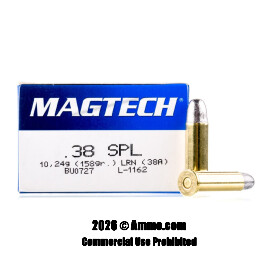
Magtech 38 Special Ammo - 1000 Rounds of 158 Grain LRN Ammunition
 $414.99
42 In stock now
-
PMC 38 Super Ammo - 50 Rounds of 130 Grain FMJ Ammunition
 $28.00
55 In stock now
-
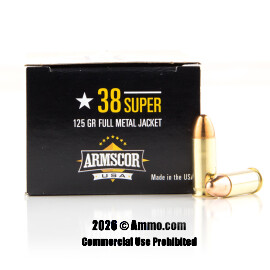
Armscor 38 Super Ammo - 1000 Rounds of 125 Grain FMJ Ammunition
 $489.99
9 In stock now
-
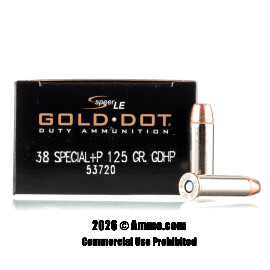
Speer 38 Special +P Ammo - 50 Rounds of 125 Grain JHP Ammunition
 27% off
$40.99
$29.99
40 In stock now
-
PMC Bronze 38 Super +P Ammo - 1000 Rounds of 130 Grain FMJ Ammunition
 $549.99
24 In stock now
Compare Ammo by Cartridge
190 head-to-head comparisons, grouped by platform. Find your cartridge, tap to open its matchups:
Handgun
23 cartridges
9mm 19
- .380 ACP vs 9mm
- 9mm vs 45 ACP
- 9mm vs 40 S&W
- .357 SIG vs 9mm
- 10mm vs 9mm
- 9mm vs 9mm Luger
- 9mm vs 40 vs 45
- 357 Magnum vs 9mm
- 5.7 vs 9mm
- 22 vs 9mm
- 9mm Makarov vs 9mm Luger
- 32 ACP vs 9mm
- 38 Special vs. 9mm
- 30 Super Carry vs. 9mm
- 5.56 vs 9mm
- .50 Action Express vs 9mm
- 7.62x25 vs. 9mm
- 38 Super vs. 9mm
- 25 ACP vs. 9mm
45 ACP 12
357 Magnum 7
44 Magnum 7
10mm 6
38 Special 5
25 ACP 2
32 ACP 2
357 SIG 2
454 Casull 2
30 Super Carry 1
38 S&W 1
45 GAP 1
460 Rowland 1
460 S&W 1
7.62x25 Tokarev 1
9mm Makarov 1
Rifle
58 cartridges
308 Winchester 18
- .308 vs 5.56
- 6.5 Creedmoor vs .308
- .300 Blackout vs .308
- .300 Win Mag vs .308
- .243 vs .308
- .308 vs .30-06
- 7mm-08 vs .308
- .270 vs .308
- 7.62x39 vs .308
- .223 vs .308
- .338 Lapua vs .308
- 6.5 Grendel vs .308
- 450 Bushmaster vs 308
- 277 Fury vs 308
- 300 PRC vs 308
- 7.62x39 vs 7.62x51
- 7.62x54r vs. 308 Winchester
- 300 Savage vs. 308 Win
223 Remington 17
- .223 vs .308
- .223 vs 5.56
- 300 Blackout vs 223
- 224 Valkyrie vs 223
- 22-250 vs 223
- 5.7x28 vs 223
- 450 Bushmaster vs 223
- 22 Hornet vs 223
- 204 Ruger vs 223
- 30 Carbine vs 223
- 350 Legend vs 223
- 277 Fury vs 223
- 243 Win vs 223 Rem
- 22 ARC vs. 223 Rem
- 22 LR vs. 223 Rem
- 6.5 Creedmoor vs. 223 Rem
- 223 Wylde vs. 223 Rem
5.56 NATO 17
6.5 Creedmoor 16
- 6.5 Creedmoor vs .308
- 6mm Creedmoor vs 6.5 Creedmoor
- 6.8 Western vs 6.5 Creedmoor
- 243 vs 6.5 Creedmoor
- 260 Remington vs 6.5 Creedmoor
- 28 Nosler vs 6.5 Creedmoor
- 6.8 SPC vs 6.5 Creedmoor
- 6.5x55 vs 6.5 Creedmoor
- 6.5 Creedmoor vs 270
- 6.5 Grendel vs 6.5 Creedmoor
- 6.5 PRC vs 6.5 Creedmoor
- 277 Fury vs 6.5 Creedmoor
- 300 PRC vs 6.5 Creedmoor
- 6.5 Creedmoor vs. 30-06 Springfield
- 6.5 Creedmoor vs. 300 Win Mag
- 6.5 Creedmoor vs. 223 Rem
300 Win Mag 13
- .300 Win Mag vs .308
- .300 Win Mag vs .30-06
- 300 Win Mag vs 338 Lapua
- 300 PRC vs 300 Win Mag
- 300 WSM vs 300 Win Mag
- 300 Win Mag vs 338 Win Mag vs 338 Lapua Mag
- 300 Win Mag vs 300 Norma
- 28 Nosler vs 300 Win Mag
- 7mm Rem Mag vs 300 Win Mag
- 277 Fury vs 300 Win Mag
- 300 Blackout vs 300 Win Mag
- 7mm PRC vs 300 Win Mag
- 6.5 Creedmoor vs. 300 Win Mag